 Ferndale
 Custer's Exterior Climate: What Homes Are Really Up Against
Custer sits in the northwest corner of Whatcom County, close enough to Birch Bay and the Strait of Georgia that salt-laden air is a routine part of the weather here, not an occasional event. Add in the wind that comes off the water with little to break it across the open farmland around town, and you get siding that takes driving rain almost horizontally during fall and winter storms. That combination — salt, wind-driven moisture, and long stretches of gray, damp weather — is harder on exterior materials than most homeowners realize until they're dealing with the results.
The other constant in this part of Whatcom County is moss and algae growth. Custer doesn't get the intense summer heat that dries things out quickly, so north-facing walls, areas under tree cover, and anything shaded by eaves stay damp for extended periods. That moisture, sitting on a wall system month after month, is exactly the condition that separates siding products that hold up from siding products that don't.
Why This Matters More Than People Expect
A lot of siding failures aren't dramatic — they're slow. Paint that won't hold a finish past a few years, panels that swell at the edges, trim that softens where water collects. None of that shows up in year one. It shows up in year five or eight, after the material has spent several wet seasons absorbing moisture it wasn't built to handle. In a climate like Custer's, that timeline moves faster than in drier parts of the state.
Why We Install Only James Hardie Fiber Cement
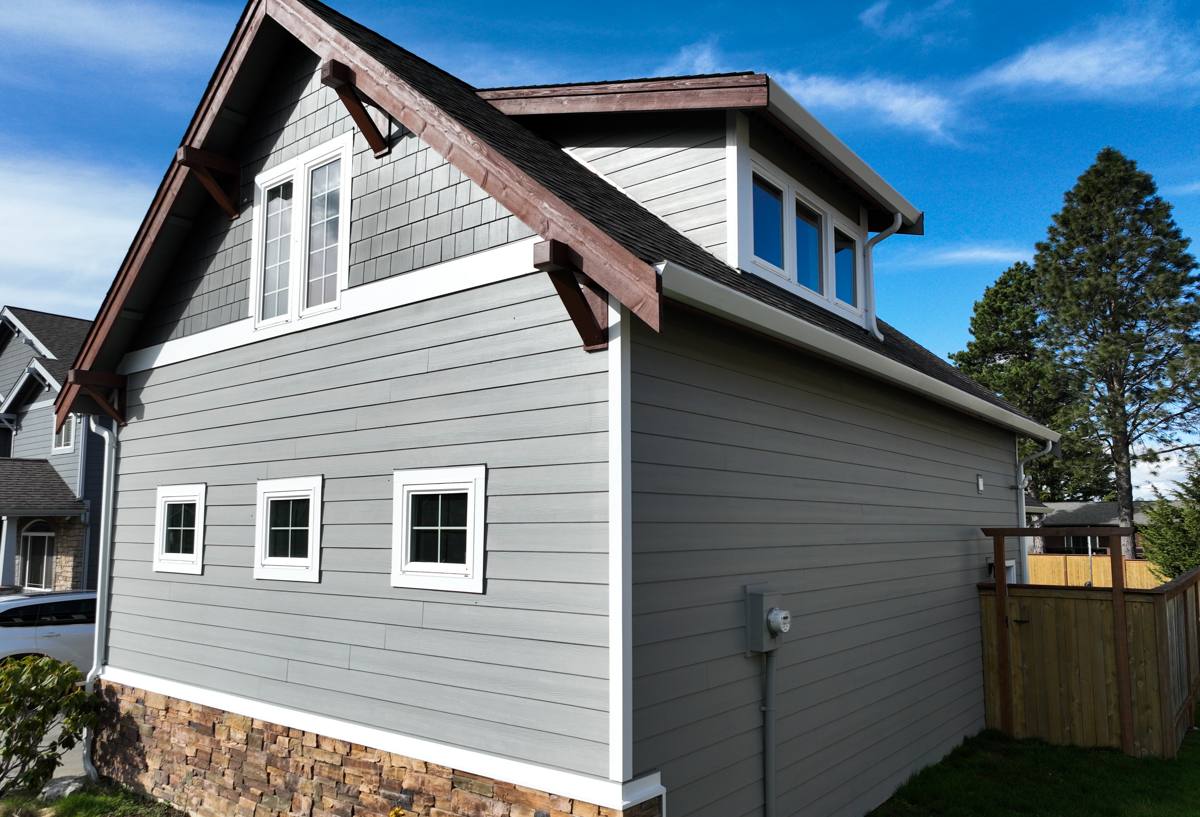
We made a decision as a company to install James Hardie fiber cement siding exclusively — no vinyl, no LP SmartSide, no Cemplank or Allura, no primed spruce or cedar. That's not a marketing position, it's a practical one built around what actually performs in Whatcom County's weather.
Fiber cement is made from cement, sand, and cellulose fibers, which makes it non-combustible and dimensionally stable in a way wood-based and engineered-wood products aren't. It doesn't swell when it takes on moisture the way an OSB-core product can, and it doesn't need the same vigilance around cut edges and exposed seams that wood-based siding does. In a coastal-influenced climate with a lot of wet weather, that stability matters more than it does somewhere dry.
James Hardie's ColorPlus factory finish is baked on in a controlled environment rather than field-applied, which gives it better adhesion and UV resistance than a job-site paint job. For a home that's going to sit under salt air and long gray winters, a finish that doesn't need repainting every few years is a real difference in long-term maintenance, not just a selling point.
What We're Not Willing to Install, and Why
Vinyl siding is inexpensive and easy to install, but it's a thin plastic product that can warp in temperature swings, fade over time, and offers little in the way of impact resistance or fire performance. LP SmartSide and similar engineered-wood products use an OSB substrate that performs fine when installation is flawless and maintenance is kept up, but any breach in the coating — a missed caulk joint, a cut edge left unsealed — gives moisture a path into a wood-fiber core that swells and deteriorates once it's wet. Primed spruce and cedar are genuinely attractive materials, but they're wood: they need repainting on a cycle, they're vulnerable to rot in damp, shaded areas, and they carry fire and pest considerations that fiber cement doesn't. None of these are bad products in the abstract. They're just not the product we're willing to stand behind on homes that sit in this specific climate, under our name.
The James Hardie Product Lines We Work With
James Hardie builds different product lines for different climate zones, and the HZ5 line is engineered for regions like the Pacific Northwest that see significant moisture exposure. That's the baseline we work from for homes in the Custer area. Beyond climate engineering, homeowners typically choose between a few core styles:
- HardiePlank lap siding — the most common choice, available in several exposure widths and a smooth or cedar-textured finish
- HardieShingle — for a shingle-style look on gables, accent walls, or full elevations
- HardiePanel — vertical panel siding, often used for board-and-batten style or modern facades
- HardieTrim — matching trim boards for corners, fascia, and window/door casing
All of these come pre-finished through the ColorPlus system in a range of colors, which means the color is part of the material rather than a coating applied after the fact — that's a meaningful difference when the goal is a finish that survives salt air and UV exposure without fading unevenly.
How We Approach a Siding Installation in Custer
Installation quality determines how well fiber cement performs over its lifespan, arguably more than the product choice itself. A poorly installed Hardie job can still develop moisture problems; a well-installed one is built to shed water and resist the elements for decades.
What Correct Installation Actually Involves
A few things we hold to on every job, regardless of size:
- Proper water-resistive barrier and flashing details behind the siding, not just at the surface
- Correct fastening pattern and nail placement per James Hardie's engineering specs — this affects both wind resistance and long-term panel integrity
- Rain screen or drainage gap detailing appropriate to the wall assembly, so any incidental moisture has somewhere to go
- Sealed and caulked joints at trim, windows, and penetrations, using products compatible with the ColorPlus finish
- Attention to grade clearance and the bottom course, since ground-level splash-back and standing water are common failure points on any siding product
Cutting corners on any one of these doesn't usually show up right away. It shows up two or three wet seasons later, which is exactly why we don't treat installation as a step to move through quickly.
Beyond Siding: Roofing, Windows, and Decks
Siding doesn't work in isolation — it's one part of a home's exterior envelope, and the same weather that stresses siding in Custer stresses the roof, windows, and any exterior decking. We handle all four because they interact with each other. A roof that's shedding water poorly will overload the siding and trim below it. Windows with failing seals let moisture into wall cavities that siding alone can't protect against. Decks exposed to the same driving rain and moss conditions need materials and drainage details that match the rest of the house.
Approaching a home's exterior as one connected system, rather than a series of separate trades, is part of why a local crew that handles all of it tends to catch problems that a siding-only or window-only contractor might miss.
Why a Local Crew Matters in a Community Like Custer
Custer is a smaller, more rural community than the bigger cities in Whatcom County, and homes here range from older farmhouses to newer construction spread across open land. A crew that works this specific area regularly understands the practical realities: how far a job site might be from the nearest supply yard, what the wind exposure looks like on an open lot versus a more sheltered one, and how the moss and moisture patterns here compare to nearby Ferndale or Blaine. That local familiarity shapes decisions on the job — where extra flashing attention is warranted, which elevations need the most moisture protection, and how to sequence work around the wet season.
It also means accountability doesn't disappear once the crew leaves. A contractor based in the region, working under a manufacturer-backed warranty, is who you call if a question comes up five or ten years down the road — not a name that only shows up for the original bid.
What Affects the Cost of a Siding Project
Every home is different, but a few factors consistently drive the price of a fiber cement siding job up or down. We won't quote a number without seeing the house, but this gives a sense of what to expect going in.
| Factor | Why It Matters |
|---|---|
| Home size and wall complexity | More square footage and more corners, gables, and dormers mean more cuts, more trim, and more labor hours |
| Removal of existing siding | Tear-off and disposal of the old material adds cost versus a bare or already-stripped wall |
| Condition of sheathing underneath | Rot or water damage found once old siding comes off may need repair before new siding goes on |
| Product line and style chosen | Lap, shingle, and panel styles carry different material and labor costs; some ColorPlus colors and textures cost more than others |
| Trim and detail work | Custom trim around windows, corners, and rooflines adds material and installation time |
| Site access | Difficult access, tall walls, or tight lot lines can increase equipment and labor needs |
Signs Your Current Siding Is Due for Replacement
Homeowners often wait until a problem is visible from the street, but there are earlier indicators worth checking for, especially given how this area's weather accelerates wear:
- Paint that's peeling, chalking, or won't hold a fresh coat
- Soft spots or visible swelling, especially near the bottom edge or around windows
- Persistent moss or algae staining that keeps returning after cleaning
- Visible gaps, warping, or panels pulling away from the wall
- Rising energy bills that suggest the wall assembly isn't performing the way it should
- Interior signs like musty smells or staining on walls that share an exterior wall
Any one of these on its own might not mean a full replacement is necessary, but a few together, especially on a home more than 15-20 years old, are worth having looked at.
Maintenance Expectations With James Hardie Siding
One of the practical advantages of fiber cement over wood-based alternatives is a lighter maintenance load, though "lighter" doesn't mean "none." A periodic rinse to keep moss and grime from building up, an eye on caulking at joints and trim over the years, and prompt attention if a panel is ever damaged by impact will keep a Hardie installation performing the way it's designed to. Because the ColorPlus finish is factory-applied, repainting isn't a recurring necessity the way it is with wood siding — that's a meaningful time and cost savings over a 20-30 year window, particularly in a climate that's hard on painted surfaces.
Get an Estimate for Your Custer Home
If you're weighing a siding replacement, or want a second opinion on what your current exterior is telling you, we're happy to come take a look. We'll walk the house, talk through what we see, and give you a straightforward estimate — no pressure, no obligation. Reach out through the form below to get started.