 Ferndale
 Siding Built for Lynden's Weather, Not Just Its Look
Lynden sits inland from the coast but still lives inside the same weather system that soaks the rest of Whatcom County: long stretches of driving rain off the Pacific, cool damp air that lingers into the shoulder seasons, and a moss season that can run from October clear through April in shaded yards. Homes here don't fail because of one big storm. They fail slowly, from siding materials that were never engineered to handle months of standing moisture and repeated freeze-thaw cycling on the coldest nights of the year.
We're based out of Ferndale and work throughout Whatcom County, and Lynden is a regular stop for us. Dairy country living means a lot of homes here sit on open lots with less tree cover than you'd find closer to Bellingham, which cuts down on moss but increases direct exposure to wind-driven rain. Other properties back up to tree lines or creek corridors where shade and moisture sit longer. Either way, the siding on a Lynden home earns its keep every single year.
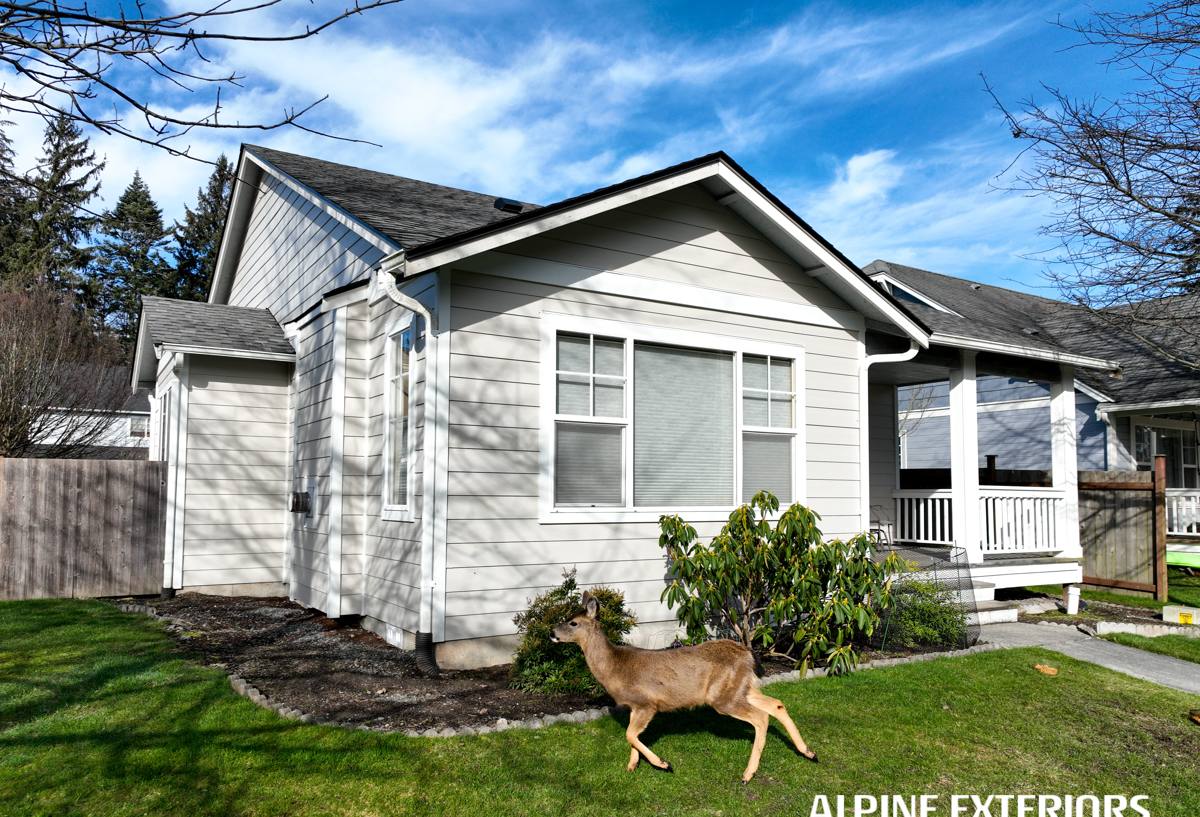
What the Regional Climate Actually Does to Siding
People tend to think of "bad weather" as the dramatic stuff — windstorms, heavy snow. In Whatcom County, the material stress is quieter and more constant.
Driving Rain and Wind-Driven Moisture
Storms coming off the Strait of Georgia and the Pacific frequently arrive with enough wind to push rain sideways into wall assemblies, not just straight down. Siding materials and installation details that assume rain falls vertically — face-nailed trim, undersized gaps, poor flashing at windows and butt joints — let water track behind the cladding. Once moisture gets behind siding, it doesn't dry quickly in this climate, and that's when rot starts in the sheathing and framing underneath, not just on the surface.
A Long, Real Moss Season
Moss and algae need moisture and shade to establish, and Whatcom County gives them both for the better part of six months. On siding, moss growth traps moisture directly against the material surface, which accelerates whatever degradation process is already at work — paint failure on wood-based products, swelling on engineered wood, and staining on nearly everything. It's not just cosmetic. Sustained moss contact keeps a wall assembly wetter, longer, than open air would.
Salt Air Influence
Lynden is inland, but Whatcom County as a whole sits close enough to Bellingham Bay and the Strait that salt-laden air reaches well past the immediate shoreline on windy days. Salt exposure accelerates corrosion on fasteners, trim flashing, and any exposed metal components, and it can affect how factory finishes hold up over time. It's a smaller factor here than it would be in a beachfront town, but it's part of the honest picture for anything installed outdoors in this region.
Freeze-Thaw Cycling
Whatcom County doesn't get brutally cold, but it does get repeated cycles of near-freezing nights followed by wet days, especially in late fall and winter. Materials that absorb water are the ones that suffer here — trapped moisture expands when it freezes, and that stress compounds year over year at seams, fastener holes, and butt joints.
Why We Only Install James Hardie Fiber Cement
We made a deliberate decision as a company to install James Hardie fiber cement siding exclusively — not vinyl, not LP SmartSide, not primed wood products, and not other fiber cement brands. That's not a marketing angle; it's a standard we hold because of what we've seen these materials do (and not do) in exactly the climate Lynden sits in.
- Non-combustible material — fiber cement doesn't feed a fire the way wood-based products can, which matters for insurance conversations and peace of mind alike.
- Moisture resistance by design — Hardie's fiber cement formulation is engineered to resist swelling, cracking, and moisture intrusion far better than engineered wood substrates, which is the single biggest factor in a climate like this one.
- Factory-applied ColorPlus finish — the color and finish are baked on in a controlled factory environment, not brushed or sprayed on site, which gives more consistent coverage and better long-term fade and moss resistance than field-applied paint.
- Climate-engineered HZ5 product line — Hardie manufactures regional formulations, and the HZ5 line is built for the Pacific Northwest's wet, moderate climate specifically, rather than a one-size-fits-all national product.
- A strong, transferable warranty — backed by a large manufacturer with decades of market presence in this exact climate zone.
Products like vinyl and LP SmartSide aren't bad products in every setting — they have real strengths, and plenty of homes around the country carry them well. But vinyl can warp and become brittle with temperature swings and offers limited protection where wind-driven rain gets behind panels, and engineered wood products are inherently more vulnerable to the kind of sustained moisture exposure Whatcom County delivers every winter. We'd rather turn down a job than install something we don't believe will hold up on a Lynden roofline for the next 30 years.
How We Approach a Siding Job in Lynden
Inspection First
Every job starts with a walk-around of the existing exterior — checking for soft sheathing, signs of past moisture intrusion around windows and corners, and the condition of existing flashing and trim. This tells us what's happening behind the current siding, not just what the surface looks like, and it shapes the scope of the job before we ever quote it.
Moisture Management Comes Before the Siding Goes On
The siding itself is the visible layer, but the water-resistive barrier and flashing details underneath are what actually keep a wall dry over time. We pay close attention to window and door flashing, kick-out flashing at roof-wall intersections, and proper weather-resistive barrier lapping — all details that matter more in a high-rainfall climate than in drier parts of the country.
Installation to Manufacturer Spec
James Hardie siding is only as good as its installation. Correct fastener spacing, proper gaps at butt joints and trim, and correct clearance from grade, roofing, and decks are all spelled out in Hardie's installation guidelines, and skipping them is one of the most common causes of premature siding problems — regardless of the product. We install to those specs, not to a shortcut version of them.
Trim, Caulking, and Finish Details
The small details — corner trim, caulk joints, touch-up paint at cut edges — are where a lot of installations quietly fail years down the road. We treat these as part of the job, not an afterthought.
Full Exterior Work: Roofing, Windows, and Decks
Siding rarely exists in isolation on a Lynden home. We also handle roofing, window replacement, and deck construction, and treat all four as one connected exterior system rather than separate projects. A roof that's shedding water correctly at the eaves protects the siding below it. Windows with tight, properly flashed openings keep water out of the wall assembly the siding is trying to protect. Decks that attach to a house need the same moisture-conscious flashing details as any other penetration in the exterior envelope. When we're on-site for a siding project, we're looking at how the whole exterior works together, and we'll flag anything else that's putting the house at risk even if it's outside the original scope.
What Siding Replacement Typically Costs
Every home is different, and the only accurate number comes from an in-person estimate, but these are the main factors that move the price up or down on a Lynden project.
| Factor | Why It Matters |
|---|---|
| Home size and wall complexity | More square footage and more corners, gables, and dormers mean more material and labor time. |
| Existing siding removal | Tear-off of old wood, vinyl, or engineered wood siding adds labor and disposal cost versus a bare-wall install. |
| Sheathing and framing repair | If the inspection turns up rot or moisture damage underneath, that repair happens before new siding goes on. |
| Trim and accent detail | Board-and-batten sections, shake-style panels, or custom trim packages add cost over a straightforward lap siding install. |
| Access and site conditions | Steep lots, limited driveway access, or multi-story walls affect equipment needs and labor time. |
Comparing Siding Materials
This is a general comparison to help frame the decision — actual performance depends heavily on installation quality for any of these products.
| Material | Moisture Behavior | Finish | Fire Resistance |
|---|---|---|---|
| James Hardie fiber cement | Engineered to resist swelling and moisture intrusion; HZ5 formulated for PNW climates | Factory-baked ColorPlus finish | Non-combustible |
| Vinyl siding | Doesn't absorb water itself, but can allow moisture behind panels at seams and in wind-driven rain | Color molded through, can fade over decades | Combustible, can warp near heat sources |
| LP SmartSide / engineered wood | More vulnerable to swelling and edge damage under sustained moisture exposure | Factory or field-applied, varies by product | Wood-based, combustible |
| Primed wood/cedar | Natural material, needs consistent maintenance to resist moisture and rot | Field-painted, requires recoating over time | Combustible |
Signs Your Lynden Home May Need New Siding
- Visible warping, buckling, or gaps at panel seams
- Soft or spongy spots when you press on the siding surface
- Peeling or bubbling paint that keeps coming back after repainting
- Persistent moss or algae growth that returns within a season of cleaning
- Rising energy bills that suggest the wall assembly isn't insulating or sealing the way it used to
- Cracks radiating from fastener points or corners
- Visible daylight or drafts felt near exterior walls from inside
Why a Local Whatcom County Crew Matters
Siding installation guidelines exist on paper, but knowing how they actually play out on a Lynden roofline in February rain is a different skill. A crew that works this county regularly understands which details of a Hardie install matter most in this specific climate — how far to hold siding off grade given the rainfall patterns here, how to handle flashing on the kind of roof-wall intersections common in local home styles, and where moss and moisture tend to concentrate on a given lot orientation. That local knowledge doesn't replace following manufacturer spec — it's what makes sure the spec gets applied correctly to the conditions your specific home actually faces.
Being based in Ferndale also means we're not a crew that shows up once and disappears. If a warranty question or a maintenance question comes up years down the road, we're still in the county, still reachable, and still standing behind the work.
Get a Free, No-Pressure Estimate
If your Lynden home's siding is showing its age, or you're planning ahead before a problem develops, we're happy to come take a look. The estimate is free, there's no pressure to move forward, and you'll get a straight answer about what your exterior actually needs — use the form below to get started.