 Ferndale
 What Vinyl Siding Gets Right
We'll start with the honest part: vinyl siding earned its popularity for real reasons. It's inexpensive to buy and install, it never needs painting, and on a dry, moderate-climate home it can look fine for years with almost no attention. If budget is the only variable in the decision, vinyl wins that round every time. We're not here to pretend otherwise.
The problem is that budget isn't the only variable in Ferndale. Whatcom County sits right up against the Strait of Georgia and Bellingham Bay, which means salt-laden air, long stretches of wind-driven rain off the water, and a wet season that runs far longer than most of the country experiences. Vinyl siding was engineered for a national market and average conditions. It was not engineered for this particular combination of salt, moisture, and shade. That's the gap this page is about.
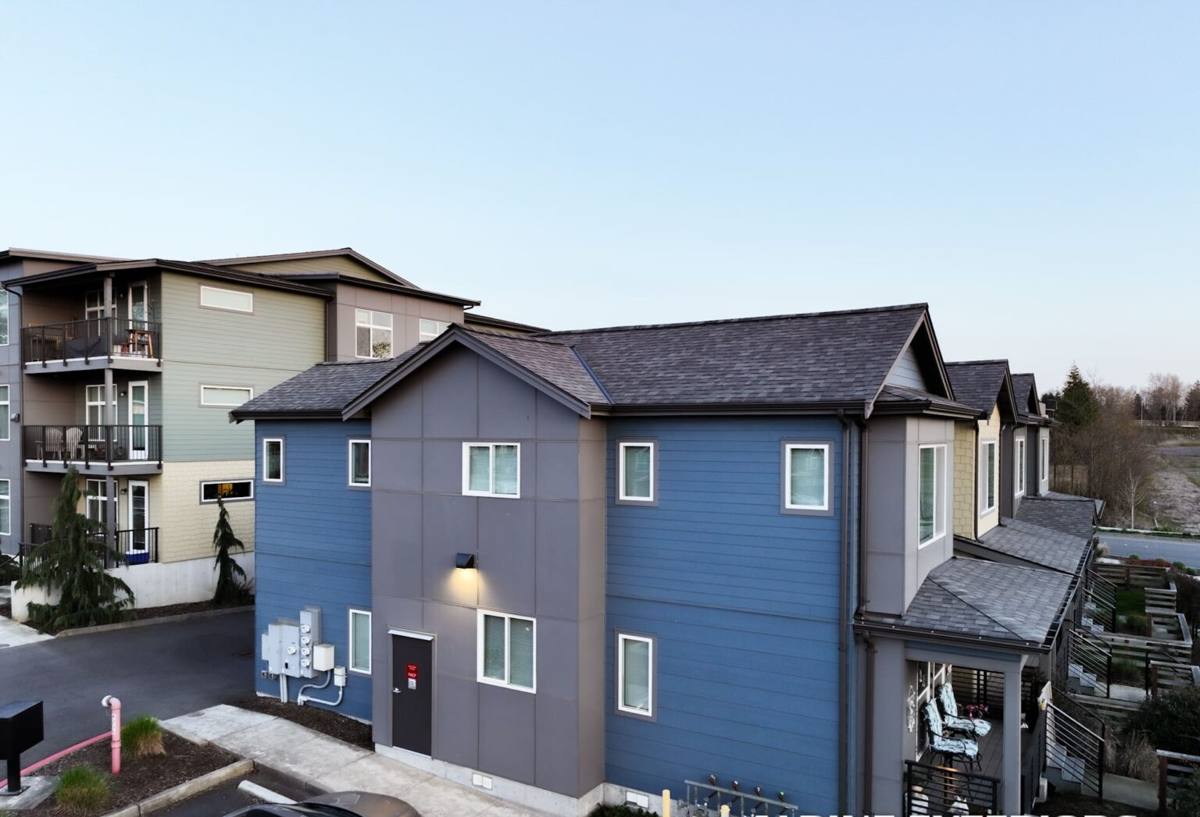
Salt Air and Coastal Exposure Near Bellingham Bay
Homes within a few miles of the water in Ferndale and the surrounding Whatcom County coastline take on salt in the air even when they're not directly on the beach. Salt doesn't rot vinyl the way it corrodes metal, but it does two things that matter over the life of a siding job. First, it accelerates the chalking and dulling of the surface color, since vinyl's pigment is baked into a thin plastic skin with no protective topcoat to renew. Second, salt residue mixes with the fine dust and pollen that collects in vinyl's overlapping panel seams, and that combination holds moisture against the wall longer than plain rainwater would on its own.
None of this shows up in year one. It shows up around year eight or ten, when a vinyl-clad house near the water starts looking noticeably more weathered than an identical house a few miles inland, even though both were installed the same week by the same crew.
Why This Matters More Here Than in a Dry Climate
In a low-humidity region, salt residue mostly just sits there. In Ferndale, it sits there and then gets wet again within a day or two, for months at a stretch. That repeated wet-dry cycling on a plastic product with no factory sealant layer is where the slow fade and surface degradation comes from.
Driving Rain, Wind-Driven Moisture, and What's Behind the Panel
Vinyl siding is not a waterproof skin — it's a rain screen made of overlapping panels that are designed to shed most water while letting some pass through to a weather-resistant barrier underneath. That design works reasonably well in light, vertical rain. It works less well in driving, wind-pushed rain, which is exactly what comes off the water during Whatcom County's fall and winter storm systems.
When wind pushes rain sideways instead of straight down, water gets forced up and under vinyl's laps and into the nail slots, J-channels, and corner posts far more than the panel was designed to handle. The house wrap behind it is doing the real waterproofing work at that point — the vinyl is just cosmetic cover. If that underlying barrier has any weak points (an aging felt paper, a poorly lapped seam, a puncture from a staple), water gets behind the cladding and stays there, because vinyl's loose-fit design doesn't let a wall dry outward the way a rigid, well-flashed cladding can.
We've opened up enough old vinyl walls on remodel jobs in this region to know that "looks fine from the street" and "the sheathing behind it is fine" are two different questions. Vinyl hides moisture problems for a long time before they become visible.
Ferndale's Long Moss Season
Whatcom County's growing season for moss and algae is long — shaded north walls, tree-lined lots, and months of damp, mild weather give it plenty of time to establish. Vinyl siding's textured, embossed surface (the wood-grain pattern most panels are stamped with) gives moss and mildew spores more microscopic grip than a smoother, factory-finished surface would. Combine that texture with the moisture-holding seams described above, and north-facing and shaded vinyl walls in this area tend to green up faster than homeowners expect.
The fix isn't complicated — pressure washing and a mild cleaning solution handle it — but it's a recurring maintenance task, not a one-time chore, and pressure washing vinyl incorrectly (too close, too much pressure, angled up under the laps) is one of the more common ways homeowners accidentally force water behind their own siding.
Heat Warping, Cold Cracking, and Impact Damage
Vinyl is a thermoplastic, which means its physical properties change with temperature more than fiber cement's do. On the hot side, dark-colored vinyl panels can absorb enough solar heat on a clear summer afternoon to soften and distort — a well-documented industry issue that's why vinyl manufacturers restrict which dark colors they'll warranty, and why reflective siding near windows or grills is a known problem. On the cold side, vinyl gets brittle as temperatures drop, and Whatcom County does get occasional hard frosts and cold snaps. A stray baseball, a ladder bump, or storm debris that would leave a scuff on fiber cement can crack a cold vinyl panel outright.
Once a panel cracks or a section warps, matching it is a genuine problem — vinyl color runs fade from batch to batch and discontinue over time, so a repair five or ten years after installation often means a visibly mismatched patch rather than an invisible fix.
The Warranty Fine Print
Vinyl siding warranties read impressively on the sales sheet — many are labeled "lifetime." What that label doesn't advertise up front is that most vinyl warranties are prorated after the first several years, meaning the manufacturer's payout shrinks the longer you've owned the siding, and they typically cover material replacement only, not the labor to remove and reinstall it. They also frequently exclude fading, warping from heat, and damage from normal impact — the exact failure modes described above. Read closely, and "lifetime" often means "lifetime of diminishing value against a narrow list of covered defects."
Vinyl vs. James Hardie Fiber Cement — Side by Side
| Factor | Vinyl Siding | James Hardie Fiber Cement |
|---|---|---|
| Material behavior in heat | Can soften, warp, or distort in direct summer sun, especially dark colors | Dimensionally stable; not a thermoplastic, so it doesn't heat-warp |
| Cold weather durability | Becomes brittle and more prone to impact cracking in cold snaps | Holds impact resistance across the temperature range Whatcom County sees |
| Moisture behavior | Loose-fit panel system relies entirely on the barrier behind it | Rigid board with engineered rain-screen detailing when installed to spec |
| Surface finish | Color is a thin plastic skin, no factory topcoat | ColorPlus factory-baked finish, warrantied separately against fade and peel |
| Combustibility | Plastic-based, will soften and burn under fire exposure | Non-combustible fiber cement |
| Moss/algae resistance | Embossed texture holds spores; regular cleaning needed in shaded areas | Smoother factory finish sheds spores more easily |
| Repair matching | Discontinued colors make later patch repairs visibly mismatched | Longer-lived color program; better long-term match availability |
| Warranty structure | Often prorated after early years; material-only, excludes warping/fading | Non-prorated, transferable warranty covering the product as installed |
| Upfront cost | Lower | Higher, but reflects the material and labor difference |
Why We Standardized on James Hardie
We made a decision as a company to install James Hardie fiber cement exclusively and to stop bidding vinyl, LP SmartSide, and other engineered wood or plastic sidings, even when a customer requests them. That's a deliberate trade-off, not a marketing angle. We'd rather turn down a lower-cost job than install something we know will underperform against Ferndale's specific climate and then have to explain, years later, why the siding is warping, greening, or cracking.
James Hardie's fiber cement is non-combustible, doesn't soften in heat or embrittle in cold the way vinyl does, and comes with a factory-applied ColorPlus finish that's warrantied separately from the substrate — meaning the color itself is backed, not just the board. Hardie also engineers specific product lines (their HZ5 and HZ10 formulations) for different moisture and freeze-thaw zones, which lets us match the product to what this specific stretch of the Pacific Northwest coast actually does to a wall over a winter. Correct installation — proper flashing, gapping, fastener pattern, and rain-screen detailing — matters as much as the material itself, and it's the other half of why we only do this one system: we can actually guarantee the installation quality because it's the only thing we install.
A Practical Checklist Before You Choose Siding
- Ask how close your home is to open water or a shoreline — salt exposure changes which materials make sense
- Check how much of your home's exterior sits in shade for most of the day, since that's where moss and moisture problems concentrate
- Ask any contractor to explain the warranty's proration schedule and what it actually excludes, not just its headline length
- Find out whether the quoted product is warrantied for the color you're choosing, especially if it's a dark shade
- Ask what happens behind the siding — what house wrap, flashing, and rain-screen gap is included, not just the visible panel
- Get a straight answer on whether a future repair, years out, will be able to match the original color and texture
If you're weighing siding options for a home in Ferndale or elsewhere in Whatcom County, we're happy to walk your property, point out what your specific exposure looks like, and give you a straightforward, no-pressure estimate for James Hardie siding done right.