 Ferndale
 Building for Life on the Water
Lummi Island sits in the marine waters off Whatcom County, reachable only by ferry, and that separation shapes everything about how a home should be built and maintained there. Homes on the island face a combination of stresses that inland Ferndale properties simply don't see in the same combination: constant exposure to salt-laden air off the Sound, driving rain that comes in sideways during winter storms, and a long, damp moss season that can run from fall through spring. None of these factors are exotic on their own — they show up in various forms all over the Pacific Northwest coast — but together, and applied continuously to a building envelope, they accelerate wear on siding, roofing, trim, and decking faster than most manufacturers' generic warranty language accounts for.
We're a Ferndale-based exterior contractor, and Lummi Island is part of our regular service area. That means we're not treating an island job as a special trip — it's a normal part of how we schedule, source materials, and plan installs.
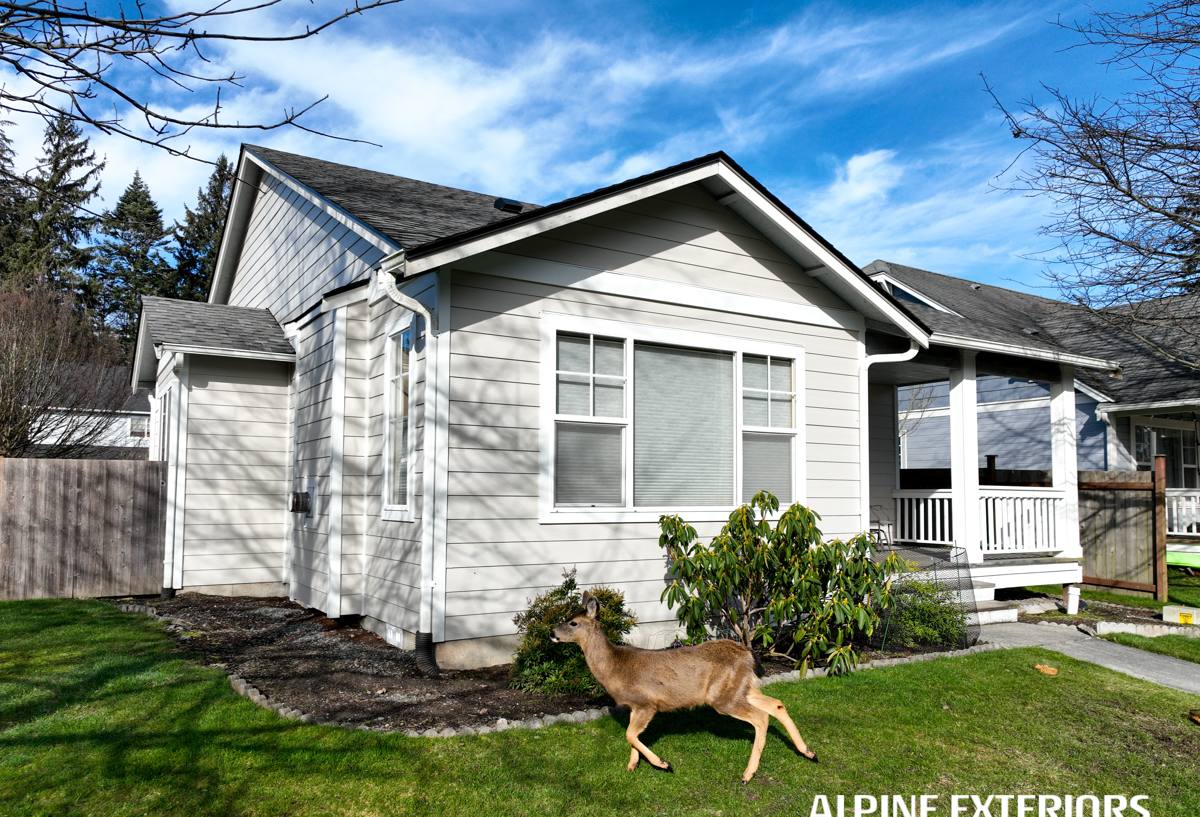
What Salt Air Actually Does to a Building Envelope
Salt air is corrosive to metal and abrasive to organic materials over time. On a home near the water, airborne salt settles on every exterior surface — siding, flashing, fasteners, window frames — and when it mixes with the region's frequent moisture, it accelerates oxidation and breaks down protective coatings faster than the same products would wear inland. This shows up in a few predictable ways:
- Fasteners and metal flashing corrode faster if they aren't rated for coastal exposure
- Paint and factory finishes chalk, fade, or lose adhesion sooner near salt spray zones
- Wood trim and untreated wood siding absorb moisture and salt together, which speeds up rot
- Caulking and sealants around windows and penetrations dry out and crack sooner
None of this means a house near the water is doomed to constant repair — it means the materials and installation details need to be chosen with that exposure in mind from the start, rather than treated as an afterthought.
Why We Only Install James Hardie Fiber Cement Siding
We standardized our siding installs on James Hardie fiber cement, and we don't install vinyl, LP SmartSide, or other engineered wood or fiber cement alternatives. That's not a marketing position — it's a decision based on how these products actually perform over years of real weather exposure, particularly in demanding environments like a marine island setting.
Fiber cement is made from cement, sand, and cellulose fiber, which means it doesn't feed mold or rot the way wood-based products can, and it holds up to sustained moisture exposure without the swelling or delamination risk that engineered wood siding can face if a seam or cut edge is left exposed to water over time. It's also non-combustible, which matters increasingly to homeowners and insurers in this region. Vinyl siding, by contrast, can become brittle and crack under repeated freeze-thaw and wind stress, and its seams and J-channels give wind-driven rain more opportunities to find a way behind the cladding — a real concern on a site that gets sustained exposure to weather coming off open water.
ColorPlus Factory Finish
Most of the siding we install uses Hardie's ColorPlus finish, which is baked on in a controlled factory environment rather than sprayed on-site. That finish is formulated to resist fading and hold color consistency longer than field-applied paint, which matters in a location where sun, salt, and moisture are all working on the finish simultaneously. It also means touch-up and color-match products are available specifically for that finish, so repairs down the road don't require repainting an entire wall.
HZ5 and Climate-Engineered Product Lines
James Hardie engineers certain product lines for specific climate zones, including formulations designed for wetter, harsher conditions. For a coastal Whatcom County property, we specify the products and installation details suited to that exposure rather than defaulting to a generic inland spec. That includes attention to fastener spacing, flashing details at penetrations, and clearance at grade — details that matter more on an exposed site than on a sheltered inland lot.
Roofing for Wind, Rain, and Moss
Roofing on Lummi Island deals with the same combination of stresses as the siding: wind-driven rain that can push water uphill under poorly lapped shingles, and a moss season long enough that a roof without good drainage detailing and periodic maintenance can hold moisture against the roofing material for months at a stretch. Moss isn't just a cosmetic issue — as it grows, it holds water against shingles and can lift edges, and its root structure can work into the granule surface over time, shortening the roof's effective life.
Good roofing work here comes down to a few fundamentals done correctly: proper underlayment for wind-driven rain protection, correctly lapped and sealed flashing at every valley, chimney, and penetration, adequate attic ventilation to keep moisture from condensing inside the roof assembly, and material choices that suit the exposure. We also talk with homeowners honestly about moss prevention and periodic roof cleaning — it's a maintenance item, not a one-time fix, in a climate that supports moss growth for most of the year.
Windows and Doors: Sealing Against Wind-Driven Rain
On an exposed site, the window and door openings are usually where water intrusion problems actually start — not because the window unit itself failed, but because flashing and sealant details around the rough opening weren't built to handle sustained wind-driven rain. We pay particular attention to head flashing, sill pan drainage, and integration between the window flange and the weather-resistive barrier behind the siding. Replacing windows is also a natural point to upgrade energy performance, since older single-pane or early dual-pane units lose a lot of heat compared to current products, and that gap is more noticeable in a home that takes the wind directly off the water.
Decks in a Marine, Moss-Prone Climate
Decking on the island faces the same moisture load as everything else, plus foot traffic and direct sun-to-rain cycling. Wood decking needs regular sealing and cleaning to resist rot and moss growth in shaded or low-airflow areas, while composite decking trades that maintenance burden for a higher upfront cost. Whichever material a homeowner chooses, the details that actually determine deck longevity here are structural: adequate gaps between boards for drainage and airflow, joist protection from ongoing moisture contact, and railing and ledger connections built to hold up under wind loading.
Getting Crews and Materials to the Island
Because Lummi Island is ferry-accessible, project logistics take more planning than a typical mainland job — material deliveries and crew schedules have to work around ferry timing, and we plan for that up front rather than treating it as a surprise mid-project. In practice, that means we consolidate material deliveries, batch our crew days to make the most of time on the island, and build ferry schedules into the project timeline we give homeowners so expectations are realistic from the start.
Why a Local, Familiar Crew Matters Here
A crew that regularly works Whatcom County's coastal properties already understands the difference between a standard inland install and one that has to account for salt exposure, sustained wind-driven rain, and a long moss season. That shows up in the small decisions — fastener choice, flashing laps, clearance at grade, ventilation detailing — that don't show up on a spec sheet but determine whether an exterior actually performs for its expected lifespan. It also means fewer surprises for the homeowner: a crew that has priced and scheduled island logistics before isn't guessing at ferry timing or material staging on the day of the job.
Cost Factors for Island Exterior Projects
| Factor | Why It Affects Island Jobs |
|---|---|
| Ferry-based logistics | Material and crew scheduling built around ferry timing rather than open road access |
| Coastal-rated materials and fasteners | Corrosion-resistant flashing and fasteners cost more than standard-grade hardware but hold up far longer near salt air |
| Site exposure | Homes closer to open water or on elevated, wind-exposed lots need more robust flashing and sealing detail |
| Existing envelope condition | Moisture-damaged sheathing or trim found during tear-off adds scope that's hard to quote sight unseen |
| Access and staging | Narrower or steeper island driveways can affect equipment staging and material handling |
Every one of these gets addressed at the estimate stage — we walk the property, note the exposure and access, and build a scope and price around what's actually there rather than a generic mainland number.
Maintenance That Extends the Life of Island Exteriors
- Rinse salt residue off siding and windows periodically, especially after storm events
- Keep gutters and downspouts clear year-round — clogged gutters compound moss and moisture problems
- Have roofs inspected and moss-treated on a regular schedule rather than only after a leak appears
- Check caulking and sealant at window and door trim annually and re-seal as it dries out
- Keep vegetation trimmed back from siding and roof edges to reduce trapped moisture and shade that encourages moss
- Address small trim or flashing issues promptly — on an exposed site, small gaps become bigger problems faster
Planning a Project on Lummi Island
Whether it's a full siding replacement, a roof nearing the end of its service life, window upgrades, or a deck rebuild, the right approach starts with an honest look at how the specific property is exposed to wind, rain, and salt, not a one-size-fits-all spec. We bring that same standard — James Hardie fiber cement, proper flashing and drainage detail, and materials chosen for the actual climate a home sits in — to every island property we work on.
If you own a home on Lummi Island and want a straightforward, no-pressure look at your siding, roofing, windows, or deck, we're happy to come out, walk the property, and give you an honest estimate — use the form below to get started.