 Ferndale
 Exterior Work Built for Lummi Nation's Coastal Conditions
Homes in and around Lummi Nation sit close to the water, and that proximity shapes everything about how an exterior should be built. Salt-laden air moves inland off the bay, driving rain comes in sideways during the fall and winter storm cycle, and the shaded, moisture-heavy conditions common to this part of Whatcom County keep moss and algae active on north- and west-facing walls for much of the year. None of that is unusual for this stretch of coastline, but it does mean an exterior contractor working here needs to think differently than one working fifty miles inland. We've built our siding, roofing, window, and decking work around those exact conditions, because we're based nearby and see the results of coastal wear on a regular basis.
What Salt Air Actually Does to a Home
Salt air is corrosive to metal fasteners, flashing, and trim in ways that aren't always visible until years later. It also accelerates the breakdown of lower-grade paints and coatings, which is one of the reasons factory-applied finishes matter so much more near the water than they do a few miles inland. A coating that's rated for general Pacific Northwest exposure can still underperform in a salt-air microclimate if it wasn't engineered with that exposure in mind.
Why Driving Rain Changes the Installation Approach
Wind-driven rain doesn't just run down a wall — it gets pushed sideways and upward into laps, seams, and penetrations that would stay dry in a calmer climate. That means water-resistive barriers, flashing details around windows and doors, and the way siding courses are lapped and fastened all matter more here than they would in a drier region. A siding job that looks identical to one done inland can perform very differently over ten years if those details weren't handled with coastal exposure in mind.
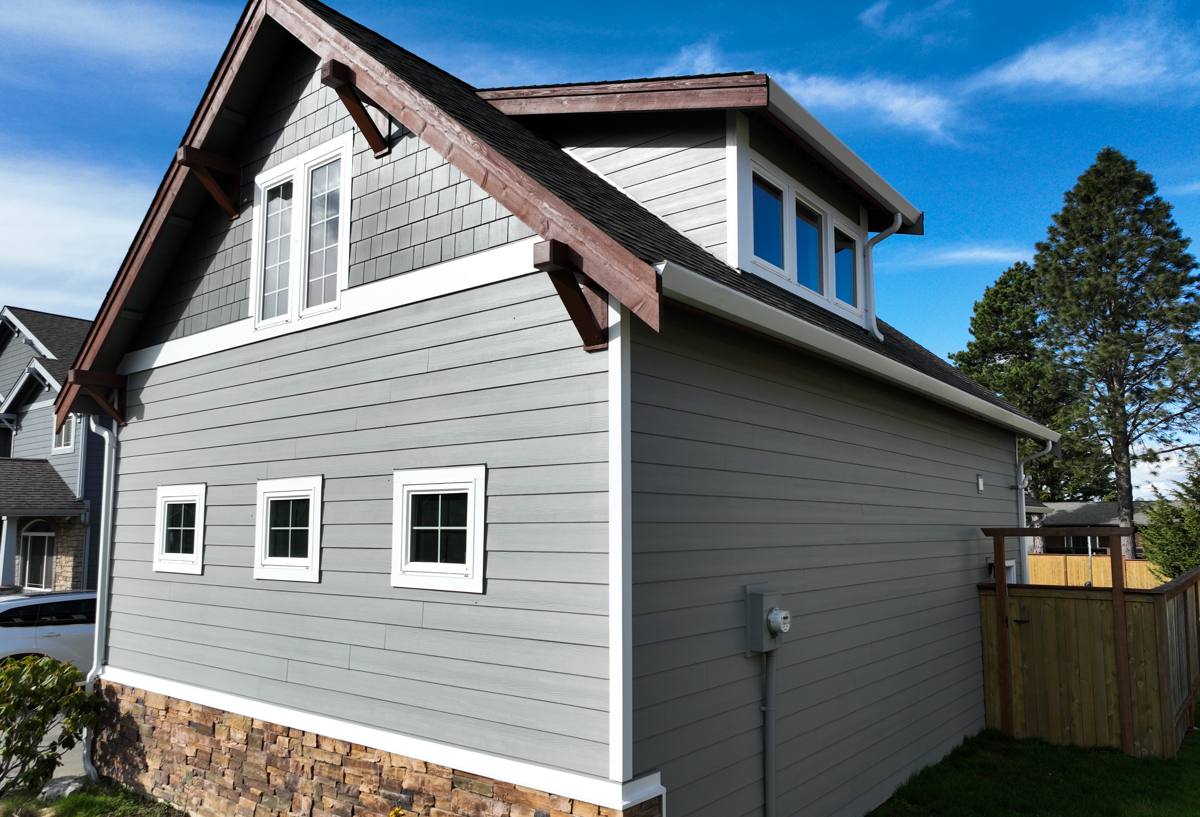
Why We Install Only James Hardie Fiber Cement Siding
We made a decision as a company to install James Hardie fiber cement siding exclusively, and we don't install LP SmartSide, vinyl siding, Cemplank, Allura, primed spruce, or cedar. That's not a marketing position — it's a standard we hold ourselves to because of what we've seen these materials do over time in this exact climate, and we think homeowners deserve an honest explanation of why.
Vinyl Siding
Vinyl is inexpensive and easy to install quickly, which is why it's so common. But it's a thin, flexible material that expands and contracts significantly with temperature swings, and in coastal wind exposure it can loosen, rattle, or crack at the fastening points over time. It also can't be painted to a durable, factory-grade finish the way fiber cement can — you're committed to whatever color it shipped in, and that color fades unevenly under UV and salt exposure.
LP SmartSide and Other Engineered Wood Products
Engineered wood siding has improved a lot over the years, and it has real advantages — it's lighter than fiber cement and easier on installation crews. But it's still a wood-based product at its core, and wood-based products are more vulnerable to moisture intrusion at cut edges, seams, and fastener penetrations. In a climate where driving rain and prolonged damp conditions are the norm rather than the exception, that vulnerability is a real long-term maintenance factor, not a hypothetical one.
Cemplank and Allura (Other Fiber Cement Brands)
These are legitimate fiber cement products and share the same base chemistry as Hardie board. Our reason for standardizing on Hardie isn't that these are inferior materials — it's that Hardie's ColorPlus factory finish process, its HZ5 product line engineered specifically for the Pacific Northwest's moisture and temperature patterns, and its transferable warranty structure are the combination we've found most consistent to install and stand behind. Sourcing one product line also means our crews install it correctly every time, rather than switching techniques between brands.
Primed Spruce and Cedar
Wood siding, whether primed spruce or cedar, offers a natural look that some homeowners genuinely prefer, and we respect that. But solid wood siding requires the most ongoing maintenance of any option on this list — regular repainting or restaining, vigilance against rot at end grain and seams, and real vulnerability to moss and algae growth in shaded, damp conditions like those common around Lummi Nation. For homeowners who want that look with far less maintenance, Hardie's wood-grain finishes are worth a look before committing to real wood.
What James Hardie Fiber Cement Offers Instead
Fiber cement is a mix of cellulose fiber, sand, and cement, and it holds up differently than wood or vinyl because it isn't organic and it isn't a plastic. It doesn't rot, it's non-combustible, and it holds paint and factory finishes far more durably than wood does. James Hardie's ColorPlus finish is baked on in a controlled factory environment rather than sprayed on site, which produces a more consistent, fade-resistant, chip-resistant surface — something that matters more in salt air than it does inland.
The HZ5 Product Line
James Hardie engineers its siding in climate-specific formulations, and the HZ5 line is built for regions with wet, temperate conditions like the Pacific Northwest. It's formulated to resist moisture-related issues that show up more in HZ10 (hot-humid) or freeze-heavy climates. That regional engineering is part of why we don't treat "fiber cement" as a single generic category — the formulation matters.
Warranty Structure
James Hardie backs its siding with a non-prorated limited warranty that's transferable to a new owner if the home is sold, and the ColorPlus finish carries its own separate finish warranty. That combination gives homeowners real protection over decades, not just at installation.
Beyond Siding: Roofing, Windows, and Decks
Siding is only one piece of a home's exterior envelope, and in a climate like this one, the pieces work together or they fail together. We also handle roofing, window replacement, and deck construction, and we approach all four with the same coastal-first mindset.
Roofing
A roof in this region needs to shed driving rain and resist the moss growth that thrives in shaded, damp conditions. Ventilation, underlayment quality, and flashing at valleys and penetrations matter as much as the shingle or panel product itself — a roof that isn't detailed correctly will develop moss and moisture problems regardless of the material on top.
Windows
Window flashing and sealing is one of the most common failure points on coastal homes, because wind-driven rain finds gaps that would never be tested in a calmer climate. When we replace windows, proper flashing integration with the surrounding siding is as important as the window unit itself.
Decks
Decks near the water face the same salt-air and moisture exposure as siding, plus direct weather exposure on the walking surface. Fastener selection, board spacing for drainage, and ledger flashing all need to account for that.
Local Crews, Local Knowledge
A crew that works primarily inland doesn't see coastal wear patterns often enough to build habits around them. We're based in Whatcom County and do this work throughout Ferndale and the surrounding communities, including Lummi Nation, so the moisture patterns, wind exposure, and moss cycles here aren't unusual conditions to plan around — they're the baseline we already build to. That local familiarity shows up in small decisions: where we add extra flashing, how we detail penetrations, and which finish products we trust to hold up.
Comparing Siding Options for Coastal Whatcom County Homes
| Material | Moisture Resistance | Maintenance | Finish Durability | Typical Lifespan |
|---|---|---|---|---|
| James Hardie Fiber Cement | Very high — non-organic, HZ5-engineered | Low | Factory ColorPlus finish, long fade resistance | 30-50+ years |
| Vinyl | Moderate — can loosen/crack in wind exposure | Low, but limited repair options | Molded-in color, fades and chalks over time | 20-30 years |
| LP SmartSide | Moderate — vulnerable at cut edges/seams | Moderate | Factory-primed, needs field paint upkeep | 20-30 years |
| Cedar / Primed Spruce | Lower — organic material, rot risk | High — regular refinishing | Field-applied, shortest interval | 15-25 years with upkeep |
These are general industry ranges, not guarantees — actual performance always depends on installation quality, sun/shade exposure, and maintenance follow-through.
What to Check Before Hiring an Exterior Contractor Here
- Ask whether the crew has experience specifically with coastal or salt-air exposure, not just general siding work
- Confirm they use manufacturer-specified fastening and flashing details, not shortcuts
- Check that they carry current Washington state contractor licensing and insurance
- Ask how they handle window and door flashing integration with the siding, since this is a common leak point
- Get a clear explanation of warranty coverage — both material and workmanship — in writing
- Ask about their experience with moss and algae-prone shaded walls, common in this area
What a Typical Project Looks Like
Every home is different, but most siding projects in this area follow a similar arc: an on-site evaluation of the existing exterior and any moisture or rot issues, a detailed proposal covering product selection and flashing details, removal of the old siding, correction of any water-resistive barrier or sheathing issues found underneath, and installation to manufacturer specification with attention to the coastal details discussed above. We walk homeowners through each stage so there are no surprises about scope or timeline.
Get a Free, No-Pressure Estimate
If your home in Lummi Nation is dealing with worn siding, a roof that's holding onto moss, drafty windows, or a deck that's seen better winters, we're happy to take a look and talk through honest options — no pressure, no obligation. Fill out the form below and we'll set up a time to walk the property with you.