 Ferndale
 Why This Comparison Matters More in Whatcom County Than Elsewhere
Homeowners in Ferndale ask us the same question almost every week: "Why does fiber cement cost more than vinyl, and is it actually worth it?" It's a fair question, and it deserves a straight answer instead of a sales pitch. The honest truth is that both materials can look good on a wall. The difference shows up over years, not on install day — and in this part of Washington, the climate is not gentle on siding.
Ferndale sits close enough to Bellingham Bay and the Salish Sea that salt-laden air is a real factor on homes near the water and even several miles inland during onshore wind events. Add Whatcom County's long wet season — months of driving rain off the Pacific, followed by a moss-friendly stretch of damp, shaded, low-sun weather from fall through spring — and you have a climate that quietly tests every seam, joint, and fastener on a home's exterior. This page walks through how vinyl and fiber cement actually perform under those conditions, not just how they look in a showroom.
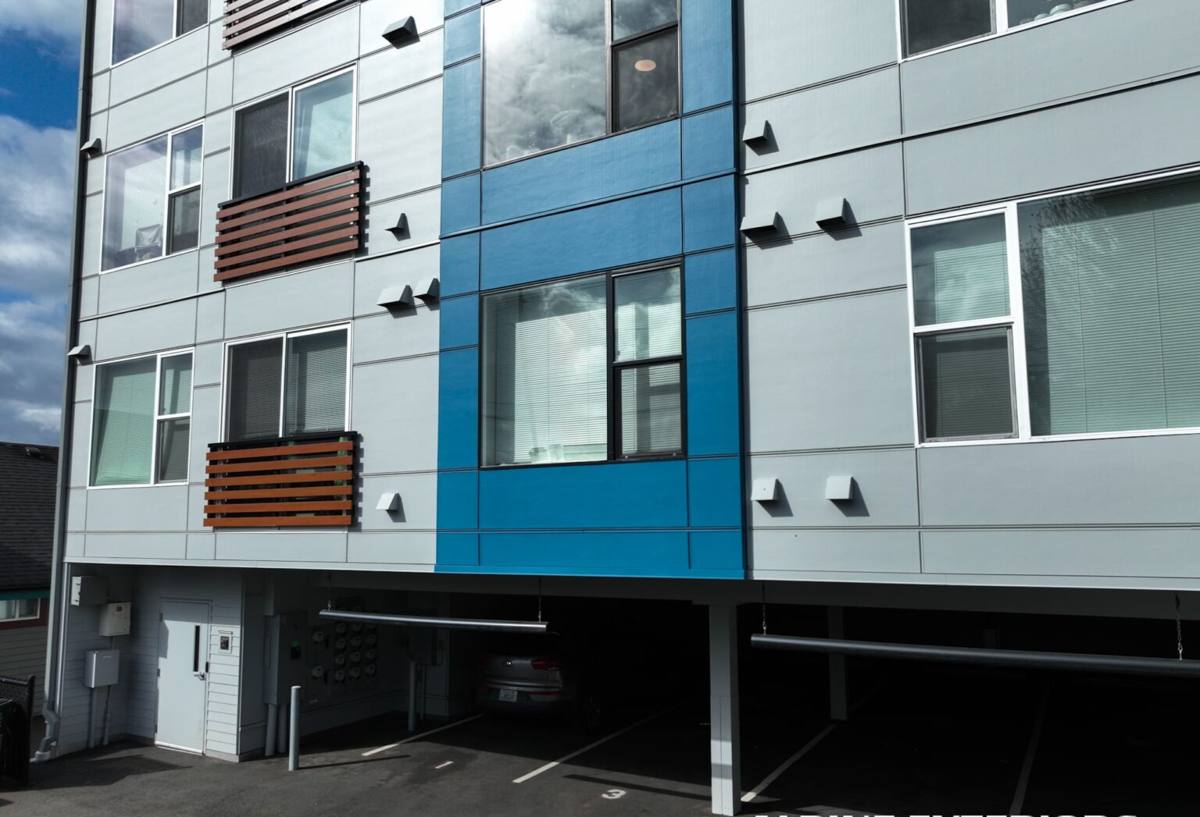
What Vinyl Siding Actually Is
Vinyl siding is an extruded PVC (polyvinyl chloride) plastic panel, formed into overlapping planks that hang on a wall using a nail hem along the top edge. It's been a mainstream American siding product for decades because it's inexpensive, lightweight, and fast to install. The color is mixed into the plastic itself rather than painted on, and it doesn't need to be primed or sealed at the joints the way wood or fiber cement does.
Vinyl's biggest strength is upfront cost and installation speed. It's genuinely low-maintenance in the sense that it doesn't need repainting, and it holds up fine in mild, dry climates. Where it struggles is in the specifics of a Pacific Northwest coastal climate — and that's worth walking through honestly rather than glossing over.
What Fiber Cement Actually Is
Fiber cement siding is a composite of Portland cement, sand, and cellulose fiber, cured under pressure into a dense, rigid plank or panel. James Hardie, the manufacturer we install exclusively, engineers separate product formulations for different climate zones — the HZ5 formulation used in the Pacific Northwest is built specifically to resist moisture absorption and freeze-thaw stress in a wet, temperate climate like ours.
Because it's cement-based rather than plastic, fiber cement is heavier, more rigid, and dimensionally stable across temperature swings. It arrives from the factory with a baked-on finish (ColorPlus Technology) that's engineered to hold color and resist fading, chipping, and cracking better than field-applied paint. Installation takes longer and requires more precision than vinyl, which is part of why it costs more — both in material and labor.
Head-to-Head: How Each Material Actually Performs
Moisture and Moss
Vinyl siding is essentially waterproof itself, but it isn't installed as a sealed skin — it's designed to allow water behind the panels, relying on the house wrap and drainage plane to manage moisture. In a climate with as much sustained rainfall as Whatcom County gets, that gap can become a place where moisture lingers, especially on north-facing or heavily shaded walls where sun never fully dries things out. Those are exactly the spots where moss and algae take hold on any siding material, but vinyl's slightly flexible, low-friction surface and visible seams give organic growth places to establish that are harder to keep clean without pressure damaging the panel.
Fiber cement is far less hospitable to moisture intrusion at the panel itself, and Hardie's factory finish resists the kind of surface staining that invites algae and moss growth. It's not moss-proof — nothing mounted outdoors in this climate is — but it holds up to routine washing without the panel flexing, cracking, or losing its seal the way vinyl can after repeated pressure washing.
Wind and Impact Resistance
Ferndale gets its share of winter windstorms off the Strait of Georgia. Vinyl panels can rattle, buckle, or blow off entirely in sustained high wind if they weren't hung with the manufacturer's exact nailing and clearance specs — and because vinyl expands and contracts significantly with temperature, that clearance is easy for a rushed installer to get wrong. Fiber cement is heavier and more rigid, and when installed to spec it holds far more securely in wind events. It's also more resistant to impact damage from hail, debris, or an errant baseball than vinyl, which can crack or shatter in cold weather when it becomes brittle.
Fire Safety
This is one of the starkest differences between the two materials. Vinyl is a petroleum-based plastic and will melt, deform, and burn when exposed to sustained heat or open flame. Fiber cement is non-combustible — it's cement and sand, and it does not contribute fuel to a fire. For homeowners near wildland-urban interface areas, or anyone who simply weighs fire risk as part of a long-term investment in their home, that's a meaningful and objective difference, not a marketing claim.
Expansion, Contraction, and Long-Term Fit
Vinyl has a high coefficient of thermal expansion — it grows and shrinks noticeably with temperature swings, which is why vinyl installation requires "loose" nailing and expansion gaps. Over years, that constant movement can work panels loose, cause visible waviness on a wall, or open gaps at trim. Fiber cement moves far less with temperature, so it holds its fit and appearance more consistently over the life of the siding.
Side-by-Side Comparison
| Factor | Vinyl Siding | James Hardie Fiber Cement |
|---|---|---|
| Material | Extruded PVC plastic | Cement, sand, and cellulose fiber |
| Fire behavior | Combustible, melts under heat | Non-combustible |
| Moisture/moss resistance | Moderate; seams and shaded walls prone to growth | Strong; dense surface resists staining and growth |
| Wind/impact resistance | Can buckle, crack, or blow off in storms | Rigid, holds up well when installed to spec |
| Thermal movement | Expands/contracts noticeably; can loosen over time | Dimensionally stable |
| Finish/color | Color molded through plastic; can fade or chalk | Factory-baked ColorPlus finish, ages more evenly |
| Typical lifespan | 15-25 years in this climate | 30-50+ years when installed and maintained correctly |
| Upfront cost | Lower material and labor cost | Higher material and labor cost |
| Warranty | Varies widely by manufacturer, often prorated | Long-term, transferable non-prorated warranty from Hardie |
Installation Sensitivity: Where Problems Actually Start
Most siding failures we get called out to inspect, regardless of material, trace back to installation errors rather than the product itself. Vinyl is genuinely forgiving on a mild day with a careless crew — it'll hang and look fine for the first year. The problems show up later: over-driven nails that prevent proper expansion, missing weep points that trap water, or panels hung too tight for our temperature swings. Because vinyl installation is fast and inexpensive, it's often subcontracted to crews paid by the square foot with no incentive to slow down on the details that matter five years out.
Fiber cement is far less forgiving of shortcuts, which is actually part of why we trust it. It requires correct fastener spacing and embedment, proper joint flashing, specific clearances at grade and roof lines, and factory-approved caulking and touch-up at cut edges — all things Hardie specifies in detail and that a crew has to actually follow. That precision is exactly why we standardized on one product line we install to the letter, rather than juggling installation specs across five different materials.
Appearance and Curb Appeal Over Time
New siding of either type generally looks good on day one. The real test is how it looks in year ten. Vinyl's molded-in color can chalk, fade unevenly (especially on south- and west-facing walls), and the panels themselves can start to look slightly wavy as they've expanded and contracted through hundreds of temperature cycles. Fiber cement's factory finish is engineered to fade more slowly and evenly, and because the board itself doesn't move much, walls tend to stay flat and straight far longer. For homeowners planning to stay in their Ferndale home long-term, or those who care about resale curb appeal, that difference compounds every year.
Maintenance Reality, Not Marketing Claims
Vinyl is often marketed as "maintenance-free," and it's true you'll never repaint it. But it still needs periodic washing to keep moss and mildew from taking hold, especially on shaded sides of a home, and damaged panels usually need full replacement rather than a spot repair since discontinued colors rarely match. Fiber cement needs occasional washing too, plus attention to caulking at trim joints over the years, but its factory finish means it holds paint and color far longer if a homeowner ever does want to refresh a color down the road — something that's simply not an option with vinyl.
Questions Worth Asking Before You Choose a Siding Material
- How does this material handle sustained rain and shaded, low-sun walls — the exact conditions common in Whatcom County?
- What's the manufacturer's actual warranty, and is it prorated or transferable if I sell the home?
- Is the product rated non-combustible, and does that matter for my situation?
- How forgiving is the installation process, and what happens if a crew cuts corners?
- What does this siding realistically look like in 15-20 years, not just on installation day?
- What's the real cost difference once you account for lifespan, not just the upfront bid?
Cost: The Honest Picture
We won't pretend vinyl doesn't win on upfront price — it does, both in material cost and labor hours. If your only constraint is the lowest possible number today, vinyl will usually be cheaper to install than fiber cement. Where the math changes is over the life of the siding. Fiber cement's longer service life, stronger warranty, and lower risk of storm or moisture damage in our climate mean the cost-per-year over 20-30 years often narrows or closes the gap, especially factoring in that many vinyl installations need full panel replacement (not touch-up) after storm or fade damage, since matching an aged color is rarely possible.
Why We Standardized on James Hardie
We made the decision to install James Hardie fiber cement exclusively rather than offering vinyl, LP SmartSide, or other fiber cement brands alongside it. That's not because vinyl is a bad product in every climate — it's because we'd rather install one system correctly, to spec, every time, than spread our crews thin across materials with very different installation requirements and very different long-term performance in Whatcom County's specific combination of salt air, sustained rain, and moss-friendly shade. Hardie's HZ5 formulation, factory ColorPlus finish, and transferable warranty line up with what we've seen actually holds up on homes in this area over decades, not just the first winter.
If you're weighing vinyl against fiber cement for your Ferndale home, we're happy to walk your specific property, talk through sun exposure, wind exposure, and your budget honestly, and give you a straightforward estimate with no pressure either way.