 Ferndale
 Siding Failure Rarely Starts Where You Can See It
By the time a homeowner in Ferndale notices a problem with their siding — a soft spot near a window, a bulge along the bottom course, paint that won't stop peeling — the real damage has usually been building for years, hidden behind the surface. Siding is a system, not just a decorative skin. It's made up of the cladding itself, the water-resistive barrier behind it, the flashing at every penetration, and the fasteners holding it all together. When one part of that system fails quietly, the others usually take the blame while the actual cause keeps working.
Understanding what's actually happening behind failing siding helps homeowners catch problems early, ask better questions when hiring a contractor, and make a more informed decision about what to install next. This page walks through the real mechanics of siding failure — not scare tactics, just what we see when we open up a wall.
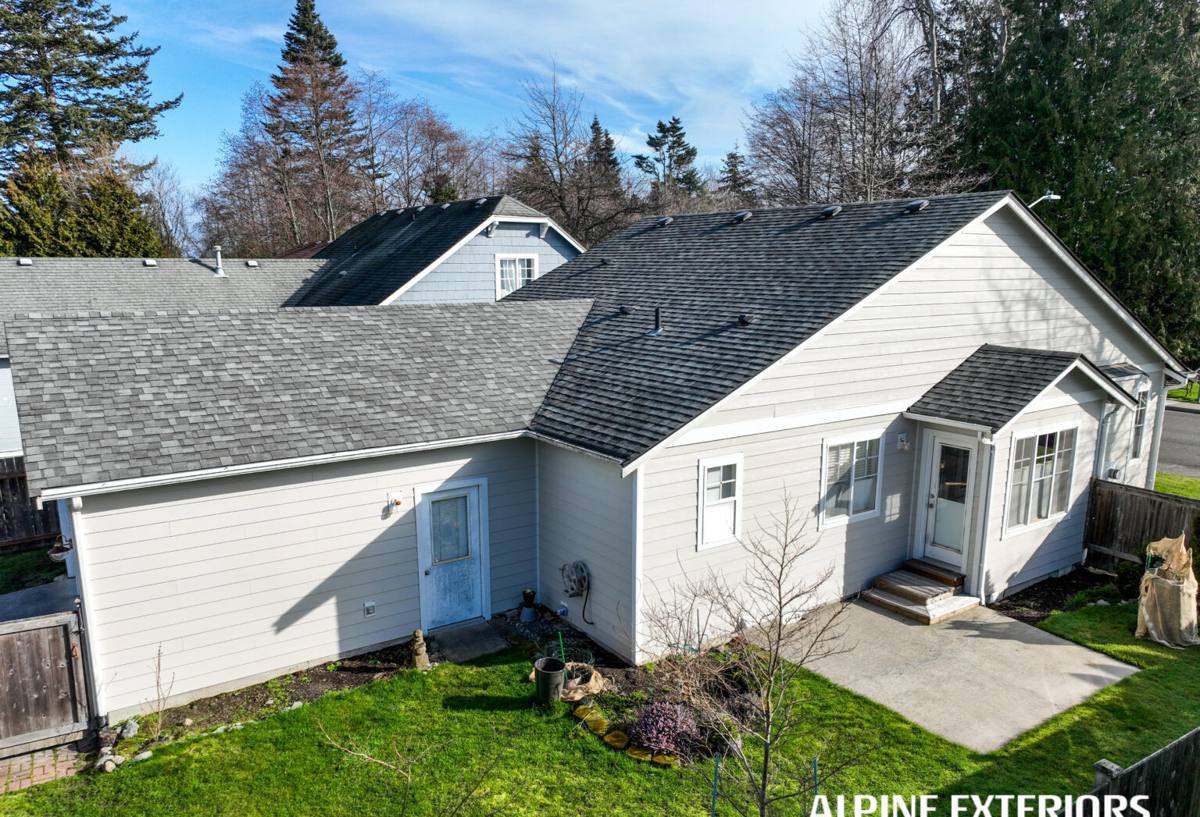
Why Whatcom County Siding Takes a Harder Hit Than People Expect
Ferndale sits close enough to the Salish Sea that salt-laden air is a real factor on siding, trim, and fasteners — especially on homes closer to Bellingham Bay or exposed to prevailing westerly winds. Add in Whatcom County's driving rain, which doesn't fall straight down so much as get pushed sideways into walls during winter storms, and you've got two forces working against any exterior cladding at once: corrosion and water intrusion.
Then there's moss. Our long, wet stretch of fall through spring gives moss and algae months of the damp, shaded conditions they need to establish themselves on siding, especially on north-facing walls and anywhere tree cover limits sun exposure. Moss itself doesn't eat through siding material the way people sometimes assume, but it holds moisture against the surface far longer than the material would otherwise see, and that constant dampness is what accelerates whatever weakness already exists underneath.
The Three-Part Local Stress Test
- Salt air: accelerates corrosion of fasteners, flashing, and any exposed metal trim
- Driving rain: pushes water sideways and upward into laps, seams, and penetrations that were designed for gravity-fed water only
- Moss season: keeps surfaces damp for extended periods, slowing evaporation and giving water more time to find a way in
The Water-Resistive Barrier Is Doing Most of the Work
Most homeowners think of siding as the thing that keeps water out. In reality, siding is the first line of defense, but the water-resistive barrier (WRB) — the house wrap or building paper behind it — is the layer actually designed to stop bulk water that gets past the cladding. Siding is expected to get wet. It's supposed to shed most water and let the rest drain down and out through a drainage plane behind it.
When siding fails prematurely, it's very often because the WRB was installed incorrectly, damaged during installation, or simply wasn't given a proper drainage gap to work with. Water gets behind the siding, has nowhere to go, and sits against the back of the material and the sheathing behind it. This is why two homes with the same siding product can have completely different outcomes — one lasts decades, the other needs wall repairs in year eight, and the difference has nothing to do with the siding brand.
Flashing Failures: The Most Common Root Cause We Find
If we had to name the single most common cause of the moisture damage we uncover behind siding, it's flashing — or the lack of it. Flashing is the metal or membrane detail that directs water around windows, doors, deck ledgers, roof-to-wall transitions, and any other place where the wall plane is interrupted.
Flashing doesn't fail dramatically. It fails by being skipped, undersized, installed in the wrong sequence (caulk instead of proper step flashing, for example), or left without the correct overlap. Water finds these gaps eventually, and once it's inside the wall assembly, it can travel a surprising distance from the actual entry point before it shows up as a visible stain or soft spot. That's why the damage a homeowner sees is often several feet away from where the problem actually started.
Common Flashing Trouble Spots
- Window and door head flashing, especially on the upper floor where wind-driven rain hits hardest
- Deck ledger-to-wall connections
- Roof-to-wall step flashing on additions or dormers
- Siding-to-trim transitions at outside corners
- Any penetration for exterior lighting, hose bibs, or vents
What Different Materials Do When Water Gets In
Not all siding materials respond to trapped moisture the same way, and this matters a lot when deciding what to install during a replacement. Some materials absorb water and swell, weakening from the inside even if the surface still looks fine. Others don't absorb water into the material itself, but poor installation can still trap moisture behind them and rot the sheathing underneath.
| Material | How It Responds to Trapped Moisture | Typical Failure Pattern |
|---|---|---|
| Engineered wood (OSB-based) | Absorbs water directly into the substrate | Swelling, edge softening, eventual delamination |
| Primed spruce / solid wood | Absorbs and releases water repeatedly with humidity swings | Cupping, checking, paint failure, rot at joints |
| Vinyl | Doesn't absorb water, but traps it behind the panel | Hidden sheathing rot while the vinyl surface looks fine |
| Fiber cement (James Hardie) | Engineered to resist moisture absorption and dimensional swelling | Failures are almost always installation-related, not material-related |
This is the core reason we standardized on James Hardie fiber cement rather than continuing to install vinyl, engineered wood, or primed spruce. It's not that those products can't perform — it's that their failure modes are more forgiving of mistakes when the moisture management behind them is even slightly off, and in a climate like ours, moisture management is rarely perfect on every square foot of a house.
The Fastener Problem Nobody Talks About
Salt air doesn't just affect the siding face — it works on every exposed nail, screw, and piece of trim flashing. Under-driven or over-driven fasteners, the wrong fastener material for the coastal environment, or fasteners placed in the wrong location on the siding panel are all common contributors to premature failure. A fastener that corrodes or backs out creates a new entry point for water exactly where the siding was supposed to be sealed tight. This is one of the most preventable causes of siding failure, and it comes down entirely to installation discipline — using the fastener spec the manufacturer requires, not just whatever is on the truck.
Warning Signs Worth Investigating Before They Become Repairs
Most siding problems give some warning before they become expensive. The trouble is that the early signs are subtle and easy to write off as cosmetic.
- Paint or finish that's peeling, bubbling, or failing in one specific area rather than evenly across the wall
- Siding that feels soft, spongy, or gives slightly when pressed near the bottom edge or around windows
- Persistent moss or algae growth that keeps coming back in the same spot after cleaning
- Visible gaps, cracks, or separation at trim joints and corners
- A musty smell in an interior room that shares a wall with an exterior trouble spot
- Staining on interior drywall or trim near an exterior wall, especially below windows
- Warping or bowing visible when looking down the wall plane at a low angle
Any one of these on its own isn't necessarily an emergency, but they're worth having looked at before the next wet season rather than after.
Why We Only Install James Hardie
Given everything above, our position is straightforward: in a climate that combines salt air, sideways rain, and a long moss season, the siding material itself should be the most forgiving part of the system, not another variable to manage. James Hardie fiber cement is engineered specifically for climate durability — the HZ5 product line is formulated for wetter, harsher climates like ours — and it's non-combustible, holds a factory-applied ColorPlus finish that resists fading and doesn't require repainting on the same cycle as wood, and carries a strong transferable warranty backed by the manufacturer rather than just the installer.
We're not installing it because it's trendy. We're installing it because when we open up walls on older homes with failing siding, the pattern is consistent, and fiber cement removes several of the most common failure points from the equation — as long as it's installed correctly, with proper flashing, clearances, and fastening to spec. Material choice matters, but installation quality is still what determines whether any siding system actually performs for its expected lifespan.
What Correct Installation Actually Requires
Regardless of the material a home ends up with, a handful of installation fundamentals separate siding that lasts from siding that fails early:
- Proper water-resistive barrier installation with correct overlaps and no punctures left unsealed
- Flashing at every window, door, deck ledger, and roof-to-wall intersection — installed in the correct shingle-lap sequence, not patched with caulk
- A drainage gap or rainscreen behind the siding so water that gets past the cladding can actually get back out
- Correct fastener type, size, and placement per the manufacturer's installation instructions
- Proper clearance between the bottom of the siding and grade, decks, patios, and roof lines
- Caulking and sealant only where the manufacturer specifies it — not as a substitute for flashing
When you're evaluating a contractor's proposal, these are the details worth asking about directly. A contractor who can explain their flashing and drainage plan in specific terms is a very different hire than one who just quotes a material and a price per square foot.
Getting an Honest Look at What's Going On
If you're seeing any of the warning signs above, or you're just planning ahead for a siding replacement on a Ferndale home, the most useful first step is having someone look at the actual condition behind the surface — not just the cosmetic issue. We're happy to come out, take a look, and give you a straightforward, no-pressure estimate along with an honest read on what we find. There's no obligation, and you'll walk away with a clearer picture either way.