 Ferndale
 Siding Replacement in Sumas: What This Part of Whatcom County Puts on a Wall
Sumas sits out at the edge of Whatcom County, close enough to the Canadian border that the town has its own quiet, valley-floor character compared to the coastal towns closer to Bellingham Bay. It's still very much inside the same weather system, though. Salt-tinged marine air moves inland across this whole region, driving rain comes through sideways rather than straight down through fall and winter, and a moss season settles in on shaded roofs and walls that can run most months of the year. None of that is unusual for this corner of Washington, but it's exactly the combination that decides whether a siding job holds up for a couple of decades or starts showing trouble in five or six years.
We're based in Ferndale, and we send crews out to Sumas regularly as part of our regular Whatcom County service area. When a homeowner out here calls us about siding replacement, we're not guessing at conditions from a spec sheet — we've pulled old siding off enough houses in this climate to know what tends to fail, where, and why. On siding specifically, we install James Hardie fiber cement exclusively. This page walks through what Sumas's climate does to a wall, how we decide between repair and full replacement, and what the project itself actually involves.
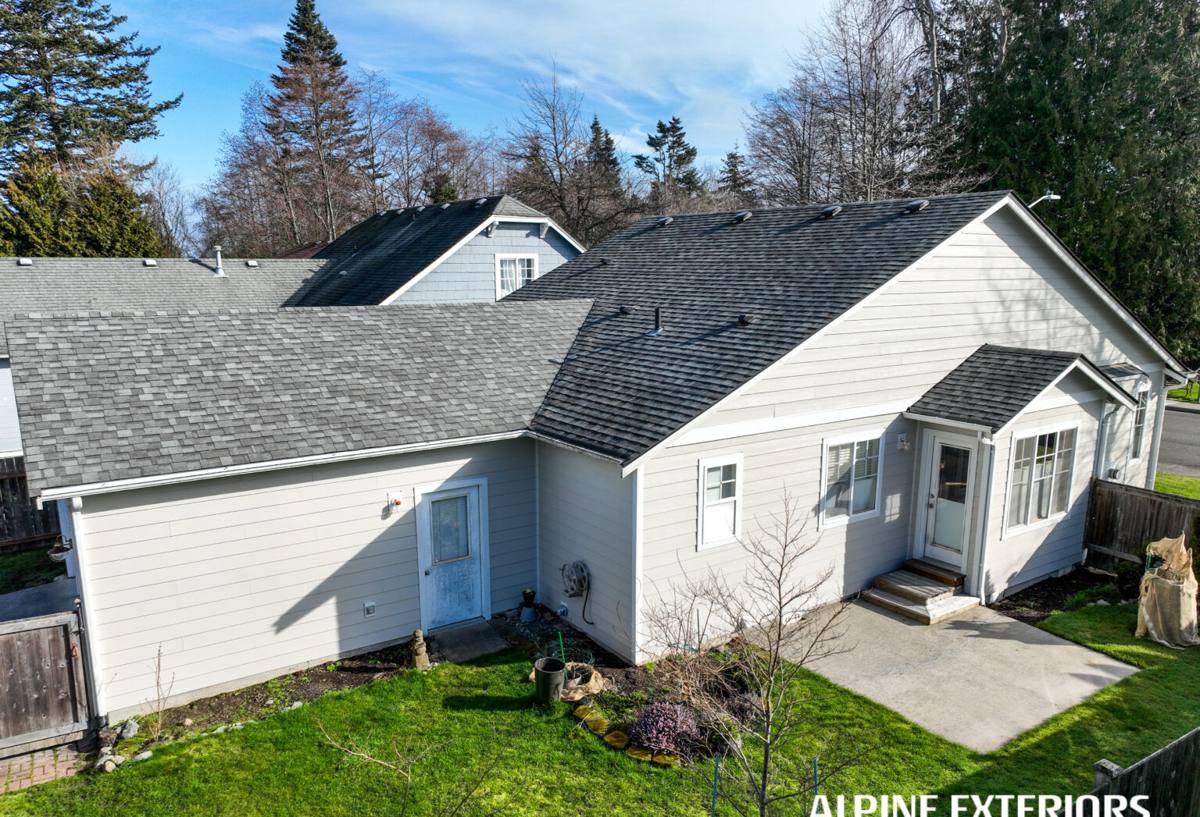
How Sumas's Weather Shows Up on Siding
Salt Air, Even This Far From the Water
Sumas is farther from open water than towns like Blaine or Birch Bay, but marine air still reaches this far inland across Whatcom County, just at a lower intensity. Over years, that salt exposure accelerates corrosion on fasteners, flashing, and lower-grade trim hardware. It's a slower process than what a house right on the shoreline deals with, but it's real, and it's one of the reasons hardware and fastener choice matters as much as the siding material itself.
Driving Rain and Wind-Driven Moisture
Rain in this part of Washington rarely falls straight down. Wind pushes it sideways into lap joints, trim seams, and window flashing, which is a more demanding load on a wall assembly than a simple annual rainfall total suggests. A siding system that would perform fine in a calm, dry climate can still let water in here specifically because the moisture is coming from the side, not just from above. Sumas's position near the mouth of the corridor that funnels air down from the Fraser Valley in British Columbia can also mean stronger wind during storm events than towns farther south in the county, which puts extra stress on those same joints and seams.
A Moss Season That Doesn't Take a Break
Mild temperatures, tree cover, and consistent moisture add up to a moss and mildew season that runs most of the year across this region. Shaded, north-facing walls are usually the first place it shows up, followed by anything under tree cover or facing away from direct sun. Any siding material that's even slightly porous, or that holds moisture against the substrate rather than shedding it, becomes a growth surface over time instead of drying out between rain events.
Signs Your Sumas Home Is Ready for Siding Replacement
Not every issue means a full tear-off. But a few patterns tend to show up together when siding has reached the end of its useful life rather than just needing a repair:
- Moss or dark staining that comes back within weeks of being cleaned off
- Soft or spongy panels, especially low on the wall or around window and door trim
- Paint that's peeling, bubbling, or chalking across large sections rather than one spot
- Visible warping, cupping, or separation at seams and corner boards
- Gaps at trim joints wide enough to see daylight or feel airflow through
- Musty odors or staining on interior walls that back up to exterior siding
- Siding older than 20-25 years with no documented replacement history
Any one of these on its own might be a repair. Several showing up together, especially alongside soft sheathing once a section is opened up, usually points to full replacement being the more honest recommendation.
Why We Replace Failing Siding With James Hardie, and Nothing Else
We used to install a wider range of siding products. We stopped, and the decision came from what we kept finding on tear-offs in this exact climate, not from a supplier relationship or a marketing angle.
- Non-combustible core: Fiber cement doesn't feed a fire the way wood-based siding can, which matters for both household safety and insurance underwriting.
- Factory-applied ColorPlus finish: The color is baked on under controlled factory conditions instead of brushed on in the field, so it holds up against fading and moisture far longer than site-applied paint.
- Climate-engineered HZ product lines: Hardie's HZ5 formulation is built for regions with heavy moisture exposure and freeze-thaw cycling, which describes a Sumas winter well.
- Dimensional stability: Fiber cement doesn't swell, cup, or warp the way engineered wood siding can after repeated wet-season moisture cycles.
- A strong transferable warranty: Hardie backs the product with one of the more robust warranty structures in the industry, provided the installation follows their published spec.
We won't install LP SmartSide, vinyl siding, Cemplank, Allura, primed spruce, or cedar. Each has a legitimate place in the market and homeowners who are happy with them. Our position is a professional one: in a climate with this much sustained moisture, wind exposure, and inland salt drift, we'd rather stand fully behind one system than offer a cheaper option that quietly shifts maintenance risk onto the homeowner a few years down the road.
Tear-Off vs. Overlay: How We Decide
Overlaying new siding directly over old material is sometimes technically possible, but we don't recommend it on a home where the existing siding has been letting moisture behind it, because that traps a problem instead of fixing it. A tear-off is the only way to actually see the sheathing and framing underneath and confirm it's sound before new siding goes on.
When Overlay Might Make Sense
On a home with siding that's cosmetically dated but structurally sound, with no signs of trapped moisture and a flat, even substrate, an overlay can be a reasonable option. This is the exception rather than the default, and we only recommend it after a real inspection, not as a way to keep a bid lower.
When Tear-Off Is the Right Call
Any of the warning signs listed above, especially soft sheathing discovered during a probe, points toward a full tear-off. It costs more upfront than an overlay, but it's the only way to confirm the wall assembly underneath is actually ready for a siding system that's meant to last decades.
What a Siding Replacement Project Looks Like, Start to Finish
Inspection and Estimate
We start with an in-person look at the home — current siding condition, signs of trapped moisture, and how sun, shade, and wind exposure differ across the various walls. That's what the estimate is based on, not a flat per-square-foot number pulled from a generic list.
Tear-Off and Sheathing Check
Once the old siding is off, we check the sheathing for rot or soft spots before anything new goes up. Covering damaged sheathing with new siding just hides a problem that keeps getting worse behind the wall.
Weather Barrier and Flashing
Given how much siding failure in this region traces back to water getting behind the cladding rather than through it, the house wrap, window flashing, and every wall penetration get careful attention at this stage. It's the step that's easy to rush and hardest to inspect once the new siding is up.
Installation to Manufacturer Spec
James Hardie's warranty depends on installation following their published specifications — correct fastener spacing and placement, proper clearances from grade and roofline, and correctly lapped and sealed joints. We treat that spec as the baseline, not an upsell.
Final Walkthrough
We walk the finished job with the homeowner, cover basic care and maintenance, and confirm everything matches what was estimated before calling the project done.
Cost Factors for a Sumas Siding Replacement
| Factor | What It Affects | Why It Matters in Sumas |
|---|---|---|
| Home size and wall complexity | Total material and labor | More trim, dormers, and corners mean more joints exposed to wind-driven rain |
| Tear-off vs. overlay | Labor scope and substrate access | Tear-off reveals hidden moisture damage that's common under older siding in this climate |
| Substrate condition | Repair costs before new siding goes on | Trapped moisture behind failing siding can rot sheathing and framing over time |
| Product line and color | Material cost and finish longevity | HZ5 and ColorPlus finishes hold up better against inland salt drift and UV than field-applied paint |
| Site access and travel | Labor time and scheduling | Sumas is on the outer edge of our Whatcom County service area, which we factor into scheduling, not pricing surprises |
Exact numbers depend on the specific home, which is why we walk the property in person before giving a real estimate rather than quoting off a generic price sheet.
Roofing, Windows, and Decks While We're There
Siding rarely fails in isolation. A roof valley that's letting water track down behind a wall, a poorly flashed window, or a deck ledger board trapping moisture against the house can all show up as siding damage even though the siding itself isn't the actual source. Because we also handle roofing, windows, and decks, we can look at a Sumas home as one connected exterior system during a siding estimate rather than diagnosing the wall by itself and missing where the water is actually getting in.
Why a Ferndale-Based Crew Serving Sumas Matters
Sumas isn't our home base, and we're upfront about that — we're a Ferndale-based crew that works this route regularly, not a company that showed up for one job and moved on. Working across Whatcom County day to day, from the coastal towns near Bellingham Bay out to a valley community like Sumas, means we see how salt air, driving rain, and moss actually behave on real houses over a full year, not just how a product performs on a spec sheet. That shapes practical decisions on install day: where extra flashing attention pays off, which wall orientations stay wet longest, and which details are worth the extra time so a homeowner isn't dealing with a callback two winters later. If a warranty question or maintenance issue comes up years after the job is done, it's a call to a crew still working in the area, not one that's disappeared from the county.
If your Sumas home needs siding replacement, or you'd like an honest opinion on whether repair or full tear-off makes more sense, we're glad to come take a look. Reach out using the form below to schedule a free, no-pressure estimate.