 Ferndale
 Why Cordata Roofs Age Differently
Cordata sits close enough to the water and the lowland weather patterns of Whatcom County that roofs here take a different kind of beating than roofs even twenty miles inland. It's not one big storm that does the damage — it's the steady combination of salt-tinged marine air, months of driving rain, and long stretches of shade and moisture that keep moss and algae active nearly year-round. Asphalt shingle roofing can handle all of that, but only when it's installed with this specific climate in mind, not with a generic install that would work fine in a drier region.
We work on homes throughout Ferndale and the surrounding Whatcom County area, and Cordata's mix of tree cover, moisture, and coastal-influenced weather is a pattern we see often. This page is about what that means for an asphalt shingle roof — what tends to go wrong, what a correct installation actually involves, and how we approach the work.
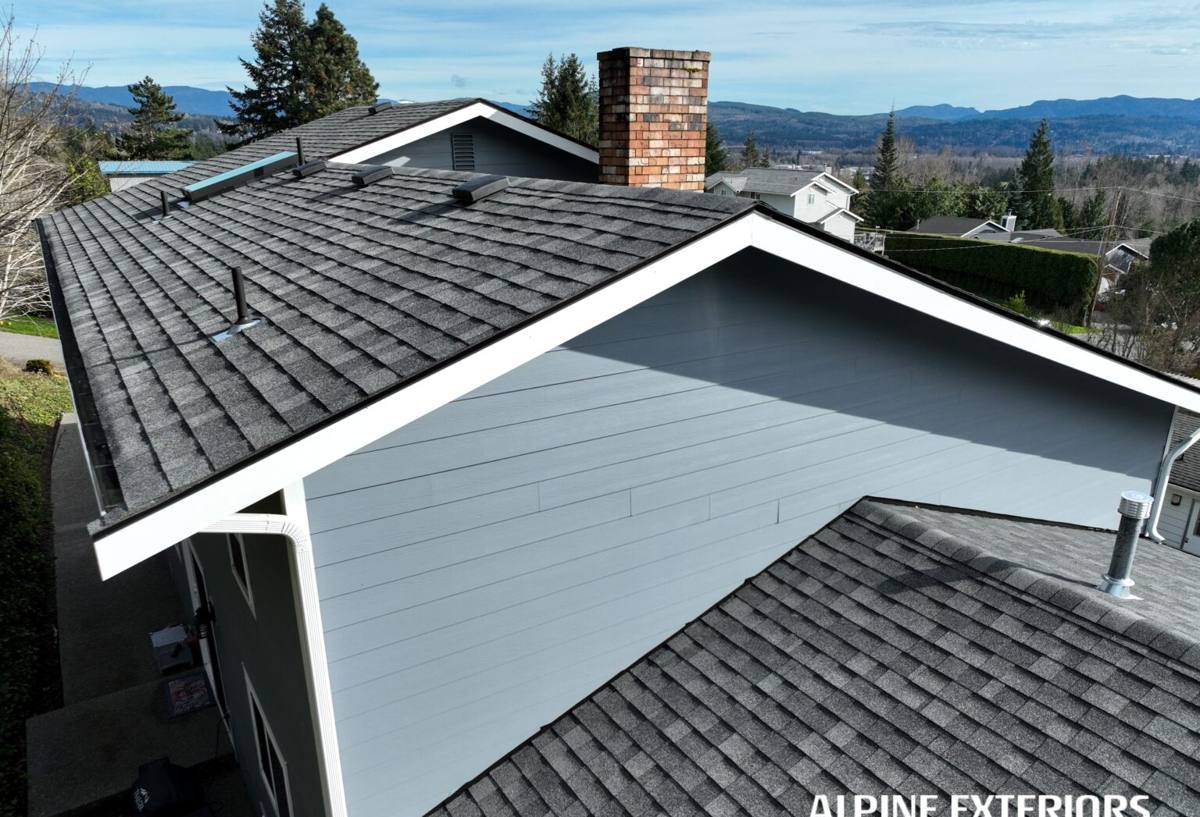
What Salt Air, Rain, and Moss Actually Do to a Shingle Roof
Salt Air and Metal Components
Asphalt shingles themselves aren't especially vulnerable to salt air, but the metal parts of your roofing system are. Flashing, fasteners, and vent components can corrode faster near the coast than they would further inland. Cheaper or mismatched metal — especially uncoated or poorly galvanized flashing — will show rust and pitting years before it should. This is one of the most common issues we find on older roofs in this area: the shingles are still serviceable, but the flashing around chimneys, valleys, and vents has failed and started letting water in underneath.
Driving Rain
Whatcom County doesn't just get rain — it gets wind-driven rain that hits roofs at an angle instead of falling straight down. That matters because it pushes water sideways and upward under shingle edges, into laps, and around penetrations that would stay dry in a calmer climate. A roof that's watertight in a light straight-down shower can still leak in a sideways storm if the underlayment, fastening pattern, and flashing details weren't built for that kind of weather.
Moss and Algae
Shaded, moisture-holding roof sections — common on lots with mature trees, which describes a lot of Cordata — grow moss faster than open, sun-exposed roofs. Moss isn't just cosmetic. As it establishes itself, it lifts shingle edges, holds standing moisture against the roof deck, and accelerates granule loss. Algae streaking is a lesser but related issue: it's mostly appearance, but it's a sign that a roof surface stays damp longer than it should.
What a Correct Installation Looks Like Here
Any asphalt shingle roof can look right from the ground the day it's finished. Whether it holds up through a Whatcom County winter comes down to details most homeowners never see once the shingles are down.
- Ice-and-water shield at eaves, valleys, and penetrations — a self-adhering waterproof membrane installed under the shingles in the areas most exposed to wind-driven rain and moisture backup.
- Synthetic underlayment across the full roof — a secondary water barrier that outperforms old-style felt paper in wet climates and holds up better during the install process itself when weather doesn't cooperate.
- Corrosion-resistant flashing — properly specified metal at chimneys, walls, valleys, and vent boots, not reused or mismatched flashing from the old roof.
- Correct fastening pattern — nails placed per manufacturer specification, not just "enough to hold it down." Under-fastening is one of the top causes of wind and rain damage on shingle roofs in this region.
- Balanced attic ventilation — intake at the eaves and exhaust at the ridge, sized to the attic volume, so moisture doesn't get trapped under the deck and shorten the roof's life from underneath.
- Proper ridge cap installation — the ridge takes the most direct wind exposure on the roof and needs its own attention, not an afterthought.
Skipping any one of these doesn't necessarily cause a problem on day one. It causes a problem in year three or four, usually right after the manufacturer's basic warranty period, and usually in the form of a slow leak that's hard to trace back to its source.
Shingle Choices for This Climate
We install architectural (laminated) shingles on the large majority of roofs in this area, and for the Cordata climate specifically, that's not a marketing preference — it's a practical one.
| Factor | 3-Tab Shingles | Architectural Shingles |
|---|---|---|
| Wind resistance | Lower rated, more prone to lifting in driving wind | Higher wind rating, better suited to storm exposure |
| Moss/algae resistance options | Limited | Widely available with algae-resistant granules |
| Expected lifespan | Shorter | Longer, with better long-term value in wet climates |
| Upfront cost | Lower | Moderate premium over 3-tab |
| Appearance | Flat, uniform | Dimensional, shadow-line look |
Within architectural shingles, we recommend algae-resistant (AR) granule products for Cordata roofs specifically, given the tree cover and shade common in the area. These granules are treated to slow algae growth on the shingle surface — they don't prevent moss from establishing where debris and moisture collect, but they meaningfully reduce the streaking and discoloration that comes from airborne algae spores common in the Pacific Northwest.
How We Approach a Cordata Roofing Project
Inspection First
We start by getting on the roof, not just looking at it from the driveway. We check the deck condition, existing flashing, ventilation setup, and any soft spots or moisture staining in the attic. This tells us whether a straightforward re-roof is the right call or whether deck repair is needed first.
Tear-Off vs. Overlay
We recommend full tear-off for almost every project in this climate. Overlaying new shingles over old ones traps moisture, hides deck problems, and works against the ventilation and underlayment details that matter most here. A tear-off costs more upfront but lets us actually address the deck, flashing, and ventilation instead of building a new roof on top of unknown problems.
Weather-Aware Scheduling
We plan installs around forecasted dry windows where possible and use underlayment products rated to handle brief exposure if weather shifts mid-project — a realistic necessity in a region where a dry forecast can change fast.
Cleanup and Final Walkthrough
We magnet-sweep for nails, clear debris, and walk the finished roof with you before considering the job done.
Cost Factors for a Cordata Re-Roof
Every roof is different, so we don't quote sight-unseen — but the main factors that move the price on a typical Cordata home are:
| Factor | Why It Matters |
|---|---|
| Roof size and pitch | More surface area and steeper pitches increase labor and safety requirements |
| Deck condition | Rotted or soft decking found during tear-off requires repair before shingles go on |
| Number of penetrations | Chimneys, skylights, and vents each need individual flashing work |
| Shingle tier chosen | 3-tab, standard architectural, and premium architectural products vary in material cost |
| Existing layers | Removing multiple old layers adds tear-off time and disposal cost |
| Access and tree cover | Mature trees common in Cordata can add setup and protection time |
We'll walk through these specifics with you and explain what's driving your number line by line — no vague allowances or padded estimates.
Maintenance That Actually Extends a Cordata Roof's Life
A well-installed shingle roof in this climate still needs some upkeep. Homeowners who stay on top of these basics typically get more usable life out of their roof:
- Keep gutters clear so water doesn't back up under the shingle edge, especially during heavy fall and winter rain
- Have moss growth addressed before it establishes under shingle edges, not after it's visibly thick
- Trim back overhanging branches to reduce shade, debris buildup, and physical abrasion on the roof surface
- Schedule a visual roof check after major windstorms, not just on a fixed annual calendar
- Address small flashing rust or granule loss early — these are cheap fixes when caught early and expensive ones when ignored
Why Local Experience on This Specific Roof Type Matters
A crew that mostly works drier or more inland climates can still install a technically correct shingle roof — on paper. What we bring from working Ferndale and the greater Whatcom County area consistently is pattern recognition: which flashing details tend to fail first in this specific mix of salt air and rain, which roof orientations in Cordata's tree-covered lots hold moss longest, and how local wind patterns actually load a roof during a real winter storm, not a textbook one. That's the difference between a roof that's built to spec and a roof that's built for where it actually sits.
If you're weighing a repair against a full replacement, or just want a straight read on the condition of your current roof, we're happy to take a look. Reach out for a free, no-pressure estimate using the form below.