 Ferndale
 Fiber Cement Siding Built for the Nooksack Valley
Everson sits inland along the Nooksack River, in the flatter farm country east of Ferndale, and that setting shapes an exterior differently than a lot of homeowners expect. The town doesn't take the same direct salt spray as the coastal edge of Whatcom County, but it still sits under the same storm systems that roll in off the water — and by the time those systems reach the valley, they usually arrive as wind-driven rain rather than a gentle straight-down shower. Add the humidity that settles over open farmland and low ground near the river, and you get a moss and mildew season that's every bit as long as what coastal towns deal with, sometimes longer on shaded, low-lying lots.
We install James Hardie fiber cement siding exclusively, and Everson is regular territory for our crew. This page is specifically about fiber cement siding for Everson homes: what the local conditions demand from a siding system, what a correct installation actually involves, how we run the job, and why hiring a crew that already knows this stretch of the valley is worth more than it sounds like on paper.
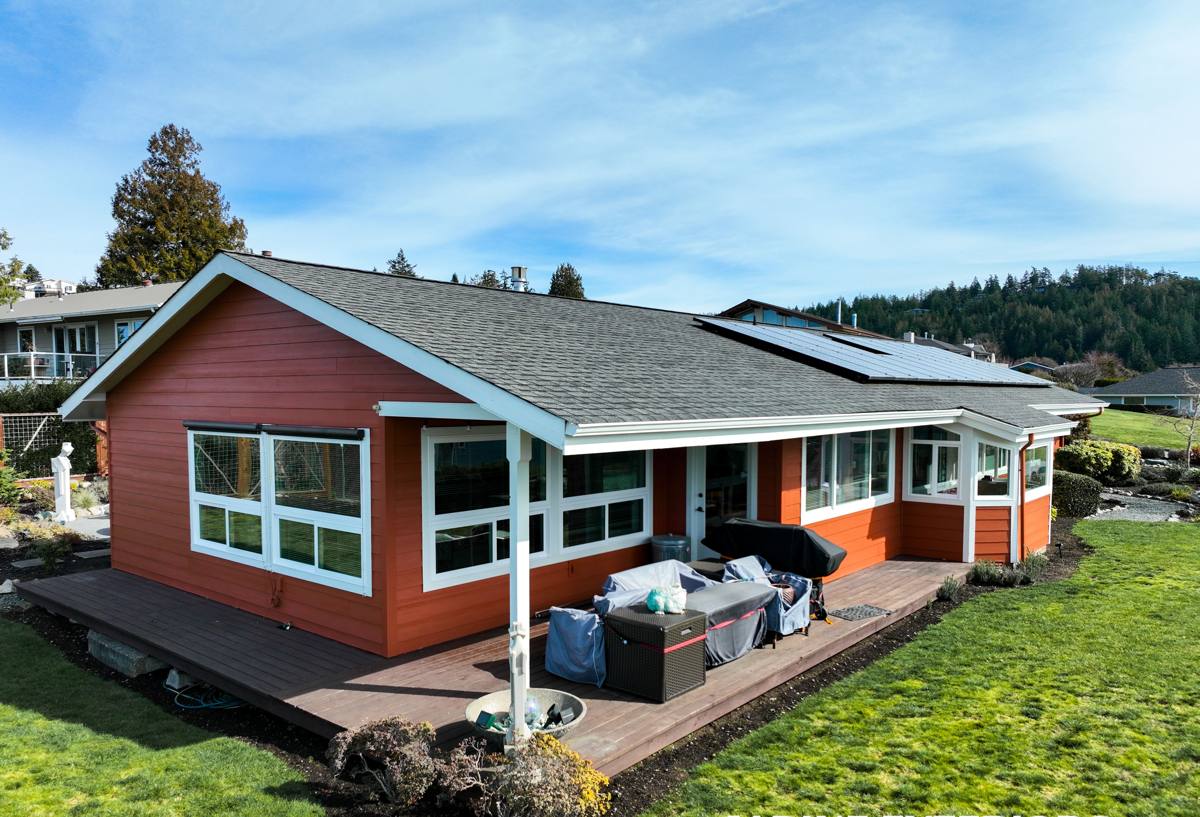
What Everson's Setting Does to Siding
Wind-Driven Rain Funneling Up the Valley
Rain in this part of Whatcom County rarely falls straight down. Pacific storm systems push moisture inland, and the Nooksack valley acts like a funnel for wind that carries rain sideways into wall assemblies, lap joints, and window trim. That sideways load matters more than a simple annual rainfall total suggests, because it finds gaps that a straight-down rain never would — loose seams, unsealed trim, and butt joints that weren't caulked and flashed correctly the first time.
River-Valley Humidity and a Long Moss Season
Low ground near the Nooksack River holds moisture longer than higher, better-drained lots, and morning fog is a regular feature of the valley floor for a good part of the year. Combined with mild temperatures, that dampness gives moss, algae, and mildew a long runway — often most of the year on north-facing walls or anywhere tree lines or outbuildings keep a wall shaded. Any siding material with even a little surface porosity becomes a growth surface under those conditions, and once moss gets a foothold it holds moisture against the wall behind it, compounding the problem rather than just sitting on the surface.
Open Exposure and Temperature Swings
A lot of Everson's housing stock sits on open, flat farmland with fewer windbreaks than a wooded or built-up lot would have, which means wind and rain hit walls with less to slow them down first. Clear valley nights can also bring a sharper temperature drop than you'd see closer to the coast, and that swing between a damp afternoon and a cold, clear night puts real stress on a siding material's ability to hold its shape and its finish without cracking or gapping over time.
Salt Air, at a Distance
Everson is far enough inland that it doesn't take the concentrated salt exposure that homes right on Bellingham Bay or the Strait deal with. Some marine influence still reaches this far up the valley in the moisture that storm systems carry, but the bigger factors here are the rain, the humidity, and the moss — which is part of why an Everson siding job and a waterfront Whatcom County siding job aren't quite the same project, even though both call for the same underlying material.
Why Fiber Cement Is the Right Call Here — and Why Only James Hardie
We used to install a wider range of siding products. We stopped, and the reason came from tear-offs and service calls across Whatcom County, including plenty in and around Everson — not from a supplier arrangement or a marketing push. Fiber cement's dense, cement-based core doesn't swell, cup, or warp the way wood-based siding can after repeated wet-season cycling, and it holds a finish far longer than a material that depends on field-applied paint to keep water out.
- Non-combustible core: Fiber cement doesn't feed a fire the way wood-based siding products can, which is a real factor in both household safety and insurance conversations.
- Factory-applied ColorPlus finish: The color is baked on under controlled factory conditions instead of brushed on in the field, so it resists fading and moisture damage far longer than site-applied paint holds up under valley humidity.
- Climate-engineered HZ product line: James Hardie's HZ5 formulation is built for regions with sustained moisture exposure and freeze-thaw cycling, which fits western Washington generally and the Nooksack lowlands specifically.
- Dimensional stability: Fiber cement doesn't expand and contract the way vinyl does or absorb and release moisture the way engineered wood does, so it stays flatter and tighter through the valley's damp-to-dry, warm-to-cold swings.
- Strong transferable warranty: Hardie backs its products with one of the stronger warranty structures in the industry, provided the installation follows their published specifications.
We won't install LP SmartSide, vinyl siding, Cemplank, Allura, primed spruce, or cedar. Every one of those products has homeowners who are satisfied with them, and none of them is a bad product in some absolute sense. But we'd rather install one system we fully stand behind, with a crew that knows its installation manual cold, than spread that expertise thin across several materials — especially in a valley where sustained moisture and wind-driven rain expose every shortcut eventually.
What a Correct Fiber Cement Installation Involves
Fiber cement only performs the way it's supposed to when it goes on correctly, and in a moisture-heavy setting like Everson, the details matter more than they would somewhere drier. None of what follows is exotic — it's James Hardie's own installation specification, applied consistently rather than shortcut on the parts a homeowner won't see once the job is finished.
- Rain screen gap behind the siding: A drainage cavity lets any moisture that gets past the exterior surface drain and evaporate instead of sitting against the sheathing.
- Correct fastener type and spacing: Hardie specifies both for a reason — loose spacing or the wrong fastener is one of the most common causes of early siding failure we find on tear-offs.
- Properly lapped house wrap and flashing: Every seam, corner, and penetration needs to shed water downward and outward, especially on walls that catch wind-driven rain directly.
- Sealed butt joints and trim transitions: Open or poorly sealed joints are where valley moisture finds its way behind the siding first, and they're the detail that separates a job that lasts decades from one that needs attention in five years.
- Correct clearance from grade, decks, and roofing: Siding installed too close to the ground, a deck surface, or a roofline traps moisture against the bottom edge of the board, which is exactly where fiber cement is least forgiving of a shortcut.
How We Run an Everson Siding Project
We walk every property in person before putting a number on the work, because two Everson homes on similar-sized lots can need very different scopes once old siding actually comes off. A farmhouse with decades of paint history behind its siding is a different job than a newer ranch-style home with a straightforward tear-off. Once we're on site, the process generally runs:
- Assessment and tear-off decision: We inspect the existing siding, trim, and — where accessible — the sheathing underneath, and determine whether a full tear-off or an overlay approach makes sense for that specific house.
- Substrate check and repair: Any water-damaged sheathing or framing found once old siding comes off gets addressed before new siding goes on. Covering a moisture problem instead of fixing it just moves the failure a few years down the road.
- House wrap, flashing, and rain screen installation: This is the layer that does most of the actual water management, and it's also the layer that's invisible once the siding is up — which is exactly why we don't rush it.
- Fiber cement installation to Hardie's specification: Correct fastening, spacing, and joint treatment throughout, not just on the elevations that are easiest to reach.
- Trim, caulking, and finish detail: Clean lines at corners, windows, and transitions, with attention to the joints that will see the most wind-driven rain over the life of the siding.
- Walk-through and cleanup: We go over the finished job with the homeowner and clear the site of old material and debris before we consider the project done.
Cost Factors for an Everson Fiber Cement Project
| Factor | Why It Matters |
|---|---|
| Tear-off vs. overlay | A full tear-off costs more up front but lets us check and repair sheathing that's already absorbed moisture — common on older Everson homes near the river or under heavy tree cover |
| Home size and wall complexity | More corners, gables, and trim transitions mean more labor and more places water can find a way in without correct flashing |
| Existing siding material | Removing old wood or engineered wood siding often turns up substrate issues that vinyl overlay would have hidden rather than solved |
| Board profile and finish | Factory ColorPlus finishes cost more up front than primed-for-field-paint options, but they hold up longer against valley humidity and sun exposure |
| Accessibility and site conditions | Rural and open-lot properties around Everson sometimes need extra staging or equipment access compared to a standard in-town lot |
These are general drivers, not a quote — every property is different once we're actually pulling old siding and looking at what's behind it, which is exactly why we walk the site before giving a real number.
Signs an Everson Home Needs New Siding
- Moss or dark staining that returns quickly after cleaning, especially on shaded or north-facing walls
- Soft or spongy siding, particularly low on the wall or around window and door trim
- Peeling paint, bubbling, or visible warping on siding boards
- Gaps opening up at seams, corners, or trim joints after a season of temperature swings
- Rising energy bills that suggest moisture or air infiltration behind the wall assembly
- Visible rot or discoloration on trim boards, especially near ground contact or roof transitions
Why a Crew That Already Works Everson Matters
A contractor who spends most of their time closer to the coast or in denser parts of the county doesn't necessarily know how differently a valley property behaves — how much longer a low, shaded lot near the river stays damp, or how exposed an open farmhouse wall is compared to one tucked behind trees in town. We work across Whatcom County regularly, Everson included, and that means practical, on-site decisions get made with real local context: which walls will stay wettest longest, where the extra flashing attention actually pays off, and which fastener and joint details are worth the additional time so you're not dealing with a callback after the next valley storm. It also means a shorter drive for follow-up questions, warranty service, or simply walking the property again before we commit to a number.
If your Everson home needs new siding — or you're just trying to figure out whether what you have is holding up the way it should — we're glad to take a look and give you a straightforward, honest assessment. Reach out using the form below to schedule a free, no-pressure estimate.