 Ferndale
 Why Blaine's Coastal Position Changes the Siding Equation
Blaine sits right on the water at the northern edge of Whatcom County, and that location does something most inland siding jobs never have to account for: it puts salt-laden air directly against the exterior of every home, every day, year-round. Combine that with driving rain off the Strait and a moss season that can stretch from fall through spring, and you have one of the more demanding siding environments in the region. A product that performs fine forty minutes inland can fail early here — not because it's a bad product everywhere, but because it wasn't built for this specific combination of wind-driven moisture and airborne salt.
This is the environment we design every Blaine installation around. It's not a generic siding job with a different zip code — it's a coastal job that needs a coastal-rated material and installation details that respect what salt air and standing moisture actually do to a wall assembly over ten, twenty, thirty years.
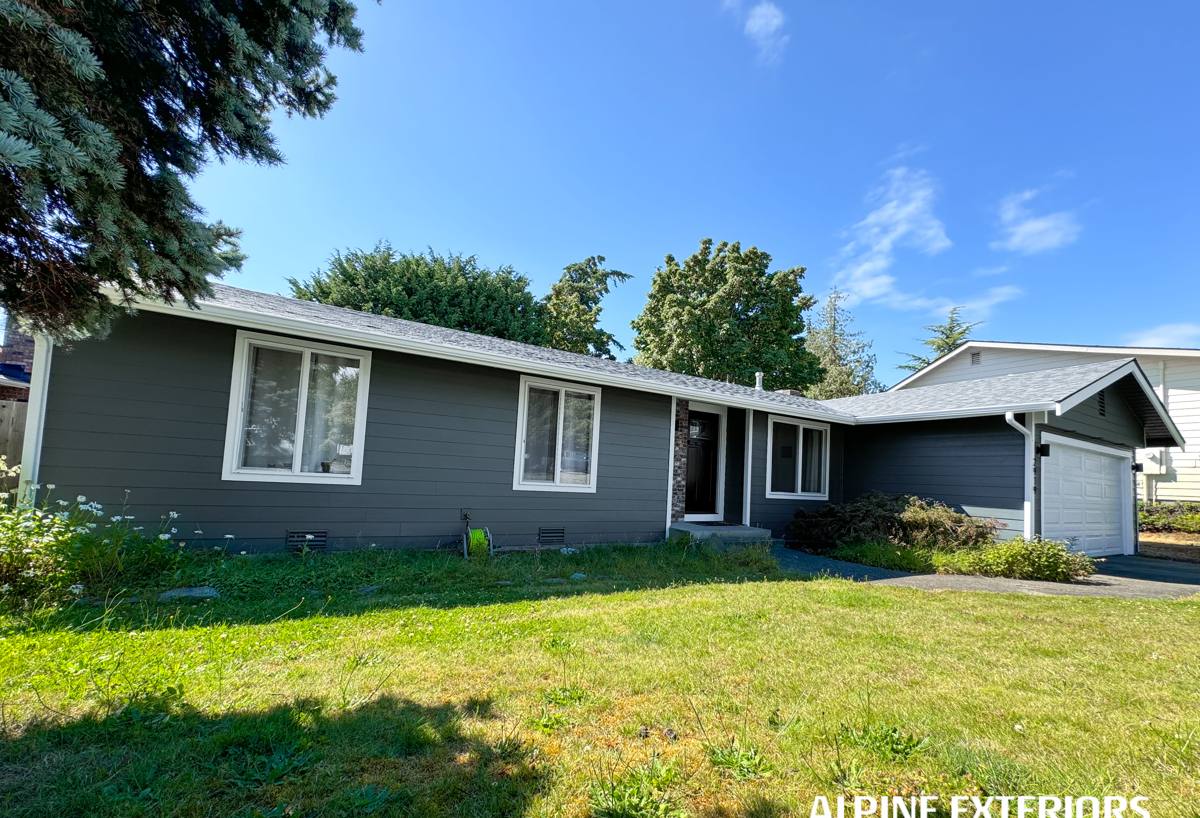
What Salt Air, Rain, and Moss Actually Do to a House
Each of these stressors attacks siding a different way:
- Salt air accelerates corrosion of exposed fasteners, trim, and any metal flashing that isn't properly protected — and it degrades some paint and coating systems faster than inland exposure would.
- Driving rain off open water doesn't just fall straight down — it hits siding at an angle, working its way behind poorly lapped joints, undersized gaps, and butt joints that weren't caulked or flashed correctly.
- Moss and algae take hold anywhere moisture lingers — north-facing walls, shaded eaves, and any siding that stays damp longer than it should because of poor drainage behind the cladding.
None of these are dramatic, one-time failures. They're slow, cumulative damage that shows up as soft trim, peeling paint, staining, or rot — usually years after a homeowner assumed the siding was simply "done" and low-maintenance.
Why We Install James Hardie Here — and Nothing Else
We install James Hardie fiber cement exclusively. We don't install vinyl, LP SmartSide, or other engineered wood or composite sidings, and Blaine's climate is a good example of why. Fiber cement is non-combustible and dimensionally stable — it doesn't expand and contract with moisture the way wood-based products can, and it doesn't soften or degrade when it stays damp during a wet Whatcom County winter. For homes exposed to salt air, that stability matters more than it does in a drier, inland setting.
James Hardie also builds region-specific product lines rather than a one-size-fits-all board, and for the Pacific Northwest coast that means their HZ5 formulation, engineered for wet, humid climates with freeze-thaw cycling and moisture exposure. It's not a marketing label — it's a different manufacturing specification aimed at the exact conditions Blaine homes deal with. Paired with the factory-applied ColorPlus finish, which is baked on under controlled conditions rather than field-applied, you get a topcoat that resists fading and moisture intrusion far better than a job-site paint job, with a real, transferable warranty behind it.
What This Doesn't Mean
Hardie siding isn't maintenance-free, and we won't tell a Blaine homeowner it is. It still needs periodic washing to keep salt residue and organic growth from building up, and caulked joints and flashing still need to be checked over time like any exterior building material. What it does mean is that the base material itself isn't the weak point — the ongoing maintenance is cosmetic and preventive, not structural repair.
How Coastal Exposure Compares Across Common Siding Materials
| Factor | Vinyl | Engineered Wood (LP-Type) | James Hardie Fiber Cement |
|---|---|---|---|
| Salt air / corrosion resistance | Doesn't corrode, but can become brittle and discolor | Coating can wear at exposed edges over time | Non-corroding substrate; factory finish resists salt-driven fading |
| Moisture / rot risk | Low rot risk, but traps moisture behind panels if installed poorly | Wood-based core is vulnerable if the coating fails or water gets behind it | Cement-based core doesn't rot; moisture management still matters at joints/flashing |
| Moss / algae staining | Can grow on surface, harder to clean without damage | Grows readily where moisture sits against the coating | Resists staining better; regular washing keeps growth from taking hold |
| Fire resistance | Combustible | Combustible | Non-combustible |
| Typical lifespan when installed to spec | 20–30 years, variable | Manufacturer-dependent, coating-sensitive | Multi-decade, backed by a transferable factory warranty |
No material is immune to Whatcom County weather. The differences show up in how much of the durability depends on the coating staying intact versus being built into the core material itself — and in a salt-air environment, that distinction compounds over years.
What a Correct Installation Actually Involves
The product only performs as designed if the installation respects Hardie's specifications — and this is where a lot of siding jobs, regardless of material, quietly fail. For a Blaine home, the details that matter most include:
- A properly lapped weather-resistive barrier behind the siding, so any moisture that does get past the cladding drains out instead of sitting against the sheathing.
- Correct fastener type and placement — corrosion-resistant fasteners, driven at the spacing and depth Hardie specifies, not overdriven or underdriven.
- Proper gapping at butt joints and around openings, sealed with a flexible, paintable sealant rated for exterior use rather than caulked shut with no room for movement.
- Flashing at every horizontal transition — window heads, roof-to-wall intersections, and trim boards — so wind-driven rain has nowhere to collect.
- Correct clearance from grade, decks, and roof lines, keeping the bottom edge of the siding above splash-back zones and standing water.
Skip any one of these and you can end up with premature staining, soft trim, or moisture intrusion — even with the best material on the market. This is installation discipline, not brand loyalty, and it's the part of the job that determines whether the siding lives up to its warranty in practice.
Our Process for a Blaine Job
Assessment
We start by walking the exterior and looking specifically at exposure — which walls face prevailing wind and rain, where moss and staining already show up, and where existing trim or sheathing shows signs of past moisture problems. That assessment shapes flashing and product decisions before a single board goes up.
Preparation
Old siding comes off, the sheathing and framing get inspected for hidden rot or damage, and any needed repairs happen before the weather barrier and siding go on — not after. This is also when we confirm flashing details around windows, doors, and roof lines.
Installation
Hardie boards, panels, or trim go up to manufacturer spec: correct fastening, gapping, and sealing at every joint. We work in sections to keep the wall assembly protected from weather during the job rather than leaving it exposed longer than necessary.
Finish and Walkthrough
We clean up the site, review the finished work with the homeowner, and make sure warranty registration is handled — the ColorPlus finish and the substrate itself each carry their own coverage, and that paperwork matters if a claim is ever needed down the road.
Color and Finish Considerations for a Coastal Property
ColorPlus finishes are available in a range of tones, and for a home exposed to salt air and heavy rain, color choice isn't purely cosmetic. Darker colors absorb more heat and can show water spotting differently than lighter tones, while lighter colors tend to show moss and organic staining more visibly on shaded or north-facing walls. Neither is right or wrong — it's a conversation about which trade-off fits the specific walls and exposure of the home, and we walk through that during the estimate rather than assuming one answer fits every elevation.
Keeping Hardie Siding Looking Right in Blaine's Climate
Fiber cement is low-maintenance, not no-maintenance. A simple seasonal routine keeps it performing the way it's designed to:
- Rinse the exterior periodically with a garden hose and soft brush to clear salt residue and organic buildup, especially on shaded or north-facing walls.
- Avoid high-pressure washing directly at joints and edges, which can force water behind properly sealed seams.
- Check caulked joints and trim seals once a year for cracking or separation, particularly after a hard winter.
- Keep gutters and downspouts clear so roof runoff isn't dumping extra water directly onto siding sections.
- Trim back vegetation and landscaping that keeps any wall section shaded and damp longer than the rest of the house.
Why a Crew That Already Works Blaine Matters
Coastal Whatcom County jobs come with details that a crew unfamiliar with the area can miss: which elevations take the worst of the wind and rain, how moss behaves on shaded walls near the water, and how local permitting and inspection expectations run for exterior work in this part of the county. A crew that already works Blaine and the surrounding Ferndale area brings that judgment into the estimate itself — not as an afterthought once the boards are already ordered. It also means a company that's still local and reachable years later if a warranty question or maintenance question comes up, rather than a crew that worked the area once and moved on.
If you're planning a siding project on a Blaine home and want a straight assessment of what your specific exposure calls for, we're glad to walk the property with you and put together a free, no-pressure estimate — no obligation, just a clear look at what your home actually needs.