 Ferndale
 Why Nooksack Homes Need Siding Built for This Climate
Homes in and around Nooksack take a steady beating from three things at once: salt-laden air moving in off the Salish Sea, driving rain that comes sideways more often than straight down, and a moss season that can stretch from October through May. Any one of those is manageable. All three, year after year, is what separates siding that lasts twenty-five years from siding that starts failing at ten. If you're planning a re-side or building new in this part of Whatcom County, the material and the installation both have to account for that combination, not just one piece of it.
The Three Things Working Against Your Siding Here
Salt air accelerates corrosion on fasteners, flashing, and any exposed metal trim — it also speeds up the breakdown of cheaper paint films and coatings. Driving rain finds every gap in a siding system, particularly around windows, corners, and butt joints, and pushes water sideways and upward, not just down. And moss and algae don't just sit on the surface — on the wrong substrate, they hold moisture against the wall for months at a time, which is exactly the condition that rots wood trim, delaminates engineered wood products, and eventually gets behind the siding into the sheathing.
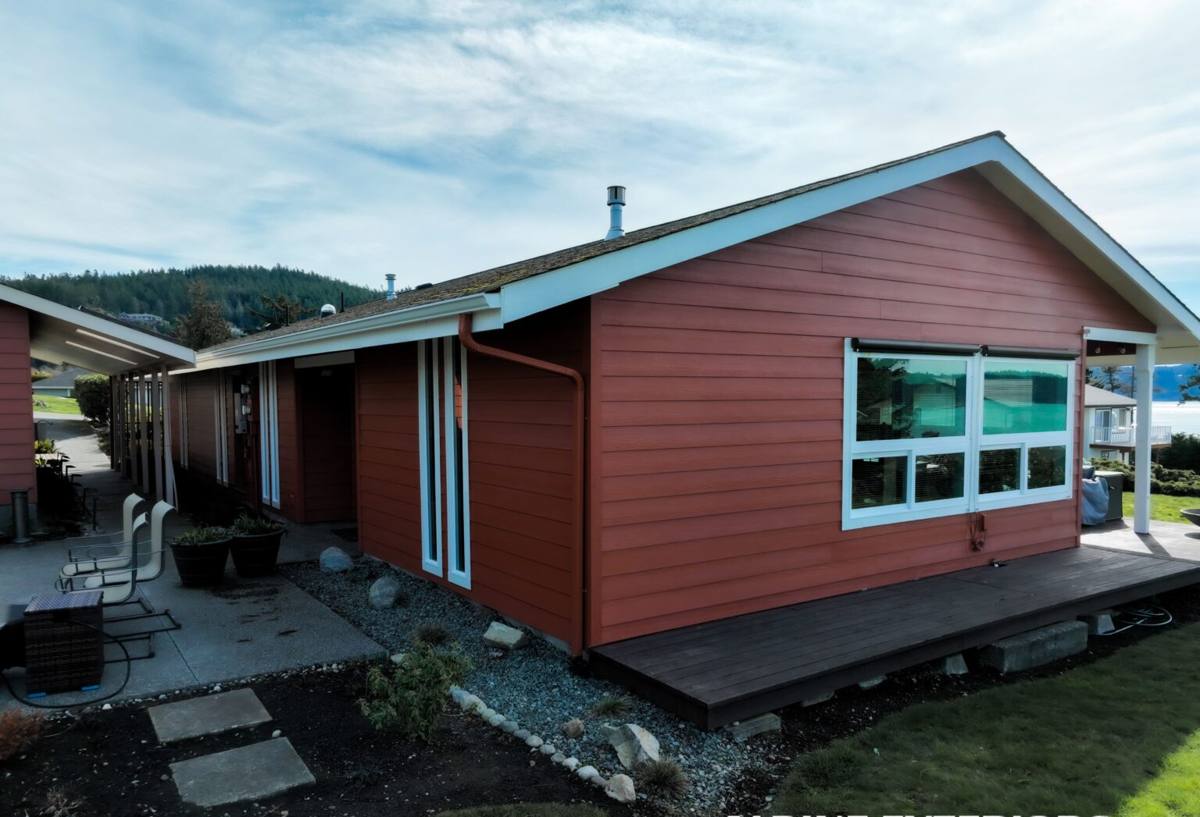
What James Hardie Gets Right for This Climate
James Hardie fiber cement is cement, sand, and cellulose fiber — there's no wood fiber in the board itself to feed rot or absorb water the way wood-based products do. It doesn't swell, it doesn't delaminate, and it's non-combustible, which matters in a region where wildfire smoke and defensible-space requirements are becoming a bigger part of homeowner insurance conversations. Hardie also engineers its product line by climate zone — the HZ5 formulation used in the Pacific Northwest is specifically built for higher moisture exposure, which is not a marketing detail, it's a manufacturing difference in how the board is formulated.
The factory-applied ColorPlus finish matters just as much as the board itself in a salt-air environment. It's baked on under controlled conditions with better adhesion and UV resistance than a field-applied paint job, and it carries its own finish warranty separate from the substrate warranty. In a spot like Nooksack, where repainting siding every six or seven years because the finish is chalking or peeling gets old fast, that factory finish is doing real work.
Where Siding Jobs Actually Go Wrong Around Here
Fiber cement is only as good as the installation. Hardie's own installation instructions are specific about clearances, fastening, and flashing details for a reason — skip them and you can end up with moisture problems on a product that's supposed to resist moisture. This is where a lot of homes end up disappointed, and it's almost never the board itself that failed.
The Mistakes We See Most Often on Re-Sides
- Siding installed tight to the ground, deck, or roofline with no minimum clearance, so splash-back and standing water wick straight into the bottom edge
- Missing or undersized flashing above windows, doors, and horizontal trim, which is exactly where driving rain gets pushed
- Butt joints and corners caulked instead of properly flashed, so the caulk becomes the only thing between the wall and the weather — and caulk is a maintenance item, not a permanent seal
- Fasteners driven at the wrong depth or spacing, which either splits the board or leaves it loose enough to work over time
- House wrap or weather-resistive barrier installed without correct lapping, so water that does get past the siding has a path straight to the sheathing
- Cut edges left unsealed, giving moisture a raw entry point into the board itself
None of these are Hardie's fault — they're installation shortcuts, and they show up faster in a climate that gives siding no rest from moisture for most of the year.
What a Correct Installation Involves
A proper Hardie install on a Nooksack home starts before the first board goes up. We look at the existing wall assembly, check for any hidden moisture damage from the old siding, confirm the weather-resistive barrier is sound or replace it, and plan flashing at every horizontal transition — window heads, door heads, deck ledgers, and roof-to-wall intersections. None of that is visible once the job is done, which is exactly why it's worth asking about before you hire anyone.
Our Process, Step by Step
- On-site inspection of the existing siding, trim, and sheathing to identify any moisture damage that needs to be addressed before new siding goes on
- Removal of old siding and correction of any rot or compromised sheathing found underneath
- Installation or repair of the weather-resistive barrier with correct shingle-style lapping
- Flashing installed at all windows, doors, and horizontal penetrations per Hardie's published details
- Hardie boards installed with correct clearances from grade, roofing, and decks, and fastened per Hardie's schedule for our wind and exposure conditions
- Joints and corners finished with the appropriate trim system rather than relying on caulk as the primary seal
- Final walk-through covering the ColorPlus finish warranty and the workmanship warranty, in writing
Choosing the Right Hardie Product Line
Hardie makes several distinct product lines, and the right one depends on the home's style and how it's exposed to weather, not just personal preference. On a lot of Nooksack properties, we're weighing wind and rain exposure against the architectural style the homeowner wants.
| Product | Best Use | Why It Fits Here |
|---|---|---|
| HardiePlank lap siding | Most traditional single-family homes | Widest color and texture range, proven track record in wet coastal climates |
| HardiePanel vertical siding | Modern builds, accent walls, gable ends | Fewer horizontal joints exposed to driving rain when detailed correctly |
| HardieShingle siding | Craftsman and cottage-style homes | Matches shingle-style architecture without the moisture and moss issues of real wood shakes |
| HardieTrim boards | Corners, fascia, window and door surrounds | Non-combustible, paint-holding trim that won't rot the way primed wood trim does in constant damp |
What a Nooksack Siding Project Costs — and Why
There's no single number that applies to every house, but the factors that move the price are consistent, and it's worth knowing them before you get quotes so you can tell whether an estimate is realistic.
| Factor | Why It Matters |
|---|---|
| Home size and wall complexity | More corners, dormers, and roof intersections mean more flashing and trim labor, not just more square footage |
| Condition of the existing wall | Hidden rot or compromised sheathing found during tear-off adds cost, but skipping the repair guarantees problems later |
| Siding profile and trim package | Wider trim, shingle accents, and custom color selections cost more than a standard lap profile in a stock color |
| Site access | Multi-story homes, tight lot lines, and limited staging space all add labor time |
| Tear-off and disposal | Removing and hauling old siding, especially old cedar or vinyl over wood, is real labor that a fair estimate has to include |
Living With Hardie Siding in a Salt-Air, Moss-Heavy Climate
Correctly installed Hardie siding is genuinely low-maintenance, but "low-maintenance" doesn't mean "no maintenance," especially with a Whatcom County moss season to contend with. A rinse-down once or twice a year keeps salt residue and organic buildup from sitting on the surface long-term. Keep gutters clear so overflow doesn't run down the face of the siding and feed moss growth at the top courses. Trim back vegetation and shrubs so air can move along the wall and dry it out between rain events — plants pressed against siding trap moisture no matter what the siding is made of. If you ever see caulk lines cracking at trim joints, get them addressed promptly; that's ordinary maintenance, not a sign of failure, but ignoring it turns a five-minute fix into a bigger repair.
Why Hiring a Crew That Already Works in Nooksack Matters
A lot of what makes a siding job hold up here is judgment calls that don't show up in a generic spec sheet — how much clearance to leave given how a particular lot drains, which corners of a house take the worst of the prevailing wind-driven rain, how local building department inspectors want flashing details documented. A crew that's already worked on homes throughout Whatcom County and Ferndale has made those calls before and adjusted for them. That's different from a crew working from a national install manual with no feel for what this specific stretch of coastline does to a house over a decade. It also means someone local is still around if a warranty question comes up five or ten years from now.
If you're weighing a siding replacement or new construction in Nooksack, we're happy to take a look at your home, walk you through what a correct Hardie installation looks like for your specific exposure, and give you a straightforward, no-pressure estimate — just reach out through the form below.