 Ferndale
 Why Roofs Wear Differently on Lummi Island
A roof on Lummi Island lives a harder life than the same roof twenty miles inland. The island sits out in the marine air of northern Puget Sound, which means fasteners, flashing, and shingle granules are exposed to salt-laden moisture almost year-round. Add Whatcom County's driving rain — often blown sideways off the water rather than falling straight down — and you get water finding its way into laps, valleys, and fastener holes that would stay dry on a more sheltered roof. Then there's moss season, which here isn't really a season so much as most of the year: shaded, north-facing slopes and anything under overhanging trees stay damp long enough for moss and algae to take hold and start working their way under shingle edges.
None of this means a roof on Lummi Island is doomed to fail early. It means the install has to account for these conditions from the start — material choice, fastener grade, flashing details, and ventilation all matter more here than they would on a dry-side roof.
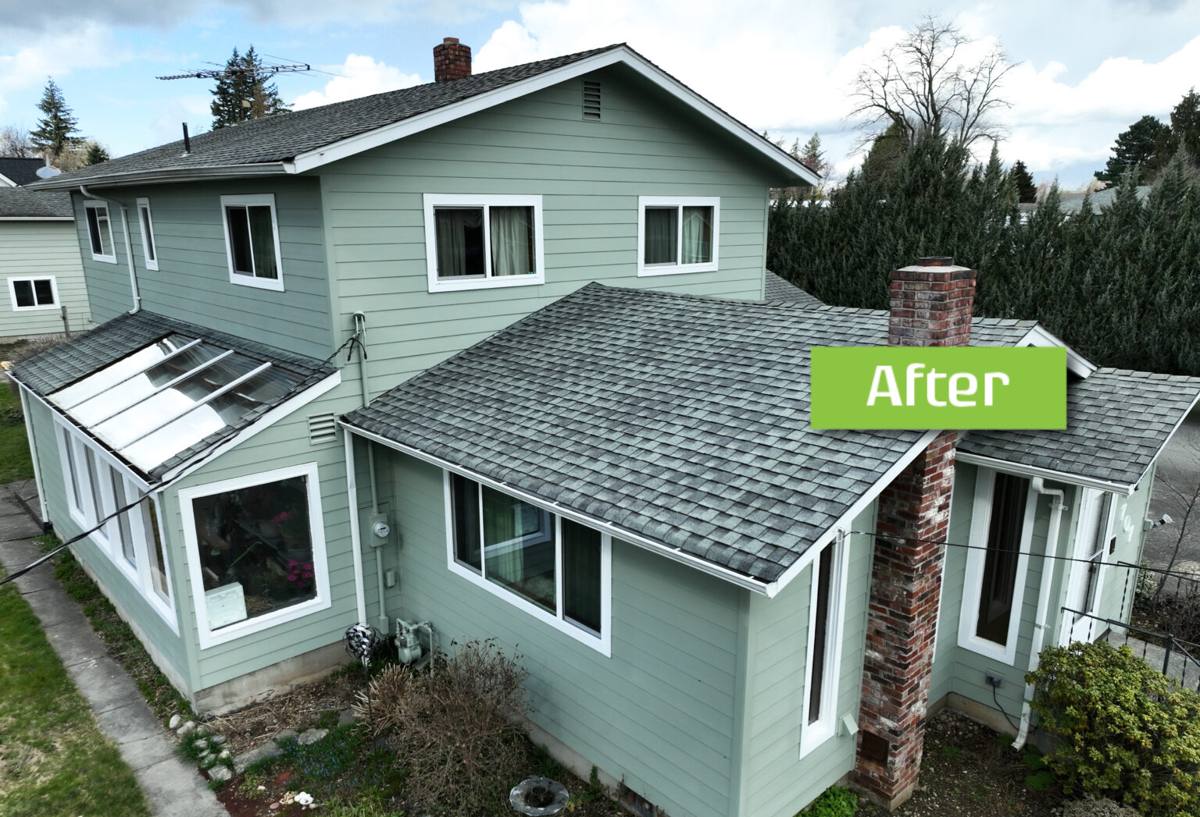
Signs You Need a New Roof, Not Another Patch
Repairs make sense when a roof has isolated damage and years of life left. A full replacement makes sense once the roofing system itself — not just one spot — is failing. On Lummi Island, that point tends to arrive a bit sooner than the shingle's rated lifespan would suggest, simply because of the exposure. Signs worth taking seriously:
- Granule loss showing as bald or shiny patches, especially on slopes that face the prevailing wind and rain
- Shingle edges curling, cupping, or lifting
- Established moss mats in valleys or on shaded, north-facing slopes — not just surface algae staining
- Soft or spongy decking underfoot when walked (a roofer will check this safely)
- Daylight visible through roof boards from inside the attic
- Rust streaking or corrosion at flashing, vent boots, or exposed fastener heads
- Leaks that keep reappearing near the same spot after repeated patch repairs
- A roof approaching or past the age where marine exposure typically shortens its expected life
If you're seeing two or more of these at once, it's usually cheaper in the long run to replace than to keep chasing patches.
What a Correct Installation Actually Involves
A new roof is more than swapping old shingles for new ones. In a climate like this, the details underneath the shingles matter as much as the shingles themselves.
Tear-Off and Deck Inspection
Old roofing comes off down to the deck so it can actually be inspected — not covered over. Any soft, delaminated, or water-stained sheathing gets replaced before anything new goes down. Skipping this step is one of the most common ways a "new" roof fails early, because rot underneath keeps spreading no matter what's on top.
Underlayment and Water Barriers
Given how much wind-driven rain this area sees, underlayment isn't just a formality. A synthetic underlayment provides the primary water-shedding layer beneath the shingles, and self-adhering ice-and-water membrane belongs at eaves, valleys, and around penetrations — the spots where wind-blown rain is most likely to work its way backward under the shingle line.
Flashing
Step flashing at walls and chimneys, counter-flashing, valley flashing, and drip edge all need to be correctly lapped and, in this climate, made from a corrosion-resistant material — aluminum or stainless rather than plain steel that will rust and stain within a few seasons of salt exposure.
Fasteners
Standard electro-galvanized nails corrode faster near salt air. Hot-dip galvanized or stainless fasteners cost a bit more but hold up substantially longer, and a fastener failure is one of the leading causes of shingle blow-off in coastal wind events.
Ventilation
Balanced intake (soffit) and exhaust (ridge) ventilation keeps the attic dry and temperatures even, which does two things: it protects the decking from condensation-driven rot, and it reduces the damp, stagnant conditions that let moss and algae establish themselves on the roof surface in the first place.
Choosing a Roofing Material for a Marine Climate
There's no single "right" material for every home — budget, roof pitch, and how the house looks all factor in. But in a salt-air, high-moisture, moss-prone climate, some trade-offs are worth understanding upfront.
| Material | Typical Lifespan Here | Moss/Algae Behavior | Salt-Air Notes |
|---|---|---|---|
| Architectural asphalt shingle (algae-resistant) | 20–30 years | AR granules slow algae staining; moss can still take hold in shaded valleys without upkeep | Needs corrosion-rated fasteners and flashing to hit its full lifespan |
| Standing seam metal | 40–50+ years | Sheds moss and debris far better than shingles; smooth surface resists buildup | Fastener and coating quality matter most — ask what corrosion protection is used |
| Cedar shake | 20–30 years with regular upkeep | More prone to moss without periodic treatment and cleaning | Absorbs moisture; needs good ventilation underneath to avoid rot |
We'll walk you through how each option performs on your specific roof — pitch, shading, and sun exposure all change the calculus more than people expect.
Ventilation and Moss: Playing the Long Game
Moss doesn't ruin a roof overnight — it works slowly, holding moisture against the shingle surface and lifting edges as it grows, which is exactly what lets water get underneath. On Lummi Island, shaded and north-facing slopes near trees are the usual trouble spots. A correct install reduces how fast moss re-establishes (better ventilation, algae-resistant materials, tighter flashing that doesn't trap debris) but it doesn't eliminate the need for occasional maintenance — keeping gutters and valleys clear of needles and leaf litter goes a long way toward keeping a new roof looking and performing like a new roof for its full expected life.
The Logistics of Roofing an Island Home
Lummi Island is reached by ferry, and that changes how a roofing job has to be planned compared to a job on the mainland. Materials, equipment, and a disposal trailer or dumpster all need to be scheduled around ferry capacity and timing rather than just driven over whenever it's convenient. Debris and old roofing material typically need to be hauled back off the island for disposal, which has to be built into the project timeline from the start — not figured out on the fly mid-job. A crew unfamiliar with this adds delays, extra ferry crossings, and sometimes extra cost that shows up as a surprise later in the project.
Our Process, Start to Finish
- Inspection and estimate — we look at the roof from the deck up (not just a drive-by), check attic ventilation and any visible sheathing issues, and give you a straightforward written estimate.
- Material selection — we talk through options based on your roof's pitch, sun/shade exposure, and budget, with honest trade-offs rather than a hard sell toward one product.
- Scheduling — for island jobs, this includes planning material delivery, crew transport, and waste haul-off around ferry logistics so the timeline holds.
- Tear-off and deck repair — old roofing removed, deck inspected, any damaged sheathing replaced before anything new goes on.
- Installation — underlayment, ice-and-water membrane at vulnerable areas, corrosion-resistant flashing and fasteners, and the roofing material itself, installed to manufacturer specification.
- Cleanup and haul-off — job site and yard cleared of debris and nails, with disposal handled including the ferry logistics that involves.
- Final walkthrough — we go over the finished roof with you and provide warranty documentation.
Why a Crew That Already Works Lummi Island Matters
A roofer who's done work on the island before isn't guessing at ferry schedules, isn't discovering mid-project that the disposal trailer needs to make a second crossing, and isn't learning on your roof what corrosion-resistant fasteners and flashing should look like in this environment. That familiarity translates directly into fewer delays, fewer surprise costs, and a roof that's actually built for the conditions it has to survive — not a generic install that happens to be located on the water.
We also pull the required permits through Whatcom County and make sure the finished job meets code, which matters both for your protection and for resale down the road.
What to Ask Before You Hire
- Are you licensed and insured to work in Whatcom County, and can you show proof?
- Have you worked on Lummi Island or other ferry-access properties before?
- What fastener and flashing materials do you use, and are they corrosion-rated?
- How do you handle deck repair if rot is found once tear-off starts?
- What's included in the written warranty — materials, workmanship, or both?
- How is debris hauled off the island, and is that cost included in the estimate?
A contractor who answers these clearly and specifically, without hedging, is one worth trusting with the job.
If your roof is showing its age or you're planning ahead for a replacement, we're happy to come take a look. Fill out the form below for a free, no-pressure estimate — we'll tell you honestly what your roof needs, not just what's easiest to sell.