 Ferndale
 Why Decks Wear Out Faster in Marietta
Marietta sits close to the water on the edge of Ferndale, and that location comes with a specific kind of weather load. Salt-laden marine air drifts in off the bay, driving rain comes in sideways for months at a stretch, and the shaded, moisture-heavy stretch from fall through spring gives moss and algae plenty of time to take hold on any horizontal wood surface. A deck out here isn't just weathering "Pacific Northwest rain" in the abstract — it's dealing with airborne salt that accelerates corrosion on fasteners and hardware, combined with near-constant dampness that wood and lesser composites struggle to shed between storms.
That combination is why decks in Marietta often show their age faster than the same structure would inland. Fastener corrosion, soft or delaminating decking, and slick, moss-covered boards are the norm rather than the exception once a deck passes the 12-15 year mark, and sometimes sooner if the original build used builder-grade materials or standard fasteners not rated for coastal exposure.
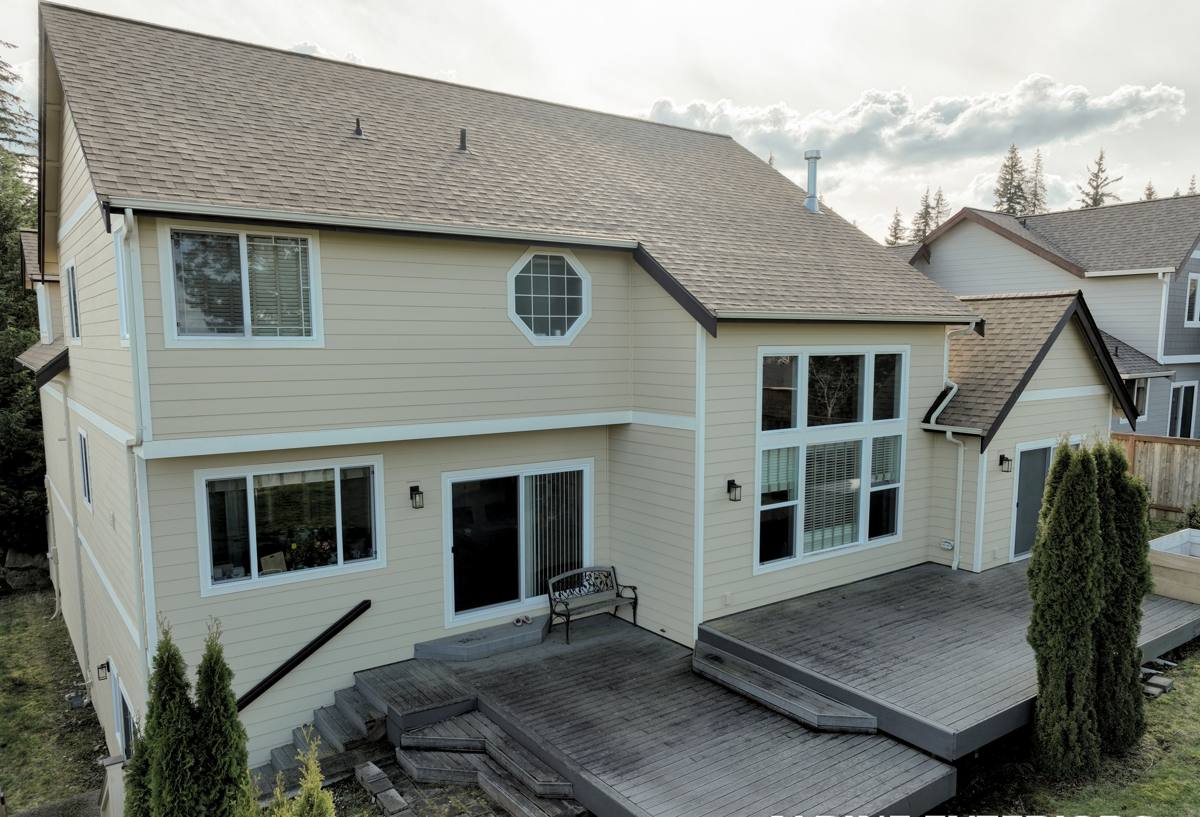
Signs Your Marietta Deck Needs Replacing, Not Just Repair
Not every deck problem calls for a full tear-off. But there's a point where patching boards or re-staining stops being a real fix and starts being a way to delay a bigger job. Here's what tells us a deck has crossed that line:
- Soft, spongy, or visibly sagging deck boards, especially near the house or in shaded corners that never fully dry out
- Rust streaks running down from screws or nail heads, or fasteners that spin freely instead of biting
- A ledger board connection that's separating, discolored, or shows signs of water having tracked behind the siding
- Persistent moss or black algae film that returns within weeks of cleaning, no matter the season
- Railing posts that flex or feel loose underfoot pressure — often a sign the post-to-frame connection has degraded
- Visible gaps opening between boards, or boards that have cupped and no longer sit flat
- A substructure (joists, beams, posts) more than 15-20 years old, even if the surface decking looks newer
If you're only seeing one or two of these, a repair might genuinely be the right call and we'll say so. When several show up together, especially anything involving the ledger or substructure, replacement is usually the more honest recommendation — patching around a failing frame just moves the same money into a job that still needs to happen later.
What a Correct Deck Replacement Involves
Substructure First
The part of a deck replacement that matters most is the part nobody sees once it's finished: the ledger board, the footings, the beams, and the joists. In a damp, salt-exposed spot like Marietta, we pay close attention to proper flashing at the ledger-to-house connection — this is the single most common failure point on older decks here, because water that gets trapped behind an improperly flashed ledger will rot the rim joist and the wall framing behind it long before the decking on top shows any sign of trouble. We also confirm footings are set to proper depth and that post bases keep wood off standing water, which matters more in low-lying areas than on higher, better-drained lots.
Fasteners and Hardware
Standard hot-dip galvanized fasteners hold up reasonably well most places, but in a marine-air environment they corrode faster than their rated lifespan suggests. We spec stainless steel or coated fasteners rated for coastal/salt exposure on connections that matter structurally — joist hangers, ledger bolts, post hardware — because replacing a $2 bolt in year six is a lot cheaper than what happens if it fails quietly inside a structural connection.
Decking Material
The decking surface itself is where homeowners have the most choice, and it's worth understanding the real trade-offs rather than just picking on price or looks.
| Material | How it handles Marietta's climate | Maintenance | Typical lifespan |
|---|---|---|---|
| Pressure-treated lumber | Absorbs moisture readily; needs sealing to resist rot and moss growth in shaded, damp spots | Annual cleaning and re-sealing/staining | 10-15 years before major issues |
| Cedar | Naturally rot-resistant but still absorbs moisture; salt air and constant damp shorten its natural advantage | Regular oiling/sealing; cleaning to slow graying and moss | 15-20 years with upkeep |
| Capped composite | Sheds water and resists moss/algae staining far better than wood; the cap layer blocks moisture absorption into the core | Occasional washing; no sealing or staining | 25-30 years, often with a manufacturer warranty |
| Uncapped/early-generation composite | Can absorb moisture at cut edges and in humid, low-airflow spots, leading to swelling over time | More cleaning to manage surface mold in shaded areas | Shorter than capped composite; varies by product |
We don't install uncapped composite in this area as a matter of our own standard — in a climate this wet and salty, the moisture-absorption trade-off isn't worth it for a homeowner who's paying for a 25+ year decking product. That's a judgment call based on how these products behave in damp coastal conditions, not a claim about any specific brand.
Our Deck Replacement Process
1. On-Site Assessment
We start by getting under the deck, not just walking on top of it. That means checking the ledger flashing, probing joists and posts for soft spots, and looking at drainage around the footings — all the things that determine whether this is a repair, a partial rebuild, or a full replacement.
2. Permitting
Most deck replacements that involve rebuilding the structure — not just swapping surface boards — require a permit through Whatcom County. We handle that paperwork as part of the job rather than leaving it for the homeowner to sort out, and we build to the code requirements that apply to structural decks, including railing height and guard spacing where applicable.
3. Tear-Off and Framing
Old decking, railing, and any compromised framing come out first. We reset or replace footings and posts as needed, install new joists and beams sized for the deck's actual span and load, and re-flash the ledger connection properly before anything gets covered up.
4. Decking, Rail, and Fastening
Surface material goes down using fastening methods appropriate to that product — hidden clip systems for most composite boards, proper screw patterns for wood — with attention to consistent board gapping so the deck can expand, contract, and drain without trapping water between boards.
5. Final Walkthrough
We walk the finished deck with the homeowner, check railings for solid connection, confirm stairs and any transitions are level and secure, and go over basic care so the new deck actually gets its full expected lifespan.
Cost Factors for a Marietta Deck Replacement
Every deck is different, but the price of a replacement generally comes down to a handful of factors:
- Size and shape — square footage, multiple levels, and complex angles all add material and labor
- Substructure condition — how much of the framing, footings, and posts need replacing versus reusing
- Decking material — pressure-treated lumber costs less upfront than cedar or composite; composite costs more initially but less over its lifespan
- Railing style — basic wood or composite rail versus cable, glass, or metal systems
- Access — decks that are hard to reach with equipment, or high off the ground, take more labor to build safely
- Permit and code requirements — structural changes, height, or guard requirements can add engineering or inspection steps
As a rough range, a straightforward pressure-treated deck replacement often lands in the lower five-figure range, while a larger deck with composite decking, upgraded railing, and multiple levels can run well beyond that. We give a firm, itemized number after seeing the actual deck and site — not a phone-quote guess — because the substructure condition alone can move the price significantly once we're under the deck.
Living With a New Deck Through Whatcom County's Moss Season
A properly built deck in Marietta still needs some seasonal attention — no material is entirely maintenance-free in this climate. A few habits go a long way toward getting the full lifespan out of a new deck:
- Sweep leaves and debris off the surface regularly through fall, especially in shaded corners where moisture lingers longest
- Rinse the deck periodically through the wet months to keep salt film and organic buildup from settling into the surface texture
- Keep gutters and downspouts near the deck clear so runoff isn't dumping extra water onto or under the structure
- Check railing connections and fastener heads once a year for any early signs of loosening or corrosion
- Trim back vegetation that shades the deck surface and slows drying between rain events
Composite decking cuts down on this maintenance considerably compared to wood, but "low maintenance" isn't "no maintenance" in a climate that stays damp as long as this one does.
Why a Marietta-Experienced Crew Matters
A deck built to a generic spec sheet, without accounting for salt air and sustained moisture, tends to show problems early — corroded fasteners, a ledger connection that wasn't flashed for this level of exposure, decking that never gets a real chance to dry out between storms. We work in Ferndale and the surrounding Whatcom County communities regularly, which means we're not guessing at how a particular fastener, flashing detail, or decking product actually performs a few years into this specific climate — we've seen it firsthand on other decks nearby. That local pattern recognition is often the difference between a deck that needs attention again in eight years and one that goes twenty-five.
If your deck in Marietta is showing its age — soft boards, rusting hardware, moss that won't quit, or a railing that doesn't feel solid anymore — we're happy to take a look and give you a straight assessment of what it actually needs. Reach out for a free, no-pressure estimate using the form below.