 Ferndale
 Why Custer Roofs Wear Differently Than Roofs Inland
Custer sits close enough to the water and open farmland that its roofs take a beating most inland Whatcom County homes never see. Salt-laden air off the Strait works into fasteners, flashing, and shingle granules over time. Driving rain off the Sound, pushed sideways by wind more often than most people expect, finds every weak seam in an aging roof. And the long, damp moss season here — often eight or nine months of the year with enough shade and moisture to keep organic growth going — will colonize a roof that isn't built or maintained to resist it.
None of that is exotic knowledge to anyone who's lived in Ferndale or the surrounding county for a while. But it matters enormously when you're deciding how a new roof should be built, not just what shingle color to pick. A roof installed the same way you'd install one in Spokane or eastern Washington will not perform the same way out here, even if it's the same product off the same shelf.
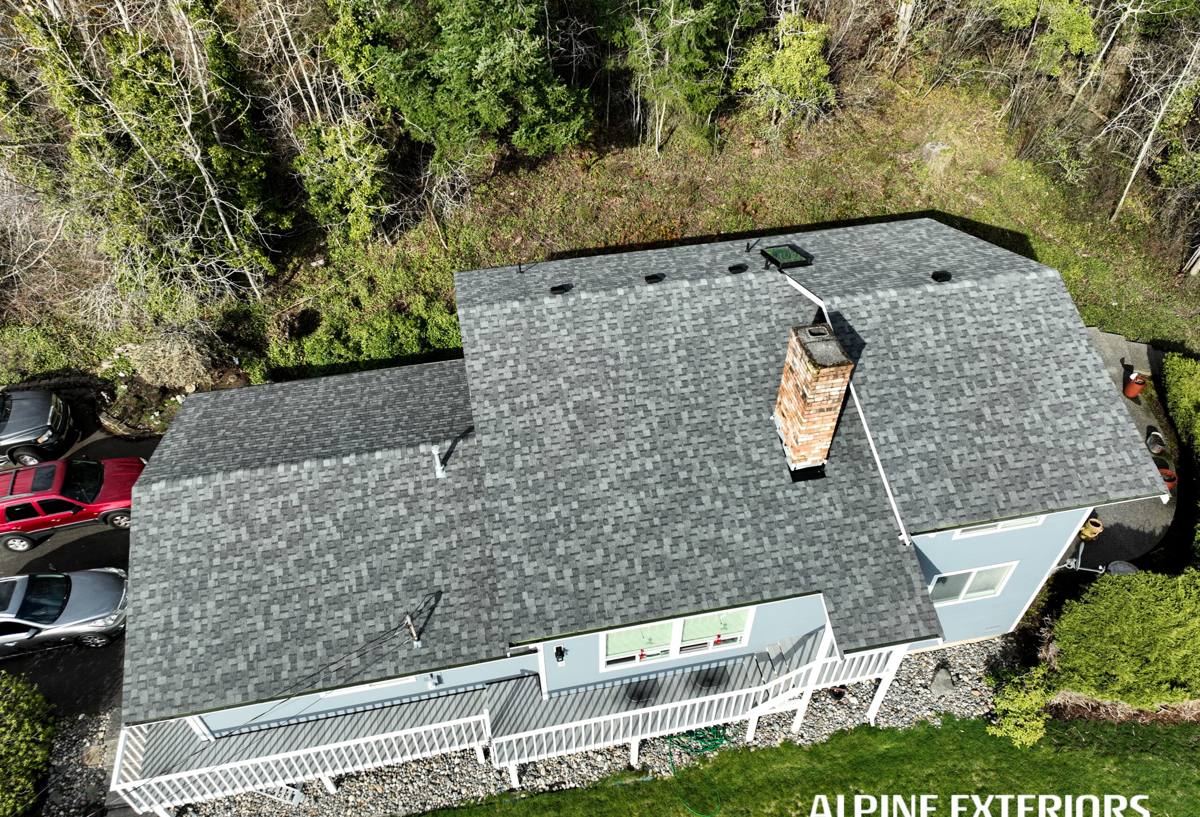
What a Correct New Roof Installation Actually Involves
A new roof is more than removing old shingles and nailing down new ones. In a climate like Custer's, the parts you don't see after the job is done are the parts that determine whether the roof lasts 15 years or 30.
Full Tear-Off and Deck Inspection
We don't install over old roofing. A full tear-off lets us actually see the roof deck — plywood or OSB sheathing that, in older Whatcom County homes, has sometimes taken on moisture damage from years of slow leaks or condensation. Soft, delaminated, or stained decking gets replaced before anything new goes down. Skipping this step is one of the most common shortcuts in the trade, and it's the one most likely to cause an early, expensive failure.
Underlayment Built for Wind-Driven Rain
Standard felt underlayment is not what we recommend for homes exposed to the kind of sideways rain Custer gets off open fields and the water. We use synthetic underlayment with self-adhering ice-and-water membrane at eaves, valleys, and roof-to-wall transitions — the spots where wind-driven rain actually gets pushed uphill under shingles rather than running off.
Ventilation That Matches the Attic, Not a Generic Formula
Proper intake and exhaust ventilation keeps attic humidity down, which slows both moss growth on the roof surface and mold or rot inside the attic. A lot of older homes in this area were built with mismatched or blocked ventilation — vents painted over, insulation stuffed against soffits, or exhaust vents that were never balanced against intake. We check and correct this as part of the install, not as an afterthought.
Roofing Materials: What Holds Up Near Custer's Coastal Air
There's no single "best" roofing material for every home, but some perform noticeably better than others under salt air, moss pressure, and heavy seasonal rain. Fasteners and flashing matter as much as the field material — we use corrosion-resistant fasteners on every job out here regardless of what's on top, because standard galvanized nails can start showing rust streaks within a few years this close to the water.
| Material | Moss Resistance | Salt Air / Corrosion Behavior | Typical Lifespan Here |
|---|---|---|---|
| Architectural asphalt shingle | Good with zinc/copper strips; fair without | Fasteners and flashing need corrosion-resistant hardware | 20–30 years |
| Standing seam metal | Excellent — sheds moss with slope and slick surface | Needs marine-grade or coated fasteners near the coast | 40+ years |
| Synthetic/composite shingle | Good, low water absorption | Handles salt air well; check manufacturer warranty terms for coastal use | 30–50 years (varies by product) |
| Basic 3-tab asphalt shingle | Fair to poor — more prone to moss retention in shaded areas | Standard hardware corrodes faster without upgrades | 15–20 years |
We install architectural asphalt, standing seam metal, and synthetic composite systems, always paired with zinc or copper moss-control strips near the ridge on shingle roofs and corrosion-rated fasteners throughout. We steer homeowners away from bare 3-tab shingle on heavily shaded, moss-prone lots — not because it's a bad product everywhere, but because it carries a shorter, harder-maintenance life in this specific kind of exposure, and we'd rather tell you that upfront than sell you a roof you'll be fighting moss on every spring.
Our New Roof Installation Process
- On-site inspection and measurement — we walk the roof, check the attic, and assess deck condition, ventilation, and existing flashing before quoting anything.
- Written estimate with material options — you see the actual product lines, underlayment spec, and ventilation plan, not a vague line item.
- Permitting — pulled through the appropriate local jurisdiction before work starts.
- Tear-off and deck repair — old roofing removed, deck inspected, any damaged sheathing replaced.
- Underlayment and flashing installation — ice-and-water membrane at vulnerable points, new flashing at chimneys, valleys, and wall transitions.
- Field material installation — shingles, metal panels, or composite installed to manufacturer spec, with corrosion-resistant fasteners.
- Ventilation correction — intake and exhaust balanced, blocked vents cleared or replaced.
- Final walk-through and cleanup — magnetic sweep for stray fasteners, debris hauled off, and a review of the finished roof with you before we consider the job done.
Flashing and Detail Work That Gets Skipped Elsewhere
Most roof leaks don't happen in the open field of shingles — they happen at transitions: chimneys, skylights, dormers, sidewalls, and valleys. In a climate that pushes rain sideways for a good chunk of the year, undersized or reused flashing is a slow leak waiting to happen. We install new step flashing, counter-flashing, and valley metal on every new roof rather than reusing old pieces, and we pay particular attention to any roof-to-wall intersection where siding meets roofline, since that's a common failure point on homes throughout Ferndale and the surrounding county.
Cost Factors for a New Roof in Custer
We don't quote a number without seeing the roof, but the honest cost drivers on almost every job are the same:
| Factor | Why It Moves the Price |
|---|---|
| Roof size and pitch | Steeper roofs take longer, need more safety setup, and use more material per square |
| Number of layers to remove | Some older homes have more than one roof layer stacked, which adds tear-off labor and disposal cost |
| Deck condition | Rotted or delaminated sheathing found during tear-off adds material and labor to replace |
| Material choice | Asphalt, metal, and composite carry different material and labor costs, with metal typically the highest upfront and longest-lived |
| Roof complexity | Valleys, dormers, skylights, and multiple roof planes all add flashing work and time |
| Ventilation and flashing corrections | Fixing pre-existing ventilation or flashing problems is worth the added cost to protect the new roof |
Broadly, a straightforward asphalt shingle re-roof on an average-size home runs in the mid-thousands, while metal or premium composite systems run higher given their material cost and lifespan. Complexity, deck repair, and material choice can move that range significantly in either direction, which is why we always inspect before quoting.
Checklist: What to Confirm Before You Sign a Roofing Contract
- Is the bid a full tear-off, or does it quote installing over existing layers?
- Does the estimate specify underlayment type, not just shingle brand?
- Is ice-and-water membrane included at eaves, valleys, and wall transitions?
- Are corrosion-resistant fasteners specified, given the coastal exposure here?
- Is attic ventilation being assessed and corrected as part of the job?
- Are new flashing components included, rather than reusing old flashing?
- Is the contractor licensed and insured, and will they provide proof in writing?
- What's covered under workmanship warranty versus manufacturer material warranty, and for how long?
Why a Crew That Already Works Custer Makes a Difference
A roofing crew that regularly works Custer and the Ferndale area already knows which details matter here — the moss pressure on shaded, tree-lined lots, the corrosion rate on standard fasteners this close to salt air, and the wind-driven rain patterns that expose weak flashing. That's not something you pick up from a general roofing manual; it's something you learn from doing the work in this specific place, season after season. It also means faster response if something needs a look after a storm, and a crew that isn't guessing at local permitting or code requirements.
After Installation: Keeping Moss and Salt Air From Shortening the Roof's Life
A correctly installed roof still benefits from basic upkeep in this climate. Keep gutters clear so water isn't backing up under the roof edge. Trim back overhanging branches to cut down on the shade and debris that feed moss growth. Have the roof looked at every couple of years, especially after a hard windstorm, to catch lifted shingles or displaced flashing before they turn into a leak. None of this is complicated, but skipping it is how a well-built roof ends up needing early repairs anyway.
If you're planning a new roof in Custer or anywhere around Ferndale, we're glad to come take a look and give you a straightforward, no-pressure estimate — just fill out the form below.