 Ferndale
 Why Siding Choice Matters More in Sumas Than It Looks Like It Should
Sumas sits at the far northern edge of Whatcom County, tucked into the Nooksack River valley right up against the Canadian border. It's a small, low-lying town, and that geography matters: valley towns like Sumas tend to trap moisture. Morning fog sits longer here than it does on higher ground, damp air lingers under tree cover and along fence lines, and the same driving rain that soaks the rest of northwest Washington rolls through with less wind to dry it back out. Add a marine air mass moving in off the Sound that carries salt-tinged moisture even this far inland, and you've got a climate that is, frankly, hard on exterior building materials.
None of that is dramatic on its own. A little fog, a little rain, a little shade — normal Pacific Northwest stuff. But siding doesn't fail from one bad week. It fails from thousands of repeated freeze-thaw and wet-dry cycles over years, and Sumas gets more of those cycles than most towns its size because the moisture simply doesn't leave as fast. That's the whole case for choosing the right siding material here, and it's the reason this page exists as its own thing rather than a copy-paste of a general siding page.
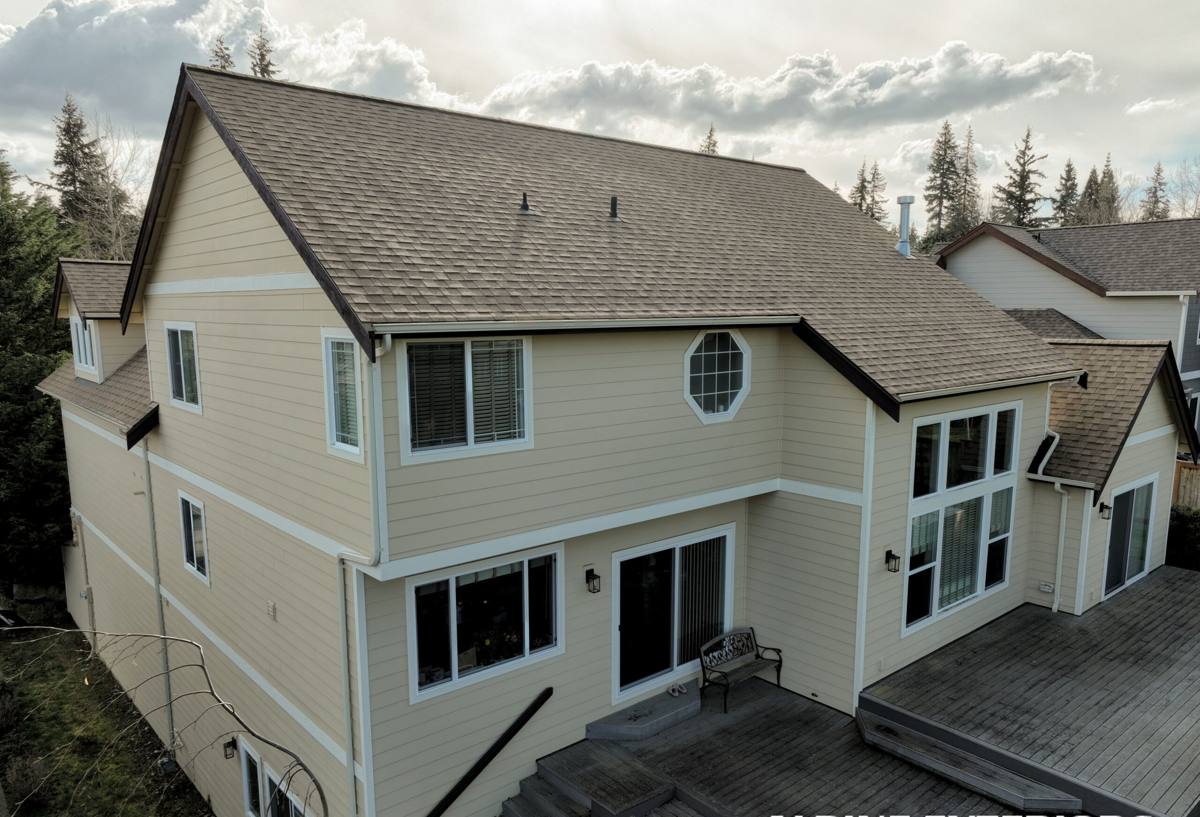
What This Climate Actually Does to Siding Over Time
Moss and Biological Growth
Moss needs three things: moisture, shade, and time. Sumas offers all three in abundance during the long stretch from fall through spring. On wood-based or wood-fiber siding products, moss and algae don't just sit on the surface — they hold water against the material, which accelerates rot underneath a coating that looks fine from the driveway. On siding with the wrong paint system or exposed seams, that moisture works its way behind the surface long before a homeowner sees a visible problem.
Driving Rain and Wind-Driven Moisture
Rain that comes straight down is manageable for almost any siding. Rain that comes sideways — which is standard weather here for weeks at a stretch — finds every gap, every under-lapped seam, and every place where flashing was skipped to save time. This is where installation quality starts to matter as much as the material itself.
Swelling, Cupping, and Paint Failure
Materials that absorb moisture expand. Materials that expand and contract repeatedly eventually cup, crack at the joints, or push paint and caulk loose. This cycle is slow — it can take a few years to show up — which is exactly why it catches homeowners off guard on siding that looked good at installation.
Why We Install Only James Hardie Fiber Cement
We get asked fairly often why we don't offer a lower-cost alternative alongside Hardie. The honest answer is that we've made a professional judgment call: for this climate, fiber cement that's engineered for high-moisture regions outperforms the alternatives enough that we don't want our name on anything else.
James Hardie makes climate-specific product lines — HZ5 and HZ10 — engineered around moisture exposure and temperature swings by region. Whatcom County falls into a zone where that engineering matters: the board is formulated to resist moisture absorption and swelling better than standard fiber cement or wood-based siding, and it carries a factory-applied ColorPlus finish baked on under controlled conditions rather than field-painted after installation. That finish resists fading and holds up to repeated wet-dry cycling better than site-applied paint, which matters a lot in a place where paint gets tested every winter.
Fiber cement itself is also non-combustible, which is worth mentioning even in a wet climate — wildfire smoke and ember exposure have become a real-season concern across Washington in recent years, and it's one more reason we don't want to compromise on the base material.
What This Means We Don't Install
We don't install vinyl, LP SmartSide, or primed wood siding products like spruce or cedar as our standard offering. Each of those has legitimate strengths — vinyl is inexpensive and low-maintenance in dry climates, engineered wood products can look and cost less than fiber cement, and cedar has a natural look plenty of homeowners love. But vinyl can warp and doesn't hold paint if you ever want to change color; engineered wood products depend heavily on sealed edges and gutters staying clear to avoid moisture intrusion at seams; and cedar requires an ongoing maintenance commitment — refinishing, sealing, moss treatment — that most homeowners underestimate until they're several years in. In a moisture-heavy valley climate like Sumas's, those trade-offs show up faster than they would somewhere drier.
Siding Materials Compared for This Climate
| Material | Moisture Behavior | Moss/Algae Resistance | Maintenance Load Here |
|---|---|---|---|
| James Hardie Fiber Cement | Minimal absorption, engineered HZ formulation | Good; factory finish resists staining | Low — periodic rinse, no repainting |
| Vinyl | Doesn't absorb, but can warp/gap with temperature swings | Moderate; grime and mildew visible on surface | Low, but limited repair/color options |
| LP SmartSide / Engineered Wood | Absorbs at cut edges and seams if not sealed | Moderate; depends on coating upkeep | Moderate — edge sealing, gutter vigilance |
| Cedar / Primed Spruce | Absorbs readily; needs consistent sealing | Poor without regular treatment | High — refinishing and moss removal cycle |
What a Correct Fiber Cement Installation Actually Involves
Fiber cement is only as good as the installation behind it. Most of the failures we get called out to inspect on other contractors' work aren't the material's fault — they're shortcuts taken during installation that only show up once water gets behind the board.
The Non-Negotiables
- Correct clearances from grade, decks, and roof lines per the manufacturer's installation manual — not "close enough"
- A properly lapped weather-resistant barrier behind the siding, with flashing at every window, door, and penetration
- Manufacturer-specified fastener type, spacing, and depth — over-driven or under-driven nails are one of the most common defects we find
- Correctly sized gaps at butt joints and trim, sealed with a compatible sealant rated for exterior movement
- Field-cut edges primed or sealed before installation, especially in a climate that doesn't give cut edges time to dry out
None of this is exotic. It's the difference between following the installation manual and eyeballing it. Because Hardie's warranty structure is tied to correct installation, cutting corners here doesn't just risk performance — it can put the manufacturer's warranty coverage at risk too.
Our Process for a Sumas Project
- On-site assessment — we look at existing siding condition, sheathing, trim, and any moisture damage already present before we ever talk numbers.
- Tear-off and sheathing check — old siding comes off and we inspect what's underneath. This is often the first time a homeowner sees moisture damage that was hidden behind their old siding.
- Weather barrier and flashing — installed or repaired to current standards before a single piece of new siding goes up.
- Installation to Hardie's spec — correct clearances, fastening, and joint treatment, not a generalized "how we always do it."
- Trim, caulking, and touch-up — joints sealed, cut edges finished, and any field-painted trim matched to the ColorPlus system.
- Final walkthrough — we go over the finished job with the homeowner before calling it done.
Cost Factors for a Sumas Fiber Cement Project
| Factor | Why It Moves the Price |
|---|---|
| Home size and wall complexity | More square footage and more corners/gables mean more cutting and labor |
| Tear-off scope | Removing and disposing of old siding, especially if it's layered over a prior product |
| Sheathing or moisture repair | Damage found once old siding is off is common in older homes and adds to the scope |
| HZ5 vs. HZ10 product line | Climate-zone-specific formulations are priced differently |
| Trim and accessory choices | Fascia, trim boards, and soffit work add to the total beyond the field siding itself |
| Access and site conditions | Steep grades, tight lot lines, or multi-story sections affect labor time |
We won't quote a number without seeing the house — anyone who does that off a phone call is guessing. What we can say honestly is that fiber cement typically costs more up front than vinyl or engineered wood, and less over a 20-30 year horizon once you account for repainting, edge repair, and moss remediation that those products tend to need along the way.
Living With Fiber Cement Siding in a Damp, Mossy Climate
Correctly installed Hardie siding is low-maintenance, not zero-maintenance. A little seasonal attention goes a long way toward getting the full lifespan out of it.
- Rinse the siding once or twice a year, especially on shaded, north-facing walls where moss and grime build up fastest
- Keep gutters clear so overflow doesn't run down the siding face during heavy rain events
- Trim back shrubs and trees that keep siding sections in constant shade and dampness
- Inspect caulking at joints and trim every couple of years and re-seal anything that's cracked or pulled away
- Address any impact damage promptly rather than letting a chip sit exposed through a wet winter
Why It Matters to Hire a Crew That Already Works This Area
A crew unfamiliar with valley climates like Sumas's can install fiber cement by the book and still get the clearances wrong for local conditions, or miss that a shaded, low wall section needs a different approach than the sun-facing side of the same house. Local experience means we already know which walls in this kind of setting take the worst of the moss and moisture, which details tend to get skipped by out-of-area crews working from a generic playbook, and how to sequence a project around the region's rain windows instead of fighting them. It also means we're not disappearing after the invoice clears — warranty support and follow-up on a Hardie installation are a lot more useful from a contractor who's still working in your area next year.
If you're weighing siding options for a home in Sumas, we're glad to come take a look and give you a straight, no-pressure estimate — no obligation, and no pressure to sign anything on the spot. Use the form below to get started.