 Ferndale
 Why Blaine Decks Wear Out Faster Than the Manual Says
Decks in Blaine take a different kind of beating than decks twenty miles inland. Sitting this close to the water means salt-laden air settles into every joint, fastener, and cut end of a deck almost daily. That salt air speeds up corrosion in hardware and accelerates the breakdown of finishes, even on decks that are only a few years old. Add in Whatcom County's driving rain — the kind that comes in sideways off the water rather than straight down — and you get moisture forced into places a standard deck design never accounts for: under rail posts, behind fascia boards, and into end grain that wasn't sealed when the deck was built.
Then there's moss season, which in this part of Washington isn't really a season so much as most of the year. Shaded decks, north-facing decks, and decks tucked under trees stay damp longer than they dry, and moss and algae take hold in the grain of wood decking and in the surface texture of some composite boards. Moss holds moisture against the deck surface, which is exactly the condition that rots framing and delaminates lower-grade composite from the inside out.
None of this means a deck in Blaine can't last. It means the deck has to be built and replaced with these specific conditions in mind, not with a generic approach that works fine forty miles from the coast.
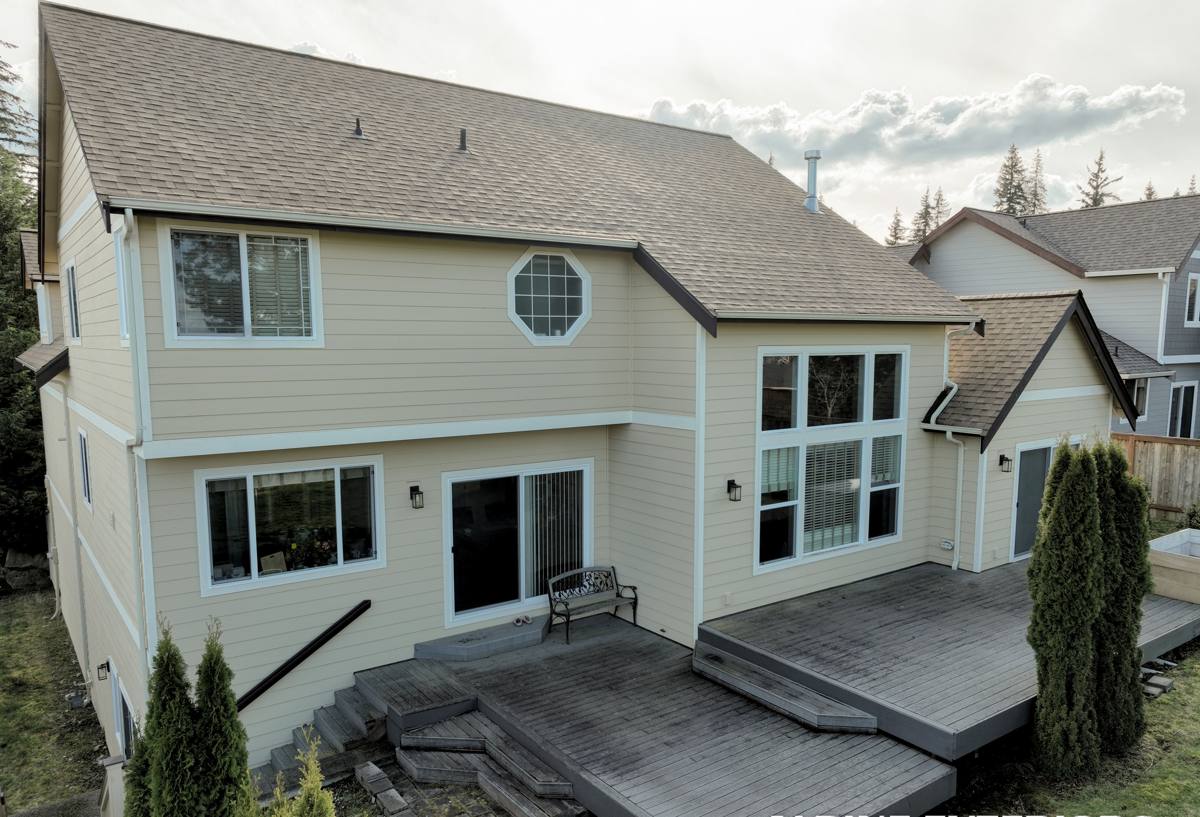
Signs a Blaine Deck Needs Replacement, Not Just Repair
Homeowners often ask us to fix a board or two, and sometimes that's genuinely all that's needed. But there's a point where patching a deck is just delaying a full replacement, and doing it costs more in the long run than starting fresh. Here's how we tell the difference during an inspection.
- Soft or spongy spots in decking, especially near the house where rain runoff collects
- Rust streaking from fasteners or visible corrosion on structural brackets and hangers
- A ledger board (where the deck attaches to the house) that shows staining, softness, or gaps at the flashing
- Persistent moss or black staining that comes back within weeks of cleaning
- Posts or footings that feel loose, or a deck that has visible sway when walked on
- Widespread cupping, splitting, or checking across most of the decking, not just a board or two
If the issues are limited to a handful of boards and the framing underneath is solid, repair makes sense. If the framing, ledger, or footings are compromised — which is common on older Blaine decks that were never flashed correctly for this climate — replacement is the honest recommendation, even if it's not the answer a homeowner was hoping for.
What a Correct Deck Replacement Actually Involves
A deck replacement done right is not just pulling up old boards and screwing down new ones. In a coastal, high-rainfall area like Blaine, the parts you don't see matter more than the decking itself.
Ledger and Flashing
The ledger board connection to the house is the single most common failure point we find on older decks here. Correct flashing — a metal or membrane barrier that directs water away from the ledger and the house's wall assembly — is what keeps driving rain from working its way behind the siding over time. On a replacement, we treat this connection as non-negotiable, even when it adds a step other crews might skip.
Framing and Fasteners
Given the salt air here, we use fasteners and structural hardware rated for corrosive, coastal environments, not standard galvanized hardware that's fine inland but starts rusting within a couple of seasons near the water. Joists, beams, and posts get sized and spaced to current code, not just matched to whatever was there before.
Footings
Whatcom County's wet ground conditions mean footing depth and drainage matter. We evaluate existing footings rather than assuming they're adequate, since older decks were sometimes built with minimal or shallow footings that don't hold up over decades of saturated soil.
Ventilation and Drainage Underneath
Low decks with poor airflow underneath trap moisture and encourage rot from below — a problem that's worse in shaded, damp yards. Where clearance allows, we build in ventilation gaps and grade the ground beneath the deck to shed water instead of holding it.
Choosing Decking Material for Blaine's Coastal Conditions
There's no single "best" decking material — there's a best material for this climate and this budget. We walk every Blaine homeowner through the real trade-offs instead of pushing whatever's easiest to install.
| Material | How It Handles Salt Air & Moisture | Moss & Algae Resistance | Maintenance |
|---|---|---|---|
| Pressure-treated wood | Needs regular sealing to resist moisture intrusion at cut ends and fastener holes | Low — moss takes hold in grain without regular cleaning | Annual cleaning and re-sealing recommended |
| Cedar | Naturally moisture-resistant but still needs finish maintenance near the water | Moderate — better than treated pine, still needs upkeep in shaded areas | Periodic cleaning and oil or sealant |
| Composite decking | Good moisture resistance; quality varies significantly by product line | Better on capped composites; uncapped boards can still stain | Low — occasional washing |
| PVC decking | Excellent — doesn't absorb moisture or salt | Highest resistance; smooth surface sheds moss more easily | Lowest — soap and water cleaning |
We're honest about where lower-cost composite and treated wood fall short in this specific environment: they can work, but they demand more upkeep from the homeowner to actually get their expected lifespan out of them here. For decks that get heavy shade, direct salt exposure, or sit low to damp ground, we typically steer clients toward capped composite or PVC — not because treated wood or cedar are bad products, but because the maintenance burden in Blaine's climate is real and worth knowing upfront.
Our Deck Replacement Process
- On-site inspection — we assess the existing deck, ledger connection, framing, and footings, and take note of drainage and sun/shade exposure specific to your property.
- Honest scope and material recommendation — you get a clear picture of what needs replacing versus what can stay, and material options suited to your home's exposure.
- Demolition and disposal — full removal of the old deck, checked for any hidden rot or damage to the house structure that needs addressing before rebuilding.
- Framing, flashing, and footings — built to current code with coastal-grade hardware and correct ledger flashing.
- Decking, railing, and finish work — installed to manufacturer spec, with attention to fastener placement and board spacing for proper drainage and expansion.
- Final walkthrough — we go over the finished deck with you, including what maintenance it will need going forward.
Permits and Code Considerations in Whatcom County
Deck replacements that involve structural changes — new footings, a different attachment point, or a larger footprint — typically require a permit in Whatcom County. Even a like-for-like replacement can trigger a permit requirement if the original deck was never permitted or doesn't meet current guardrail and stair code. We handle the permit process as part of the job rather than leaving it for the homeowner to sort out, and we build to current code even when replacing a deck that technically predates it.
Maintaining Your New Deck Through Moss Season
A well-built deck still needs some seasonal attention in this climate. A few habits go a long way toward protecting your investment:
- Sweep debris and standing water off the deck surface regularly, especially in shaded corners
- Rinse off salt residue and organic buildup a few times a year, more often if the deck is close to the water
- Keep gutters and downspouts clear so runoff isn't dumping extra water onto or near the deck
- Trim back overhanging branches to cut down on shade and debris that feed moss growth
- Inspect fasteners and railing connections once a year for early signs of corrosion or loosening
Why a Crew That Already Works Blaine Matters
Deck replacement isn't a one-size-fits-all job, and a crew that mostly works inland won't automatically think about ledger flashing for driving rain off the water, corrosion-rated hardware for salt air, or drainage details that keep moss from taking over a shaded deck. We work throughout Whatcom County, including Blaine specifically, so these aren't theoretical concerns to us — they're what we plan for on every deck replacement in this area. That local familiarity shows up in the details: where we put flashing, what hardware we spec, and which materials we actually recommend versus which ones we just sell.
Get a Free, No-Pressure Estimate
If your deck is showing its age — soft boards, rust stains, moss that won't quit, or a ledger connection you're not sure about — we're happy to take a look. The estimate is free, there's no pressure, and you'll get a straight answer about whether repair or replacement is the right call for your Blaine home. Use the form below to get started.