 Ferndale
 Siding Installation Is a Different Job in Blaine Than It Is Twenty Miles Inland
Blaine sits at the northern edge of Whatcom County, right up against Semiahmoo Bay and Drayton Harbor, close enough to the Canadian border that it catches Pacific weather systems before they've lost much force. That position means homes here deal with salt-laden air, driving rain that arrives sideways instead of straight down, and a moss season that can run most of the year on shaded walls. None of that changes what siding installation is on paper — it's still about fastening a cladding system to a wall correctly — but it changes how much margin for error a crew actually has. A shortcut that might go unnoticed for a decade on a sheltered inland lot can show up as staining, soft trim, or a failed seam within a couple of winters here.
This page is about the installation itself: what a full siding install for a Blaine home should involve, what our process looks like from first call to final walkthrough, and why hiring a crew that already knows this stretch of coastline matters more than it would somewhere drier and calmer. We install James Hardie fiber cement exclusively, and everything below is written around that system, since it's the only one we put our name behind here.
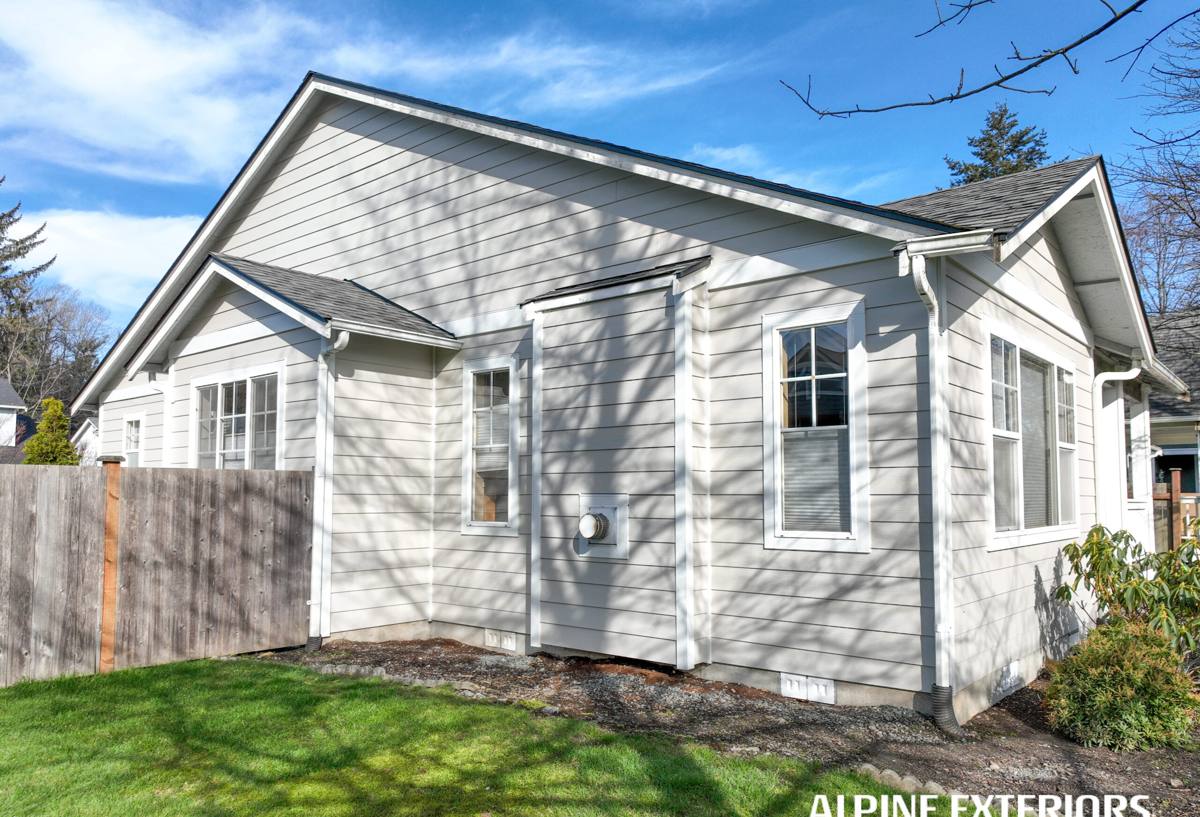
What Blaine's Climate Asks of an Installation
Salt Air and Hardware Choices
Homes anywhere near the bay or harbor in Blaine take on salt-laden air as a routine condition, not an occasional storm event. Salt speeds up corrosion on fasteners, flashing, and exposed trim hardware, and it does it faster the closer a house sits to open water. Choosing standard-grade fasteners because they're cheaper or easier to source is a decision that shows up later as rust streaking down the face of the siding and trim that loosens well ahead of schedule.
Wind-Driven Rain
Storms coming off the water don't just fall — wind pushes the rain sideways into panel joints, window flashing, and the seams where trim meets field siding. That sideways load stresses a wall assembly harder than the same rainfall total would in a calm climate, which means the water-resistive barrier underneath the siding, and how carefully it's lapped and taped at every penetration, carries more of the burden than the siding material itself.
A Long Moss and Mildew Season
Mild temperatures paired with near-constant moisture add up to a growth season that can run most of the year on north-facing and tree-shaded walls. Any wall that stays damp longer than it needs to becomes a growth surface eventually. Installation detail affects that directly — clearance at the bottom of the wall, a functioning drainage plane, and siding that isn't crowded tight against trim all give a wall the chance to dry out between wet spells instead of staying damp continuously.
What a Full Siding Installation Includes
A siding installation is more than fastening panels to a wall. Done correctly, it's a sequence of steps that each protect the ones that come after them:
- Tear-off and substrate inspection: Removing the old siding and checking the sheathing underneath for rot, soft spots, or prior water damage before anything new goes on.
- Repair of any damaged sheathing or framing: Covering over a compromised substrate just locks the problem behind new siding instead of fixing it.
- Water-resistive barrier installation: A correctly lapped and taped barrier, installed shingle-style so every seam sheds water downward.
- Flashing at every penetration: Windows, doors, hose bibs, vents, and light fixtures each need flashing detail sized and installed to that specific penetration.
- Drainage plane or rain screen setup: A gap behind the siding that lets any moisture that does get past the surface drain and evaporate instead of sitting against the sheathing.
- Panel installation to manufacturer spec: Correct fastener type, spacing, and clearance above grade, roofline, and decks.
- Sealing of field-cut edges: Any panel cut on site needs its cut edge sealed before it goes up.
- Trim, caulking, and final detailing: The visible finish work, done last so it isn't disturbed by anything that comes after.
Our Installation Process
Assessment and Estimate
We start with a walk-around of the home, looking at the existing siding condition, the substrate where it's visible, drainage around the foundation, and anything specific to the lot — tree cover, sun exposure, proximity to the water — that affects how the new siding needs to be detailed. That assessment is where the estimate comes from, not a generic square-footage number.
Product and Color Selection
We walk homeowners through the relevant James Hardie product lines and ColorPlus finish options for their home, factoring in sun exposure and how much of the house sees direct weather off the water.
Scheduling Around Whatcom County Weather
Siding installation goes faster and holds up better when it isn't fighting active rain. We plan install windows around the local forecast where we can, and we sequence the work so that any exposed sheathing is covered as quickly as possible rather than left open overnight.
Installation and Daily Cleanup
The crew works section by section — tear-off, barrier, flashing, and panels — rather than stripping the whole house at once, which limits how much of the home is ever exposed to weather at a given time. Job sites are cleaned up at the end of each day.
Final Walkthrough
Once the installation is complete, we walk the finished job with the homeowner, checking trim lines, caulking, and clearances, and answering any questions about care and maintenance going forward.
Why We Install Only James Hardie Fiber Cement
We don't offer a menu of siding brands. We install James Hardie fiber cement, and we won't install LP SmartSide, vinyl siding, Cemplank, Allura, primed spruce, or cedar. That's a professional standard, built from watching how different products perform — or don't — in a climate this consistently wet and salty, not a supplier arrangement.
- Non-combustible core: Fiber cement doesn't feed a fire the way wood-based siding can, which matters for both safety and insurance considerations.
- Factory-applied ColorPlus finish: Color is baked on under controlled factory conditions instead of brushed on in the field, holding up longer against fading and moisture exposure.
- Climate-engineered HZ formulation: Hardie's HZ5 product line is built for regions with sustained moisture and freeze-thaw cycling, which describes coastal Whatcom County well.
- Dimensional stability: Fiber cement doesn't swell, cup, or warp the way engineered wood products can after repeated wet-weather exposure.
- Strong transferable warranty: Backed by a solid warranty structure, provided the installation follows Hardie's spec — which is exactly why installation quality matters as much as the material choice.
Cost Factors for a Blaine Siding Installation
| Factor | Why It Affects the Job |
|---|---|
| House size and wall complexity | More corners, dormers, and roof-to-wall transitions mean more flashing detail and labor time. |
| Substrate condition | Rot or water damage found during tear-off adds repair work before new siding can go on. |
| Product line and finish | HardiePlank, HardiePanel, and HardieShingle carry different material costs, and ColorPlus finish options vary by line. |
| Access and site conditions | Tight lots, tall walls, or difficult staging near the water can add time and equipment needs. |
| Trim and detail work | Custom trim packages and additional flashing at windows and penetrations add labor beyond basic panel installation. |
| Removal and disposal | Tear-off volume and disposal of old siding, especially older materials, factor into the total. |
We give a firm estimate after the walk-around assessment, not a rough number over the phone, because the factors above vary enough from house to house that a generic quote isn't useful to anyone.
Why Local Installation Experience Matters in Blaine
A crew that has installed siding on other homes in Blaine has already worked out the details that matter here: how tight to run clearances given the local drainage patterns, which sides of a house take the worst of the wind-driven rain, and how much a lot's tree cover or water exposure should change the flashing and drainage plane detail. That's not something a crew coming from a drier, more sheltered part of the state necessarily has dialed in on their first job here. Familiarity with the town also means a clearer sense of realistic timelines around the wetter months, and fewer surprises once tear-off starts.
Questions to Ask Before Hiring a Siding Installer
- Are they installing to the manufacturer's published spec, including fastener type, spacing, and clearances — not a shortened version of it?
- Do they inspect and repair the substrate before installing new siding, or just cover what's there?
- What does their water-resistive barrier and flashing detail look like at windows, doors, and other penetrations?
- Have they worked on homes in Blaine or similarly exposed coastal areas of Whatcom County before?
- Does the estimate come from an actual walk-around, or a rough number given without seeing the house?
- Is the manufacturer's warranty something they can speak to specifically, including what would void it?
Getting Started
If your Blaine home needs new siding — whether it's aging, showing damage, or you're planning ahead of a problem rather than reacting to one — we're glad to walk the property, look at what's actually going on, and put together a straightforward estimate. No pressure, no generic phone quote, just a clear look at what the job actually involves for your house.