 Ferndale
 Siding Repair in Blaine Isn't the Same Job as Siding Repair Inland
Blaine sits at the far northern edge of Whatcom County, close enough to Semiahmoo Bay and Drayton Harbor that salt-laden air reaches most homes in town, not just the ones with a water view. Add in the driving rain that blows ashore with real wind behind it and a moss season that barely lets up most of the year, and you have a set of conditions that ages exterior siding faster and less predictably than what a home twenty or thirty miles inland deals with. A repair that would hold up fine in a drier, more sheltered part of the county can fail again within a season or two out here if it doesn't account for what the climate is actually doing to the wall.
We're based in Ferndale, and Blaine is regular territory for our crew rather than an occasional stop between bigger jobs elsewhere. That matters for repair work specifically, because diagnosing siding damage correctly depends on knowing what normal wear looks like in this climate versus what's an early warning sign. This page covers what Blaine homes typically need from a siding repair, what separates a repair done right from one that just covers up a problem, and how we approach that work.
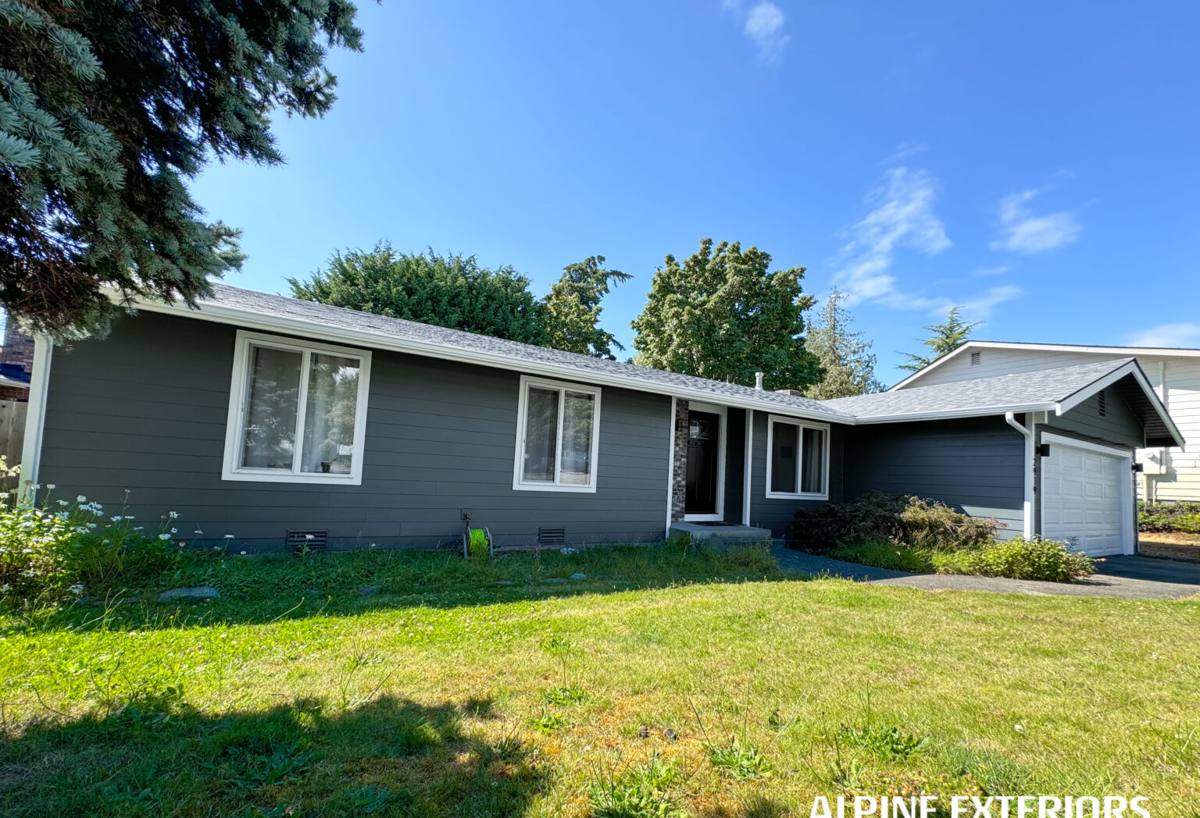
What Blaine's Climate Does to Siding Over Time
Salt Air Off the Water
Homes near Semiahmoo Bay or Drayton Harbor take on salt-laden air as a near-daily condition. Salt accelerates corrosion on fasteners, flashing, and any exposed trim hardware, and it breaks down lower-grade paint and coatings faster than a dry inland climate ever would. When we're called out to look at damaged siding in Blaine, corroded fasteners or rusted flashing are frequently part of what's actually causing the problem, not just the visible siding damage itself.
Wind-Driven Rain
Storms coming off the water rarely drop rain straight down on a Blaine home. Wind pushes it sideways into panel joints, window and door flashing, and the transitions where a roofline meets a wall. That sideways load finds gaps a straight-down rain never would, which is why damage in Blaine often shows up first at joints, corners, and trim intersections rather than in the middle of a flat wall section.
A Long Moss Season
Mild, damp conditions keep moss and mildew active on shaded or north-facing walls for most of the year. Surfaces that stay wet the longest — under overhangs, behind landscaping, on the north side of a house — are usually where we find the earliest soft spots and coating failure, because sustained moisture is what breaks a siding system down over time, not any single storm.
Signs Your Siding Needs Repair
Some damage is obvious. A lot of it isn't, especially in the early stages, which is part of why homeowners in Blaine often end up dealing with a bigger repair than the one they thought they had. Worth checking for:
- Soft or spongy spots when you press on the siding, especially near the bottom courses or around window and door trim
- Visible cracking, buckling, or warping in individual panels or boards
- Staining or streaking running down from a seam, joint, or fastener location
- Peeling or bubbling paint concentrated in one area rather than spread evenly across the house
- Gaps opening up at seams, corners, or trim joints that weren't there when the siding was newer
- Persistent moss or mildew growth in the same spot season after season, rather than surface growth that washes off easily
- Rust streaking below fasteners or metal flashing
Any one of these can be minor on its own. Several of them showing up together, or damage that keeps returning to the same spot after cleaning, usually means moisture has already gotten past the surface and is doing damage you can't see yet.
Repair or Replace? How We Make That Call
Not every damaged section needs a full re-side, and not every problem is fixable with a patch. The honest answer depends on how far the damage has spread and what's underneath it.
| Factor | Favors Repair | Favors Replacement |
|---|---|---|
| Extent of damage | Isolated to one panel or small area | Spread across multiple sections or an entire wall face |
| Sheathing condition | Dry and sound underneath | Soft, stained, or rotted sheathing found on inspection |
| Age of existing siding | Relatively new, isolated impact damage | Original siding is old and the rest is likely to fail soon anyway |
| Underlying material | Existing Hardie siding in otherwise good condition | Existing product is one we don't install (LP SmartSide, vinyl, Cemplank, Allura, primed spruce, cedar) and is failing broadly |
| Cost over time | Lower upfront cost for a contained fix | Often lower cost over the life of the house than repeated patch repairs |
Cost for an isolated repair is typically a modest fraction of a full re-side, but that only holds true if the damage really is isolated. A patch installed over sheathing that's already compromised, or matched to a siding product that's failing across the whole house, tends to buy a homeowner a year or two before the same problem reappears somewhere close by.
What a Correct Siding Repair Involves
A repair that just replaces the visible damaged piece and stops there is the most common way we see repairs fail again. Doing it right means treating the damaged area as a chance to inspect and correct what's underneath, not just cover it.
Find the Actual Source First
Visible siding damage is often a symptom, not the root cause. Before any material comes off, we look at what's driving the damage — a flashing detail that isn't shedding water correctly, a gap in the water-resistive barrier, a fastener that's corroded and letting moisture track in behind the panel. Replacing the siding without fixing what caused the failure just resets the clock on the same problem.
Check the Sheathing and Barrier Underneath
Once the damaged section is opened up, we check the wall sheathing and water-resistive barrier behind it for softness, staining, or gaps. In a driving-rain climate like Blaine's, this step is what separates a repair that actually solves the problem from one that looks fine for a season and then fails again.
Match the Repair to the Manufacturer's Spec
Fastener type and spacing, joint sealing, and clearance at grade all matter as much on a repair as they do on a full installation. A repair that skips these details because it's "just a patch" tends to be the first spot to fail again.
Color and Finish Match
James Hardie's ColorPlus finish is factory-applied and holds up better over time than field-applied paint, which is part of why a well-matched repair on Hardie siding blends in cleanly rather than leaving an obvious patch. Older or sun-faded sections sometimes need a broader color-matching conversation, which we'll walk through honestly rather than promise a perfect match we can't deliver.
Why We Repair Using James Hardie Fiber Cement — and Nothing Else
We install James Hardie fiber cement siding exclusively, and that standard applies to repair work too. We don't install LP SmartSide, vinyl, Cemplank, Allura, primed spruce, or cedar, which means that when we're called out to repair a home sided in one of those products, we're upfront about what we can and can't do.
- Non-combustible core: matters for both safety and long-term durability, including on repaired sections
- Factory-applied ColorPlus finish: holds color and resists moisture damage better than field-applied paint on a patch
- Climate-engineered HZ formulations: built specifically for regions with sustained moisture exposure like coastal Whatcom County
- Dimensional stability: doesn't swell, cup, or warp the way engineered wood products can after repeated wetting
- Transferable warranty: stays intact when repairs are made to spec, which isn't always true of DIY or off-spec patch jobs
If a homeowner has a small, isolated repair need on a house sided in a different product, we'll say so plainly rather than force a Hardie repair where it doesn't make sense for a single small section. Where damage is widespread, or where a homeowner is already thinking about what comes after a series of repeat repairs, that's usually the point where switching the affected wall — or the whole house — to Hardie starts making more financial sense than continuing to patch a product we've made a professional decision not to install.
Our Process for a Blaine Repair Job
- Inspection: we look at the damaged area and the surrounding siding, not just the spot the homeowner called about, since related damage often shows up nearby before it's obvious
- Diagnosis: we identify what caused the damage, not just what it looks like, and check the sheathing and barrier underneath before quoting the work
- Honest scope: we tell homeowners plainly whether they're looking at a contained repair or something that points toward a larger issue
- Repair to spec: fastener type and spacing, flashing, sealing, and clearance all follow manufacturer installation requirements, not a shortcut version
- Cleanup and follow-up: we leave the site clean and let homeowners know what to keep an eye on afterward, particularly in a climate where moss and moisture are ongoing concerns rather than one-time events
Why It Matters That We Already Work Blaine
A crew that only occasionally works this stretch of Whatcom County has to relearn its climate on every job. We don't. Working Blaine regularly means we've seen how salt air, wind-driven rain, and a long moss season show up on real houses here — where damage tends to start, how fast it spreads, and what a repair actually needs to hold up rather than fail again in a year or two. That local pattern recognition is part of what makes a diagnosis accurate the first time, instead of guessing based on how siding behaves somewhere drier and more sheltered.
It also means we're realistic with homeowners about timelines and priorities. In a coastal town like Blaine, some repairs are urgent — active moisture intrusion doesn't wait — and others can reasonably be scheduled around, and we'll tell you honestly which is which rather than push urgency that isn't there.
A Practical Checklist Before You Call Anyone
- Note where the damage is and whether it's near a corner, seam, window, or roofline — location often points to the cause
- Check whether the area stays damp longer than the rest of the house (shaded, low airflow, near landscaping)
- Look for rust streaking near fasteners or metal flashing, not just the siding itself
- Press gently on suspect areas to check for softness rather than relying on appearance alone
- Take note of how long the damage has been visible — a repair called in early is usually simpler and cheaper than one that's been left to spread
If you're dealing with damaged, soft, or failing siding on a Blaine home, we're happy to take a look and give you a straight answer on whether it's a contained repair or something bigger — no pressure, no upsell. Reach out for a free estimate using the form below.