 Ferndale
 Composite Decking Built for Sudden Valley's Conditions
Sudden Valley sits in a pocket of Whatcom County where the weather doesn't do decks any favors. Homes here deal with long stretches of rain from fall through spring, humidity that never fully clears out, and enough moss and algae pressure to turn an untreated deck green within a season or two. Add in the salt-tinged air that drifts through the region off the nearby waters, and you've got a combination that's hard on wood and unforgiving of sloppy composite installs alike. A deck built for this area needs to shed water fast, resist moisture intrusion at every fastener and seam, and hold its color and footing without constant upkeep.
Composite decking is a strong fit for these conditions when it's installed correctly. It doesn't rot, it doesn't need annual staining, and modern capped boards resist the mold and mildew staining that plague bare wood in a climate like ours. But composite isn't maintenance-free by default — it's maintenance-different, and the installation details matter more here than they would in a drier part of the state.
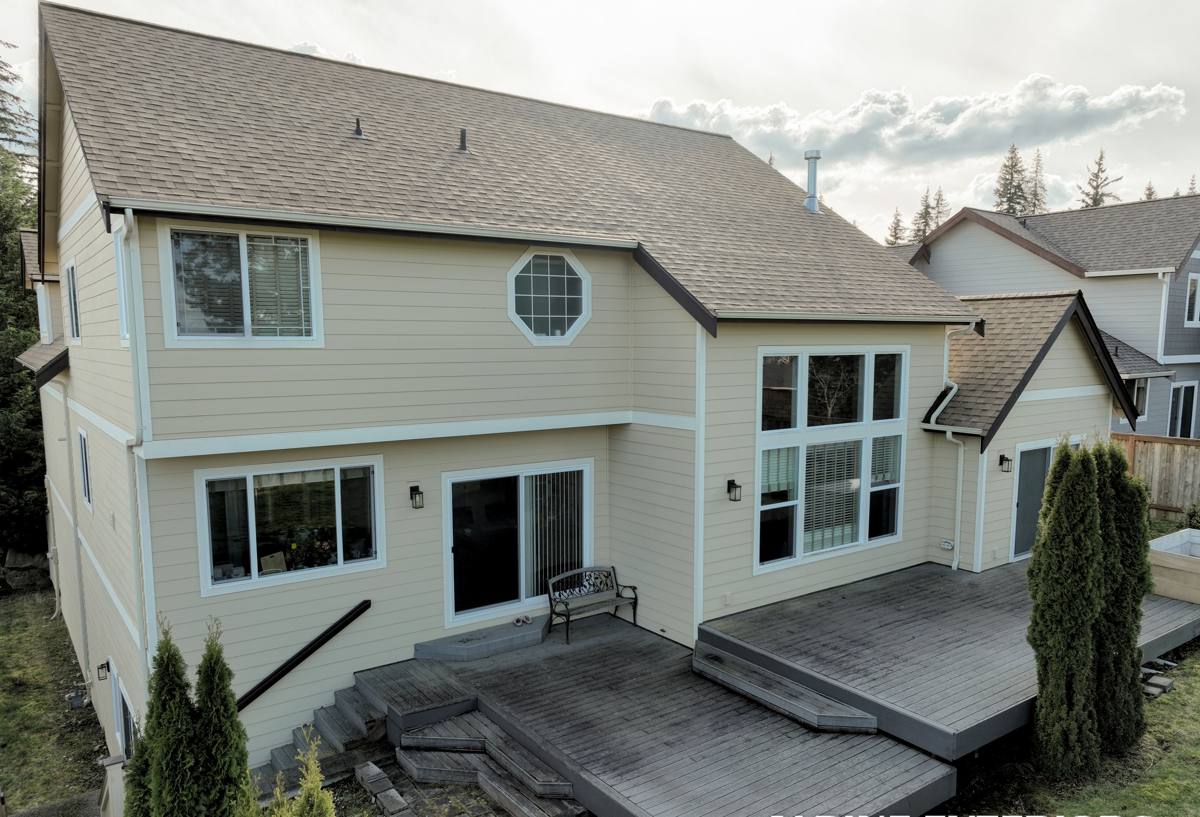
What Whatcom County's Climate Does to a Deck
Driving Rain and Standing Moisture
Sudden Valley gets rain that doesn't just fall straight down — wind off the surrounding terrain pushes it sideways into ledger boards, fascia, and any gap where water can collect. A deck that's pitched wrong, or that lacks a real drainage path underneath, will trap moisture against the substructure even if the decking itself is composite. That trapped moisture is what eventually rots joists, rusts fasteners, and causes boards to feel spongy at the edges even when the surface still looks fine.
Moss and Algae Season
Our moss season isn't a few weeks — it's most of the year. Any deck surface that stays shaded and damp will grow something green on it eventually. Composite boards with a textured, capped surface resist algae growth far better than plain wood or cheap uncapped composite, but board selection and airflow underneath the deck both play a role in how fast growth shows up.
Salt-Touched Air
Homes in and around Sudden Valley get some exposure to salt-laden air carried in off the water. Salt accelerates corrosion on exposed metal — screws, brackets, joist hangers — long before it does anything to the decking boards themselves. This is one of the most overlooked failure points in decks out here: the boards look great for years while the fasteners underneath are quietly corroding.
What a Correct Composite Deck Install Actually Involves
A composite deck is only as good as what's underneath it. We treat the substructure as the part of the job that determines whether the deck lasts fifteen years or thirty.
- Pressure-treated or naturally durable framing lumber, sized correctly for the joist spans your board manufacturer specifies — composite typically needs tighter spacing than wood decking
- Joist tape or a comparable moisture barrier on top of every joist, so fasteners driving through the tape seal rather than sitting in bare, exposed wood
- Stainless or coated fasteners and hardware rated for the corrosion pressure our air puts on exposed metal
- Proper pitch away from the house — usually a slight slope built into the framing, not just hoped for at the surface
- Ventilation gaps and skirting details that let air move underneath the deck instead of trapping humidity against the frame
- Hidden or manufacturer-approved fastening systems installed to spec, since improper fastening is one of the most common causes of composite board warping and buckling
- Flashing at the ledger board where the deck meets the house — this is the single most common point of hidden water damage on any deck, composite or wood
Skip any one of these steps and the composite boards on top can still look perfect while the structure underneath is failing. That's the trap with composite decking in a wet climate — the surface hides problems that wood would show you sooner.
Choosing the Right Composite Product for This Area
Not all composite decking behaves the same way in a wet, moss-prone climate, and we steer clients toward products based on how they actually perform here rather than on price alone.
| Factor | What to Look For in Sudden Valley's Climate |
|---|---|
| Capping | Fully capped boards (top, sides, and often bottom) resist moisture absorption and staining far better than uncapped or partially capped composite |
| Surface texture | A texture that sheds water and doesn't stay slick when wet matters more here than in drier regions — smooth, low-texture boards can get dangerously slick under moss film |
| Core material | Solid or engineered cores with lower moisture uptake hold up better long-term than older wood-plastic composite blends that can swell at cut ends |
| Warranty structure | Check what's covered — fade, stain, and structural warranties often differ, and moisture-related claims are worth reading closely before you buy |
| Fastening system compatibility | Boards should match a fastening system rated for the board thickness and profile, not a generic screw-through installation |
We don't push one brand as universally "best" — the right product depends on your budget, the deck's exposure to sun and shade, and how much upfront cost you want to trade for lower long-term upkeep. What we will say plainly: cutting corners on capping or fastener quality to save money upfront tends to cost more in repairs within five to ten years out here.
Our Process for a Sudden Valley Composite Deck
1. On-Site Assessment
We look at the site's actual exposure — how much sun and shade it gets, where water naturally runs off the roof and yard, and whether the existing structure (if there is one) is salvageable or needs full replacement. Decks tucked into shaded, tree-covered lots need different drainage and airflow planning than decks in more open, sun-exposed spots.
2. Structural Plan
Before any decking goes down, we plan the framing, ledger flashing, and drainage path specifically for this climate — not a generic spec pulled off a manufacturer's minimum installation guide.
3. Installation
Framing and moisture barrier first, then the fastening system and board layout, with attention to expansion gaps — composite expands and contracts with temperature swings, and gaps that are too tight will buckle over time.
4. Finishing Details
Fascia, stair details, railing attachment points, and any transitions where the deck meets the house or existing hardscape get the same moisture-conscious treatment as the main deck field.
5. Walkthrough
We go over basic care with you — what composite needs (periodic washing, mostly) and what it doesn't (staining, sealing) — so you know what to expect in year one versus year ten.
Why Local Experience with Sudden Valley Matters
A deck installed to a generic national spec sheet can still fail here if the crew hasn't accounted for how much rain this area actually sees or how aggressively moss takes hold on shaded surfaces. Crews that already work in Ferndale and the surrounding Whatcom County communities know which framing details matter most for our rainfall, which fastener grades actually hold up against the salt-touched air, and where drainage tends to get overlooked on sloped or wooded lots typical of the Sudden Valley area. That local pattern recognition is the difference between a deck that needs structural repair in year eight and one that's still solid at year twenty-five.
Maintenance Reality Check
Composite decking cuts down on maintenance, but it doesn't eliminate it — especially in a climate this wet.
- Plan on washing the deck surface at least once or twice a year to keep algae and pollen film from building up, more often in heavily shaded areas
- Keep gutters and downspouts clear so roof runoff isn't dumping extra water directly onto or near the deck
- Check railing posts and stair connections periodically — these high-stress points are where loose hardware shows up first
- Trim back vegetation that shades the deck surface and slows drying after rain, since prolonged dampness is what drives moss growth
- Inspect underneath the deck occasionally if access allows — this is where early moisture problems show up before they're visible from the top
Cost Factors to Expect
Composite decking costs more upfront than pressure-treated wood, generally by a meaningful margin, but the gap narrows over the life of the deck once you factor out the staining and repair cycle wood requires in this climate. Total project cost depends on deck size, structural condition of any existing framing, board tier chosen, and details like railing style and stair configuration. We'll walk through real numbers for your specific project rather than quoting a broad range that doesn't reflect your site.
If you're planning a new composite deck or replacing an aging one in Sudden Valley, we're glad to take a look and give you a straightforward, no-pressure estimate — just fill out the form below.