 Ferndale
 Building New in Cordata: What the Climate Asks of Your Windows
Cordata sits in the part of Whatcom County where three weather factors stack up on a house at the same time: salt-laden air pushing in off the Strait, long stretches of driving rain, and a moss season that can run most of the year on anything that stays damp and shaded. None of that is a problem for a new-construction window on its own. It becomes a problem when the window, the flashing, and the weather-resistive barrier aren't installed as one connected system. A window that's correctly flashed and sealed on day one will handle decades of this climate without complaint. One that's slightly off — a missing sill pan, a reversed flashing lap, sealant used where mechanical flashing should have done the work — starts failing quietly behind the trim long before anyone sees a stain on the drywall.
For a new build, this is the good news: you only get one shot to do it right, but doing it right at rough-in is far cheaper and far more reliable than fixing it after siding and interior finish are in. That's the whole case for treating new-construction window installation as its own trade, not an afterthought bolted onto framing.
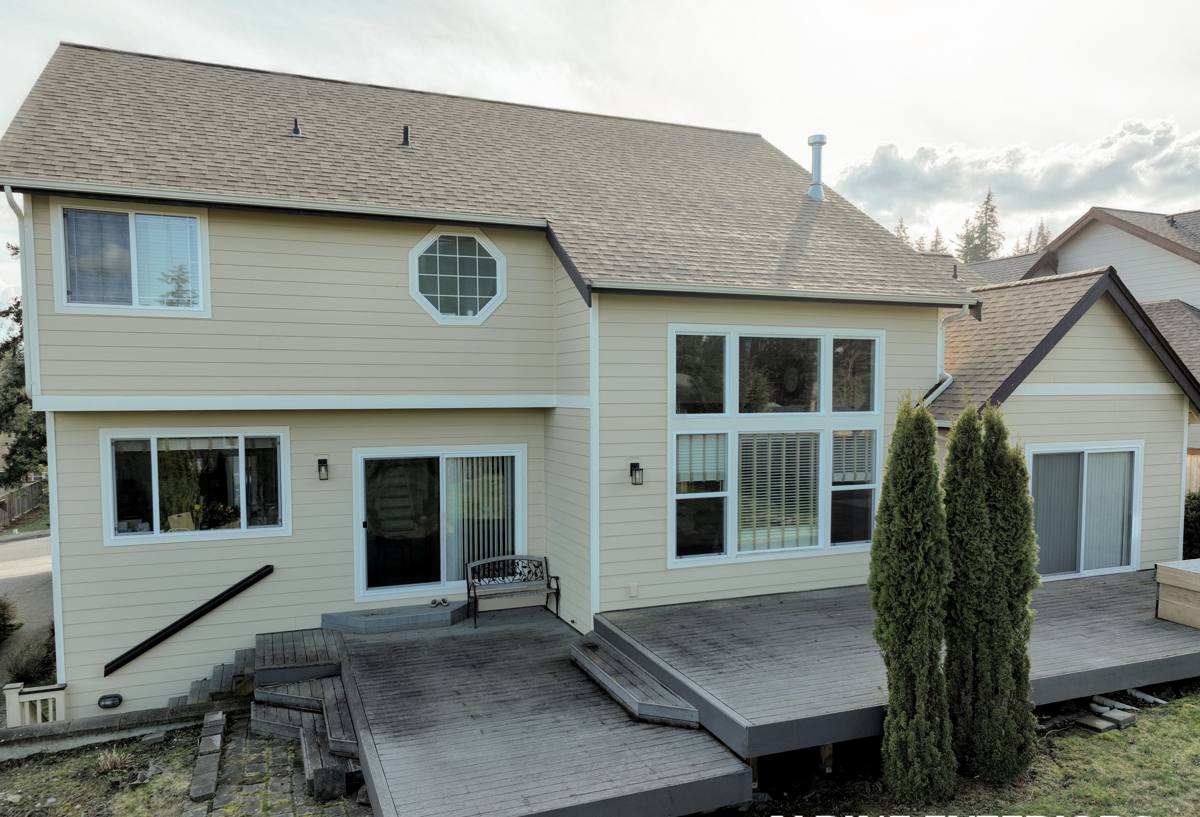
What "Correct" New-Construction Window Installation Actually Involves
Nail-Fin vs. Block-Frame Windows
Most new construction in this area uses nail-fin (flange) windows set into the rough opening from the outside, over a properly lapped weather-resistive barrier (WRB). Block-frame windows, more common in masonry or some higher-end assemblies, get anchored differently and rely on the surrounding wall detail rather than a flange. Either works — the failure point is almost never the window itself, it's whether the surrounding water management was built to match the window type actually being installed.
The Flashing Sequence, in Order
There's a correct order of operations, and skipping or reversing a step is what causes hidden leaks:
- Sill pan flashing installed first, sloped to drain outward, with back and end dams so any water that gets past the window has somewhere to go besides the framing.
- Window set into the opening, shimmed level and plumb, fastened per the manufacturer's schedule — not just "enough nails to hold it."
- Side flashing lapped over the sill pan legs, jamb flanges sealed to the WRB.
- Head flashing installed last, lapped over the WRB above so water sheds down and over the window, never behind it.
- Sealant used only where the manufacturer specifies it — as backup to the shingle-lap water path, not as a substitute for it.
Get that order backward — head flashing under the WRB instead of over it, for example — and the assembly can look finished while actively directing water into the wall.
Salt Air, Driving Rain, and Moss Season — What Each One Actually Does
Salt Air
Coastal-influenced air accelerates corrosion on exposed fasteners, hardware, and lower-grade cladding. It's not usually enough to be a daily concern for the glass or frame itself, but it does mean fastener selection and hardware finish matter more here than they would further inland — corrosion-resistant fasteners at the flange and trim are worth specifying rather than assuming.
Driving Rain
Wind-driven rain doesn't just fall on a window, it gets pushed sideways and upward against the sill and jambs, which is exactly why sill pan flashing and correct flashing laps matter more here than in a drier climate. A window rated for a modest water-penetration resistance elsewhere in the country needs that rating backed up by installation detail here, not instead of it.
Moss and Sustained Moisture
Long damp stretches keep exterior surfaces wet longer between drying periods. Anything that traps moisture against wood trim — caulk used as the primary seal instead of flashing, or trim installed tight with no drainage gap — becomes a slow rot problem over a few seasons rather than a fast one. It's rarely dramatic; it just shows up as soft trim or a stained interior sill a few years down the road, well after the crew that installed it has moved on.
Choosing the Right Window for a Cordata New Build
| Frame Material | How It Handles This Climate | Maintenance Reality |
|---|---|---|
| Vinyl | Good moisture and corrosion resistance; performance depends heavily on installation quality | Low; won't rot, but seals and hardware still need periodic checks |
| Fiberglass | Very stable dimensionally, handles wet/dry cycling well | Low; higher upfront cost, longer service life |
| Wood-clad | Good performance if cladding and flashing details are correct; interior wood offers a different look | Higher; any breach in the clad exterior exposes wood to this climate's moisture |
| Aluminum | Strong and slim sightlines, but a poor thermal performer and prone to condensation in a wet, cool climate unless thermally broken | Moderate; finish holds up, condensation management is the real issue |
We don't push one material as universally "best" — we size the choice to the house, the budget, and how exposed a given elevation is to wind-driven rain. A window on a covered, protected elevation has more flexibility than one on an exposed gable facing the prevailing weather.
Our New-Construction Window Installation Process
On a new build, we work directly off the framer's rough openings and the WRB installer's schedule, so timing matters as much as technique:
- Rough opening check — verify size, square, and plumb before any window goes in; correcting a framing error now is a lot cheaper than after.
- Sill pan flashing — installed and tested for proper slope before the window is set.
- Window set and fastened — shimmed, leveled, and fastened to the manufacturer's schedule, not a generic pattern.
- Flashing tie-in — jambs and head integrated into the WRB in the correct shingle-lap order.
- Operation check — every sash and lock cycled before we call it done, not just visually inspected.
- Documentation — noting product, install date, and any site-specific detail for the manufacturer's warranty file.
Common Mistakes We See on New Builds
- Sealant used as the primary water barrier instead of proper flashing laps
- Head flashing installed under the WRB instead of over it
- Missing or flat (non-sloped) sill pans
- Fasteners driven through the flange at the wrong spacing, warping the frame slightly and stressing the seal
- Trim installed tight to the siding with no drainage gap, trapping moisture against the window
- Rough openings cut oversized "to make it easier," leaving gaps that get filled with foam instead of proper shimming
Each of these can pass a walkthrough. None of them show up as a problem until a wet season or two has gone by.
Why a Crew That Already Works Cordata Matters
A window install crew that regularly works this stretch of Whatcom County already has the flashing sequence, fastener choices, and product tolerances dialed in for this specific mix of salt air, driving rain, and moss-season moisture — it's not a generalized "coastal Pacific Northwest" approach applied loosely, it's built from doing the work here repeatedly. We also coordinate directly with framers, siding crews, and window suppliers on active builds in the area, which matters on a new-construction timeline where the window install has to land in the right sequence between framing and siding, not before the WRB is ready and not after siding has started.
Cost Factors on a New-Construction Window Package
| Factor | Why It Moves the Price |
|---|---|
| Frame material | Vinyl is typically the most budget-friendly; fiberglass and wood-clad run higher |
| Number and size of openings | More glass, larger units, and specialty shapes add labor and material |
| Exposure of each elevation | Elevations facing prevailing wind-driven rain may warrant higher-performance units or extra flashing detail |
| Access and building phase | Installing at the correct framing stage is faster and cheaper than retrofitting later |
| Hardware and glazing options | Impact-resistant glazing, upgraded locks, or low-E coatings add cost but can be worth it depending on the elevation |
Checklist Before Your Windows Go In
- Rough openings confirmed square, level, and correctly sized for the chosen windows
- WRB installed and inspected before window set begins
- Sill pan flashing plan confirmed for every opening, especially exposed elevations
- Window schedule matches the approved plans — no last-minute substitutions without checking the rough opening
- Fastening and flashing sequence agreed on with the framing and siding crews so nothing gets covered up out of order
- Manufacturer's installation instructions on hand and followed, not just the general trade standard
If you're building or framing a home in the Cordata area and want a crew that already knows how this climate treats a new-construction window install, we're glad to take a look at your plans and give you a straightforward, no-pressure estimate — just fill out the form below.