 Ferndale
 Custer's Climate Puts Real Demands on Siding
Custer sits in the northwest corner of Whatcom County, close enough to the water that salt-laden air is a daily fact of life, not an occasional nuisance. Add Western Washington's long wet season — driving rain that comes in sideways off the water more often than most homeowners expect — and you have a climate that is genuinely hard on exterior building materials. Then there's moss. Shaded north- and west-facing walls in this part of the county stay damp for months at a stretch, and moss and algae will colonize any siding surface that holds moisture at its face or in its seams.
None of this is unique to any one house. It's the baseline condition for every home in and around Custer, and it's the reason siding choice and installation quality matter more here than they would in a drier, more sheltered climate. Siding that's marginal in Spokane can fail outright in a few years on a Custer home facing the prevailing weather.
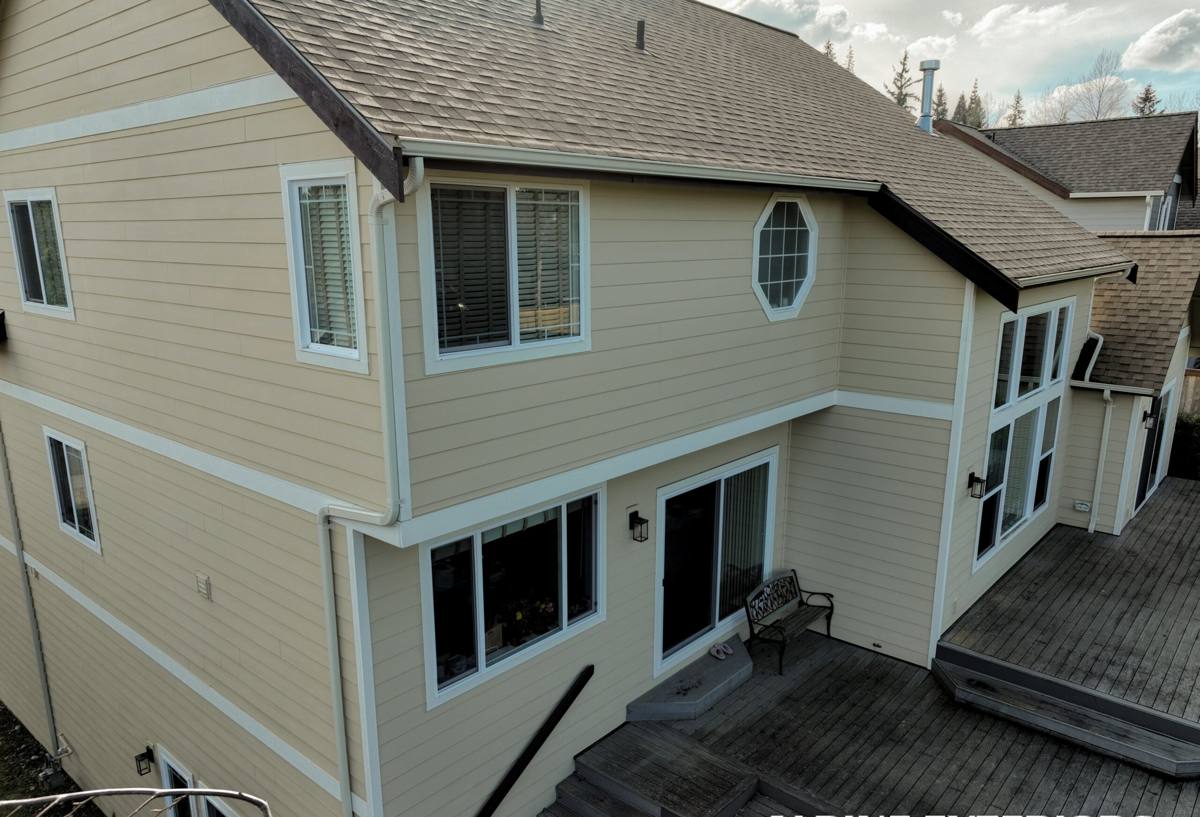
What "Correct" Fiber Cement Installation Actually Involves
Fiber cement siding is only as good as the installation behind it. James Hardie engineers a detailed installation spec for exactly this kind of climate, and skipping steps is where most siding failures we get called out to inspect actually start — not in the product itself.
The details that matter in a wet, salt-air climate
- Weather-resistive barrier installed and lapped correctly, with all penetrations flashed before a single course of siding goes up
- Rainscreen or drainage gap behind the siding so any moisture that gets past the face has somewhere to go besides trapped against the sheathing
- Minimum clearances maintained at grade, roof lines, decks, and hardscaping — Hardie's spec calls for specific gaps, and closing them up looks tidy but traps water
- Corrosion-resistant fasteners and flashing hardware, given the salt content in the air here
- Factory-primed or ColorPlus cut edges properly sealed, since an exposed raw edge is where moisture intrusion typically begins
- Caulking used only where Hardie's spec calls for it — over-caulking traps moisture as often as it keeps it out
Every one of these steps is easy to shortcut and hard to spot once the siding is up and painted. That's exactly why they matter — a rushed installation and a correct one can look identical on install day and behave completely differently five years later.
Why We Install Only James Hardie
We don't install vinyl, LP SmartSide, Cemplank, Allura, primed spruce, or cedar. That's a deliberate standard, not a lack of options. In a climate that combines salt air, sustained rain exposure, and heavy moss pressure, the trade-offs of the alternatives show up faster and cost more to fix than the price difference ever saved.
| Material | How it holds up in Custer's climate | Where it falls short |
|---|---|---|
| Vinyl | Sheds rain fine when intact | Becomes brittle in cold snaps, fades in UV, seams and laps can let wind-driven rain behind it |
| LP SmartSide (engineered wood) | Workable, budget-friendly | Wood-based core is vulnerable if any moisture gets past the coating; edge sealing and maintenance are unforgiving |
| Cedar / primed spruce | Attractive, traditional look | Needs ongoing refinishing to keep water out; moss and mildew take hold quickly on shaded, damp walls |
| Cemplank / Allura (fiber cement) | Similar base material to Hardie | Different engineering, factory finish, and warranty structure than Hardie's climate-specific HZ product line |
| James Hardie fiber cement | Non-combustible, engineered for wet regional climates, factory ColorPlus finish resists fading and moisture | Costs more upfront; installation must be done to spec to realize the benefit |
James Hardie's HZ5 product line is engineered specifically for climates like the Pacific Northwest's — freeze-thaw cycling, sustained moisture exposure, and salt air are all part of what it's built to handle. The ColorPlus factory finish is baked on rather than field-applied, which matters directly for moss and mildew resistance since a consistent, dense finish gives algae and moss far less to grip onto than a field-painted surface. Combined with a strong transferable warranty, it's the product we're willing to stand behind on homes in this area.
How We Handle a Custer Project
The work follows the same sequence on every job, because skipping steps is where problems start.
- Walk-through and assessment. We look at existing siding, trim, flashing, and any moisture damage already present before quoting anything.
- Removal and sheathing check. Old siding comes off and we inspect the sheathing underneath for rot or soft spots — this is often where a home's real condition gets revealed.
- Weather barrier and drainage plane. Housewrap, flashing, and rainscreen furring go in before any siding, sized to Custer's moisture load.
- Hardie installation to spec. Correct clearances, fastener placement, and edge sealing, following Hardie's published installation guide for this climate zone.
- Trim, caulk, and final detailing. Only where the spec calls for it — not as a catch-all for gaps that should have been solved with proper flashing.
- Walk-through with the homeowner. We go over what was done and what maintenance, if any, to expect going forward.
Maintenance in a Salt-Air, Moss-Prone Climate
Correctly installed Hardie siding is low-maintenance, not no-maintenance. In Custer's conditions, a homeowner should expect to:
- Rinse the exterior once or twice a year to clear salt residue and organic buildup before it becomes established growth
- Keep gutters clear so overflow doesn't run down the face of the siding repeatedly in the same spot
- Trim back vegetation and tree cover on shaded walls where moss pressure is worst
- Watch caulked joints and touch up as needed — caulk is the one component that ages faster than the siding itself
- Inspect after major windstorms, which are common enough here that they're worth a quick visual check rather than an assumption everything's fine
None of this is heavy lifting, but it's real, and it's worth knowing going in rather than being surprised by it later.
Signs Your Current Siding Is Already Struggling
If you're not sure whether your home's siding is due for replacement, these are the signs we look for on inspections in this area:
- Persistent moss or algae staining that comes back within weeks of cleaning
- Soft or spongy spots when pressed, especially near the bottom courses or around windows
- Visible gaps, warping, or buckling in panels or lap siding
- Paint or finish failing faster than it should, especially on north- and west-facing walls
- Interior signs — peeling paint, musty smell, or staining on inside walls that share an exterior wall
- Caulk that's cracked, pulled away, or missing in multiple places
Any one of these is worth a look. Several together usually mean the siding is past the point where patching makes sense.
What a Custer Project Typically Costs
Every home is different, but the main cost drivers on a fiber cement siding job in this area are consistent:
| Factor | Why it moves the price |
|---|---|
| Home size and wall complexity | More square footage and more corners, gables, and cutouts mean more material and labor |
| Condition of existing sheathing | Rot repair found during tear-off adds cost but is far cheaper to fix now than to cover up |
| Siding profile chosen | Lap siding, panels, and shingle-style Hardie products carry different material and install costs |
| Trim and detail work | Window and door trim, corner boards, and fascia detailing add labor time |
| Access and site conditions | Multi-story walls, tight lot lines, or landscaping that limits staging can affect labor time |
We give an honest number after seeing the actual house — broad online estimates for fiber cement siding aren't very useful until someone's looked at your specific walls, trim, and condition.
Why a Crew That Already Works Custer Matters
A contractor who works this part of Whatcom County regularly already knows what the salt air, the moss season, and the wind-driven rain patterns do to a home over time — not from a textbook, but from repeat visits to homes in the same conditions. That translates into fewer surprises during tear-off, better judgment on flashing and drainage details, and a finished job that's built for the actual weather this house will see every winter, not a generic install.
If you're weighing siding options for a home in or near Custer, we're happy to take a look and give you a straightforward, no-pressure estimate — what your walls actually need, what it will cost, and what to expect going forward. There's no obligation, just an honest assessment from a crew that already knows this area.