 Ferndale
 Building a Deck That Can Actually Handle Fairhaven's Weather
Fairhaven sits close enough to the water that its decks live a harder life than decks built twenty miles inland. Salt-laden air corrodes hardware faster, driving rain off the water finds every gap in flashing and fastening, and the long gray stretch of fall through spring keeps wood surfaces damp for weeks at a time. That combination is exactly what breeds moss, algae, and the slow rot that homeowners usually don't notice until a board flexes underfoot or a railing post feels soft.
None of that means you can't have a deck that lasts. It means the deck has to be built for this specific environment rather than built to a generic national spec and hoped for the best. The framing, the fasteners, the flashing details, and the decking material all need to be chosen with Whatcom County's marine climate in mind, not just whatever's cheapest at the yard that week.
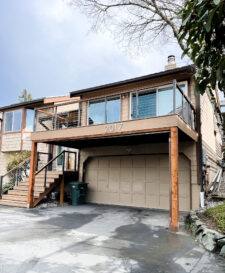
What a Fairhaven Deck Is Actually Up Against
Salt Air and Corrosion
Proximity to Bellingham Bay means airborne salt settles on everything outdoors, including your deck's screws, joist hangers, and railing hardware. Standard galvanized fasteners can start showing rust streaks and pitting well before a deck's wood or composite surface shows any wear. Once a fastener corrodes, it loses holding strength long before it looks obviously bad — which is why hardware grade matters more here than in drier, inland parts of the county.
Driving Rain
Storms coming off the water don't fall straight down — wind-driven rain gets pushed sideways into ledger boards, under railing caps, and into any seam that isn't properly flashed or sealed. A deck built with square-edge butt joints and no flashing behind the ledger board will let water track into the house framing over time, which is a far more expensive problem than the deck itself.
Moss and Sustained Dampness
Whatcom County's moss season runs long — often eight months or more of conditions damp enough for moss and algae to establish on any shaded or north-facing deck surface. Moss holds moisture against the decking material, and on wood that means accelerated rot; on composite it means staining and a slip hazard if it's not kept in check.
Getting the Substructure Right
The framing underneath a deck does the real work, and it's also the part homeowners never see once the project is done — which is exactly why it's the part worth getting right the first time.
- Pressure-treated joists and beams rated for ground contact where applicable, not just "exterior" grade lumber
- Joist protection tape or a comparable membrane on top of every joist to keep standing water out of fastener holes
- Proper ledger board flashing where the deck attaches to the house, with the flashing lapped correctly so water sheds outward, not behind the siding
- Post bases that hold posts above grade and off standing water, rather than posts set directly into concrete
- Adequate airflow and drainage under the deck so the framing can dry out between rain events instead of staying saturated
Skip any one of these and the deck may look fine on the surface for a few years while the structure underneath is quietly failing. That gap between "looks fine" and "is fine" is where a lot of expensive surprises come from.
Choosing a Decking Material for This Climate
There isn't one right answer for every homeowner — budget, maintenance tolerance, and how the deck will be used all factor in. What matters is understanding the honest trade-offs for a marine climate rather than picking on looks alone.
| Material | Upfront Cost | Maintenance in This Climate | Typical Lifespan |
|---|---|---|---|
| Pressure-treated wood | Lowest | Annual cleaning and sealing to resist moss and moisture; most vulnerable to rot if maintenance lapses | 10–15 years with upkeep |
| Cedar | Moderate | Naturally rot-resistant but still needs periodic sealing and moss removal near the water | 15–20 years with upkeep |
| Traditional composite | Higher | Low — occasional washing; older uncapped composites can absorb moisture at cut edges | 20–25 years |
| Capped composite / PVC | Highest | Lowest — a sealed outer shell resists moisture and staining, though cut edges still need capping or sealant | 25+ years |
We install both wood and composite decking, including capped composite systems from manufacturers like Trex and TimberTech. For a home this close to the water, we generally steer clients toward capped composite or well-maintained cedar over uncapped composite or basic pressure-treated boards, simply because the maintenance burden and moisture exposure here are higher than in a drier inland yard. That's a maintenance and moisture-performance judgment, not a knock on any specific product — plenty of homeowners are happy with pressure-treated decking as long as they stay on top of sealing it.
Fasteners and Hardware
Whatever decking material you choose, the hardware holding it together should be rated for coastal or marine exposure — typically stainless steel or a heavy-duty coated fastener system rather than standard galvanized screws. It costs more up front and it's the difference between hardware that's still tight in fifteen years and hardware that's rusting through in five.
Railings, Stairs, and Code Requirements
Deck railings and stairs aren't optional design flourishes — they're governed by building code, and Ferndale falls under Washington State building code requirements enforced through the local permitting process. Railing height, baluster spacing, stair rise and run, and guard requirements at certain deck heights are all inspected items, not suggestions. A deck built without a permit or without meeting these specs can create real liability and can also complicate things if you ever sell the home and it goes through inspection.
We pull permits and build to code as a standard part of every deck project — it's not an upcharge, it's just how the job gets done correctly.
How We Approach a Deck Build in Fairhaven
1. On-Site Assessment
We look at sun and shade exposure, drainage on the lot, how close the deck will sit to the water-facing side of the house, and what condition the existing structure (if there is one) is actually in underneath the surface boards.
2. Material and Layout Discussion
We walk through decking material options honestly, including cost and maintenance trade-offs specific to a marine climate, so you're choosing based on real information rather than a showroom sample.
3. Permitting
We handle the permit application and make sure the design meets current code before any framing goes in.
4. Construction
Framing first, with joist protection and proper flashing at every ledger and post connection, then decking, then railings and stairs. We don't skip the hidden steps to save time.
5. Final Walkthrough
We go over the finished deck with you, including basic care guidance specific to this climate, before we consider the job done.
Keeping a Fairhaven Deck in Good Shape Year-Round
Even a well-built deck needs some seasonal attention in a climate this damp. A little maintenance goes a long way toward avoiding the kind of neglect that turns into a rebuild.
- Sweep leaves and debris off the deck regularly in fall — trapped organic matter is what feeds moss growth
- Clean moss and algae off the surface each spring with a deck-safe cleaner, not a pressure washer set too aggressive for the material
- Check railing posts and stair stringers annually for movement or soft spots
- Inspect ledger board flashing where the deck meets the house every year or two
- Reseal wood decking on the manufacturer's recommended schedule, typically every 1–2 years in this climate
- Look underneath the deck occasionally for standing water or blocked drainage paths
Why Local Experience Matters for This Job
A deck built to a generic spec sheet from somewhere with a dry climate will underperform here. The moss season is longer, the rain comes in sideways off the water, and the salt air is harder on hardware than most manufacturers' national warranty language accounts for. A crew that already works in and around Ferndale and Whatcom County knows to spec stainless fasteners without being asked, knows which decking products actually hold up near the water, and knows what the local permitting process expects before the first post hole is dug.
That local knowledge doesn't show up as a line item on a quote, but it's the difference between a deck that needs real work again in eight years and one that's still solid in twenty-five.
If you're planning a new deck or need to replace one that's showing its age, we're happy to take a look and put together a straightforward, no-pressure estimate. Use the form below to get started.