 Ferndale
 Windows on Sandy Point Take a Different Kind of Beating
Sandy Point sits right up against the water, and that changes what a window has to survive day to day. Homes a few miles inland in Ferndale deal with normal Whatcom County weather — plenty of rain, some wind, a damp winter. Homes out on Sandy Point deal with all of that plus a steady dose of salt-laden air coming off the Strait, wind-driven rain that hits window faces at an angle instead of falling straight down, and a moss season that runs longer than most people expect in the Pacific Northwest. None of that is dramatic on its own, but it adds up year after year, and it's exactly the kind of exposure that separates a window that performs for twenty-plus years from one that starts failing at year eight.
When we talk about "energy-efficient windows" for a Sandy Point home, we're not just talking about a lower heating bill, though that matters. We're talking about a window system — glass, frame, hardware, and installation — built to keep performing after years of salt exposure and wet weather, without the seals failing, the frames corroding, or the glass fogging up between the panes.
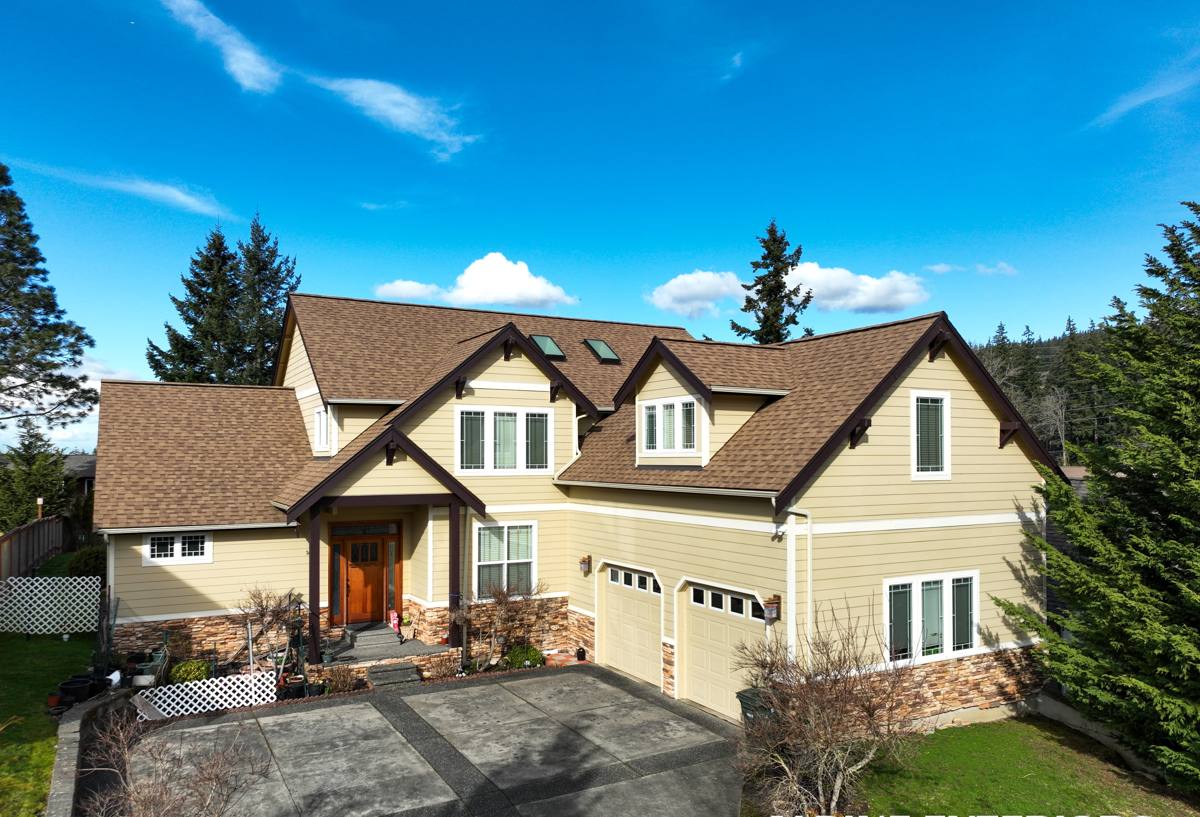
What Energy-Efficient Actually Means, Beyond the Marketing Term
"Energy-efficient" gets used loosely, so it helps to know what's actually being measured. Every legitimate replacement window carries an NFRC (National Fenestration Rating Council) label with a few key numbers:
- U-factor — how well the window resists heat loss. Lower is better. This is the number that matters most for a Whatcom County heating season.
- Solar Heat Gain Coefficient (SHGC) — how much solar heat passes through the glass. On west- and water-facing walls, this affects both winter warmth and how much a room heats up on the rare sunny afternoon.
- Air Leakage — how much air moves through the window assembly itself, independent of the glass. This one is closely tied to how well the window was installed, not just how it was manufactured.
For a coastal property, we also weigh glass coatings (low-E) and gas fill (usually argon) against the specific exposure of each elevation. A window facing open water needs a different balance of properties than one tucked on a sheltered side of the house.
Double-Pane vs. Triple-Pane
Triple-pane glass gets asked about a lot, and it's a real option, but it's not automatically the right call for every Sandy Point home. It adds weight (which matters for older frames and larger openings), added cost, and diminishing returns in a marine climate that's mild compared to harsher inland winters. Double-pane with a good low-E coating and proper gas fill covers most homes here well. Triple-pane earns its keep on north- or water-facing walls that take the brunt of wind and cold, or for homeowners specifically prioritizing sound dampening from wind and surf noise.
Frame Material: The Decision That Matters Most Near Salt Water
Glass performance gets the attention, but frame material is what determines whether a window survives salt air without maintenance turning into a second job. Here's how the common options actually compare for a shoreline property like Sandy Point:
| Frame Material | Salt Air / Corrosion Behavior | Maintenance | General Cost Tier |
|---|---|---|---|
| Vinyl | Does not corrode; UV and heat cycling can affect long-term color and seal life | Low — occasional cleaning | Lower |
| Fiberglass | Very stable dimensionally, resists corrosion well, holds paint/finish longer near salt air | Low to moderate | Mid to higher |
| Wood (unclad) | Vulnerable to moisture and rot without diligent upkeep, especially with driving rain exposure | High — regular refinishing | Mid to higher |
| Wood-clad (vinyl or aluminum exterior) | Cladding protects the wood core, but any breach in the cladding seal invites hidden rot | Moderate | Higher |
| Aluminum | Can corrode and pit in salt air unless specifically marine-rated; conducts heat/cold readily | Moderate | Varies |
As a standard, we lean toward vinyl and fiberglass for exposed Sandy Point elevations because they hold up against salt exposure with the least ongoing maintenance. That's a professional judgment about long-term moisture and corrosion behavior in this specific environment — not a knock on any manufacturer. A well-built wood or wood-clad window still has its place, particularly on sheltered sides of a house or where the look is a priority, but we'll always tell you honestly what upkeep that choice will require given the exposure.
Hardware, Flashing, and the Details That Actually Fail First
Hardware and Corrosion
Locks, hinges, and cranks are usually the first thing to show wear in a salt-air environment — long before the glass or the frame itself has any issue. Cheaper hardware finishes pit and stick within a few seasons out here. We check hardware corrosion resistance as part of picking a window line for a Sandy Point install, not as an afterthought.
Flashing and Moisture Management
Driving rain doesn't just test the glass and frame — it tests everything around the opening. Wind-driven rain finds gaps that vertical rain never would. Correct flashing (integrating the window with the house's water-resistive barrier, properly lapped so water sheds outward and down, never inward) is arguably more important to long-term performance than the window unit itself. A premium window installed with poor flashing will leak and rot the surrounding wall; a mid-grade window installed correctly will outperform it for decades.
Sealants
Exterior sealant around a window has a service life, and salt air and UV exposure shorten it compared to an inland install. We use sealants rated for the exposure and treat this as a maintenance item to check periodically, not a "set it and forget it" step.
Moss Season and What It Does to Window Performance
Moss doesn't grow on the glass, but it absolutely affects windows. On Sandy Point, moss and organic debris build up in window tracks, weep holes, and along sills during the long wet stretch of fall through spring. When weep holes clog, water that's supposed to drain back out of the frame sits instead — which is exactly how frame rot and interior sill damage start, especially on wood or wood-clad units. Sliding and low-clearance windows are the most affected because their tracks collect debris fastest.
This is a maintenance issue as much as a product issue, and it's one reason we talk homeowners through basic upkeep at the end of a job rather than just walking away after installation.
Signs Your Current Windows Are Underperforming
Most homeowners don't think about window replacement until something is obviously wrong, but by then moisture damage may already be underway. Watch for:
- Fogging or a milky haze between the panes (a failed seal — the argon or air gap is compromised)
- Visible condensation on interior glass during cold snaps, even with normal ventilation
- Drafts you can feel near the frame, especially on windows facing open water or prevailing wind
- Soft or discolored wood at the sill or the wall just below the window
- Hardware that's pitted, stiff, or won't latch fully anymore
- Visible daylight or gaps around the frame when the window is closed
- A noticeable jump in heating costs without any other explanation
Any one of these on its own might just mean a repair. Several together on the same window, or the same symptom across multiple windows on your water-facing side, usually means it's time to talk replacement before the surrounding structure takes damage too.
How We Approach a Sandy Point Window Job
1. On-Site Assessment
We look at each opening individually — orientation, current condition, signs of existing moisture intrusion, and how exposed that particular wall is to wind and salt. Not every window on the house needs the same spec; a water-facing wall and a sheltered interior courtyard wall can reasonably get different glass or frame choices.
2. Removal Without Collateral Damage
Old units come out carefully so we can actually see the condition of the framing and sheathing underneath before anything new goes in. If there's hidden rot or moisture damage from a prior bad install, this is where we catch it — before it gets sealed behind a new window and becomes a bigger problem later.
3. Correct Flashing and Air Sealing
This is the step that determines whether the install lasts. We integrate flashing with the existing water-resistive barrier so water is directed out and down, air-seal the gap between the rough opening and the new frame, and use insulation and sealant appropriate for a marine climate.
4. Final Check and Walkthrough
Every window gets operated, checked for square and smooth function, and inspected for a clean, weathertight seal before we call the job done. We also walk you through basic upkeep specific to a shoreline property — what to check each season and what to flag early.
Why Local Sandy Point Experience Matters
Window installation isn't identical from house to house, and a crew that's worked Sandy Point knows specifics that don't show up in a manufacturer's install manual: which walls in this community tend to take the worst of the weather, how far moss and salt residue build up before they start affecting hardware, and how the wetter, wind-exposed conditions here compare to a typical inland Whatcom County install. That's the kind of judgment that comes from doing the work here repeatedly, not from a one-time visit.
It also matters for something more practical: a local crew is easy to reach if a question comes up two years after the job, and we stand behind our own installs because we're not driving in from out of the area to do it.
What Affects the Cost of a Window Job Here
Costs vary enough between homes that we won't quote a number without seeing the openings, but the main factors that move the price are consistent:
- Frame material chosen (vinyl generally lowest, fiberglass and wood-clad higher)
- Glass package — standard double-pane low-E vs. upgraded coatings or triple-pane on select elevations
- Number of openings and whether sizes are standard or custom
- Condition of the existing framing — extra work is needed if there's hidden rot or moisture damage to repair before the new window goes in
- Access and site conditions specific to the home
We'd rather walk a property and give you an honest, itemized number than guess at a range that doesn't match your actual house.
Get a Straightforward Estimate
If you're dealing with foggy glass, drafty rooms, or windows that are just past their working life on your Sandy Point home, we're happy to take a look and tell you plainly what we find — no pressure, no upsell on things you don't need. Use the form below to request a free estimate, and we'll walk the exposure on your specific home before recommending anything.