 Ferndale
 Lummi Island's Climate Puts Real Demands on a House's Siding
Lummi Island sits out in Puget Sound water, surrounded by Whatcom County's marine air on nearly every side. That location is beautiful, but it's also a tougher environment for exterior building materials than most inland Ferndale neighborhoods see. Homes here deal with salt-laden air coming off the water, wind-driven rain that gets pushed sideways into wall assemblies instead of falling straight down, and a long stretch of the year — roughly fall through spring — where shaded, north-facing walls stay damp long enough for moss and algae to take hold.
None of those conditions are dramatic on their own. The problem is that they're constant. A siding material that can shrug off one wet week but slowly absorbs moisture over months of exposure, or that holds paint poorly once salt residue builds up on the surface, will show it within a few years on an island lot. That's the backdrop for every siding decision made out here, and it's why we treat Lummi Island jobs differently from a typical dry-side install.
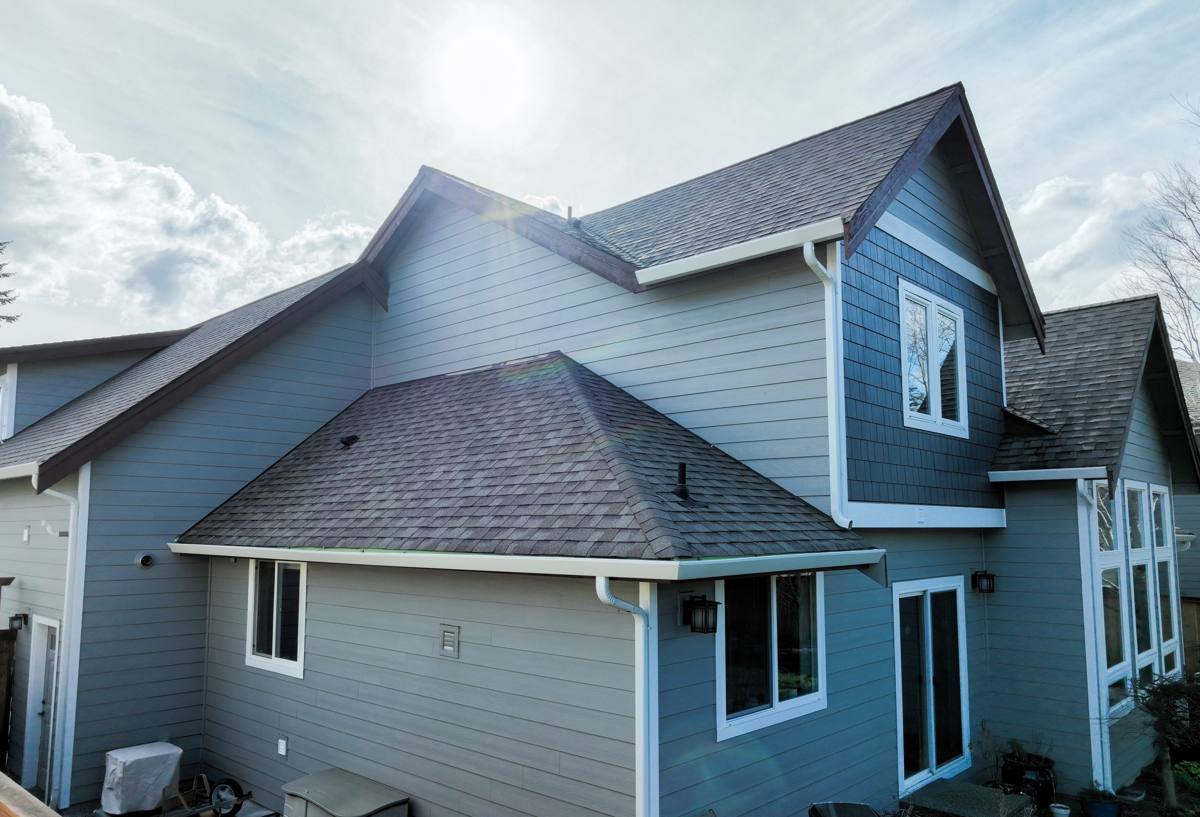
Why We Only Install James Hardie Fiber Cement Out Here
We install James Hardie siding exclusively — not vinyl, not LP SmartSide, not primed cedar or spruce, and not competing fiber cement brands. That's a company-wide standard, but it matters more on Lummi Island than almost anywhere else we work, because material differences that are minor in a sheltered subdivision become significant on an exposed island lot over a decade or two of weather.
Fiber cement is non-combustible and dimensionally stable, meaning it doesn't swell, cup, or warp the way wood-based products can when they take on moisture. James Hardie's ColorPlus finish is baked on at the factory under controlled conditions, which gives it better adhesion and better UV and salt resistance than field-applied paint — the finish most vinyl and wood siding depends on for its looks and protection. Vinyl, for its part, can fade and become brittle with long-term UV and salt exposure, and it has almost no ability to be repaired invisibly once it's damaged; you're usually replacing whole panels to fix a section instead of touching up a spot. None of this makes another product "bad" — these are trade-offs, and on a marine-exposed island lot those trade-offs tend to show up faster and cost more to manage than they would somewhere more sheltered.
HZ5: The Product Engineering Built for This Region
James Hardie doesn't make one universal siding formulation — it engineers its HardieZone products differently by climate zone. Whatcom County, including Lummi Island, falls in the HZ5 zone: the cooler, wetter climate designation used across the Pacific Northwest and other northern regions. HZ5 products are formulated for freeze-thaw cycling and prolonged damp conditions, which is exactly what siding on an exposed island has to survive year after year.
In practice this means the boards, trim, and panels used on a Lummi Island project are the correct regional formulation, not a generic national product pulled off a shelf. That matters for long-term moisture performance, and it matters for keeping the manufacturer's warranty intact — installing the wrong HardieZone product for a region can affect what's actually covered down the line if a problem shows up.
What a Correct Installation Involves in a Salt-Air, High-Rain Setting
James Hardie siding is only as good as the installation behind it. In a marine environment, several details matter more than they would in a drier inland climate, and skipping them is where most long-term problems start.
Clearance and Drainage
Siding needs proper clearance from grade, roof lines, and decks so water has somewhere to go instead of wicking up into the bottom edge of the boards. On wind-exposed island walls, we pay close attention to weep paths and drainage behind the cladding so wind-driven rain that gets past the surface can still drain out rather than sitting against the wall assembly.
Fasteners and Flashing
Salt air accelerates corrosion on anything less than corrosion-resistant hardware. We use fasteners and flashing rated for coastal exposure, and we flash every window, door, and penetration so water is directed out and down, not trapped behind the siding. This is standard good practice everywhere, but the margin for error is smaller on a site that sees more airborne salt and more wind-driven moisture than a typical inland lot.
Joints, Gaps, and Cut Edges
Fiber cement needs expansion gaps at joints, and factory-cut edges need to be properly sealed or primed where the manufacturer's finish doesn't already cover them. Left bare, a cut edge is the one place on a Hardie board where moisture can get into the material itself. We treat every field cut as part of the job, not an afterthought handled at the end of the day, and we use sealants rated for exterior, marine-adjacent use rather than whatever caulk happens to be in the truck.
Installation Details That Separate a Correct Job From a Problem Job
Most siding failures we get called out to inspect trace back to a handful of shortcuts. Here's what we look for, and what it should look like instead:
| Detail | Common Shortcut | Correct Approach |
|---|---|---|
| Ground clearance | Siding installed tight to grade or paved surfaces | Minimum clearance maintained per manufacturer spec, with a visible gap |
| Fasteners | Standard uncoated fasteners | Corrosion-resistant fasteners rated for coastal and marine exposure |
| Cut edges | Left bare or caulked over without primer | Sealed or primed per Hardie's field-cut guidance before install |
| Window and door flashing | Reliance on caulk alone | Proper flashing sequence, with caulk as a secondary seal, not the only one |
| Joint spacing | Boards butted tight with no expansion room | Gaps sized to manufacturer spec and properly caulked |
How We Approach a Lummi Island Project
Every job starts with an on-site assessment, because no two walls on an island lot see the same exposure — a wall facing open water takes a different beating than one tucked behind trees or another structure. We look at existing moisture damage, the condition of the water-resistive barrier once old siding comes off, and which elevations need the most attention to drainage and flashing detail before we ever write up a scope of work.
Because Lummi Island is reached by ferry, we plan material deliveries and crew scheduling around that ahead of time rather than treating it as a surprise mid-project. That planning is part of why a crew that already works the island gets jobs done on a predictable timeline, instead of losing days to logistics that a mainland-only contractor hasn't had to account for before.
From there the process is straightforward: remove the old siding and inspect the sheathing and barrier underneath for hidden moisture damage, repair anything compromised before covering it back up, install the HZ5 James Hardie product to manufacturer specification, and do a final walk-through on flashing, caulking, and clearance details before cleanup.
Maintenance to Expect After Installation
Even correctly installed Hardie siding benefits from a bit of seasonal attention on an island lot — less than wood or vinyl would need, but not zero. A short annual checklist covers most of it:
- Rinse accumulated salt residue off exterior walls, especially on water-facing elevations, once or twice a year
- Check shaded and north-facing walls for early moss or algae growth and clean it before it spreads
- Inspect caulk lines at trim, windows, and joints annually, and re-caulk any that have cracked or pulled away
- Keep gutters clear so roof runoff isn't dumping extra water directly onto siding below
- Touch up any nicks or scrapes in the ColorPlus finish promptly rather than letting bare material sit exposed
What Affects the Cost of a Lummi Island Hardie Project
Every home is different, so we won't quote a number without seeing the site, but a few factors consistently move the price on island jobs:
| Factor | Why It Matters |
|---|---|
| Existing siding removal | Tear-off and disposal add labor, especially with multiple layers or damaged material underneath |
| Hidden moisture damage | Sheathing or framing repairs found once old siding comes off aren't optional to address |
| Home size and wall complexity | More corners, dormers, and trim detail mean more cutting, fitting, and flashing |
| Color and profile choice | Custom trim details and certain ColorPlus colors affect material cost |
| Site logistics | Ferry scheduling and material staging factor into the project timeline and plan |
Why Local, Island-Experienced Crews Matter Here
A contractor who has never worked on Lummi Island before is learning the ferry schedule, the material staging logistics, and the exposure differences between a water-facing wall and a sheltered one — on your project. A crew that already works out here has that figured out before the first board goes up. That translates into fewer surprises, a more realistic timeline, and installation details tuned to what actually holds up on an island lot rather than what works fine forty minutes inland in Ferndale.
It also means working with someone who understands why the HZ5 product line, correct fastener selection, and careful flashing aren't optional upgrades here — they're the baseline for siding that's going to face salt air, driving rain, and a long moss season every single year, not corners to cut to save a day of labor.
If you're weighing a siding replacement on Lummi Island, we're happy to take a look at your home, walk through what your specific walls are dealing with, and give you a straightforward, no-pressure estimate — fill out the form below to get started.