 Ferndale
 Why Lynden Homes Need Siding Built for This Climate
Lynden sits inland from Bellingham Bay, but the same marine weather pattern that soaks the Whatcom County coastline pushes inland too. Homes here deal with a long wet season, wind-driven rain that hits walls sideways instead of falling straight down, and stretches of damp, low-light weather that give moss and algae months to take hold on anything that stays wet. Add in the humid, salt-tinged air that moves through the county off the water, and you have a climate that is genuinely hard on exterior building materials, even ones that look fine going up.
Most siding failures we see in this area are not dramatic. They are slow: caulk that cracked two years ago and let water behind a panel, a bottom edge that never fully dries out between rains, paint that chalked and faded because the coating wasn't rated for this much UV-and-moisture cycling. By the time a homeowner notices, the damage is usually behind the siding, not on it.
Driving Rain and Wind-Driven Moisture
Whatcom County storms don't just drop rain, they push it. Wind-driven rain finds every gap, lap joint, and fastener hole that isn't properly sealed or shingled correctly. Siding that relies on caulk alone to keep water out — rather than proper flashing and lapped water management — is working against the odds every winter.
The Long Moss and Algae Season
Shade, moisture, and mild temperatures are exactly what moss and algae need, and Lynden has all three for a good chunk of the year. Siding that stays damp on north-facing walls or under tree cover will grow something on it eventually. The question is whether the material and finish can be cleaned and hold up to that cleaning without the color breaking down.
Temperature Swings and Freeze-Thaw
Whatcom County doesn't get brutal cold, but it does get repeated freeze-thaw cycling through the winter. Any siding material that absorbs water — even a little — is vulnerable to that cycle slowly working joints and edges loose over years.
Why We Only Install James Hardie in Lynden
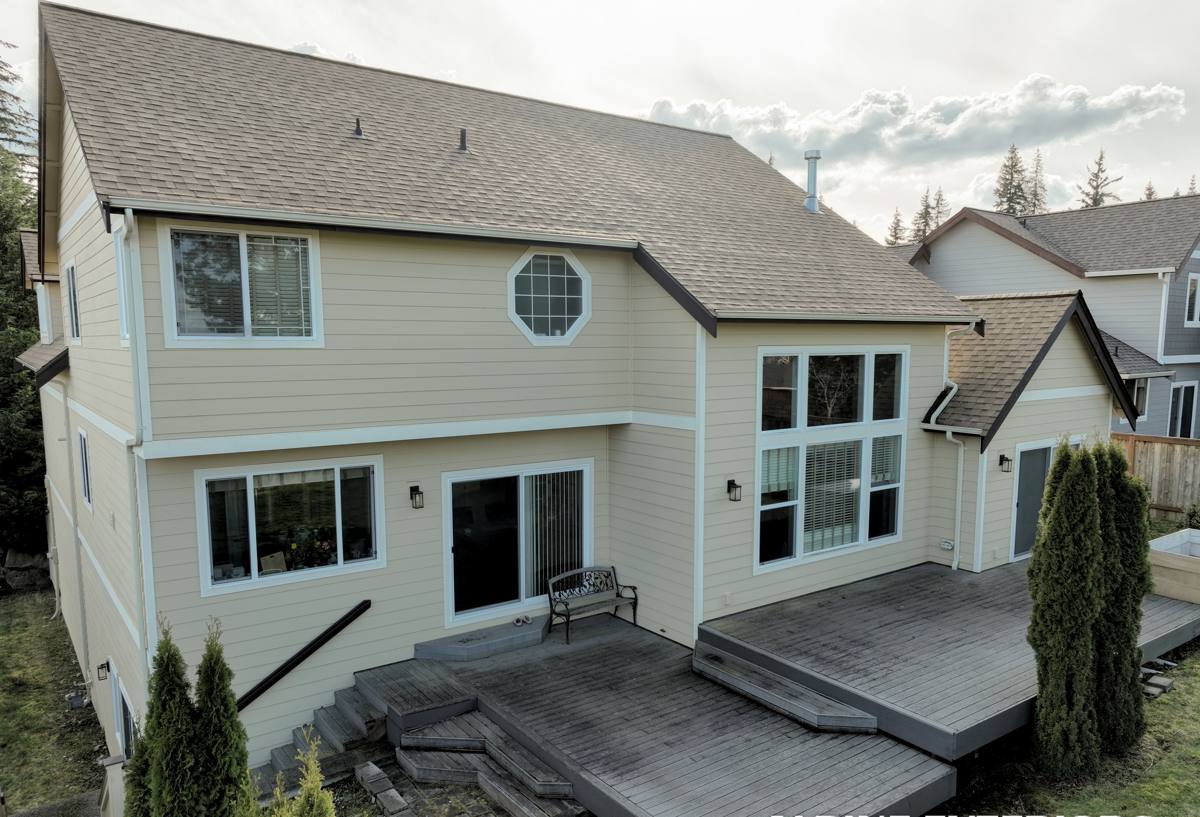
We made a decision as a company to install James Hardie fiber cement siding exclusively. We don't install vinyl, LP SmartSide, Cemplank, Allura, primed spruce, or cedar. That's not a marketing angle — it's because after years of siding work in this climate, Hardie is the product we trust to hold up to what Lynden weather actually does to a house.
Fiber cement doesn't absorb water the way wood-based products do, and it won't soften, delaminate, or feed mold the way engineered wood products can if moisture gets behind them. It's also non-combustible, which matters more every year as wildfire smoke seasons stretch further into the Pacific Northwest calendar. James Hardie's ColorPlus factory-applied finish is baked on and warranted against fading and chipping in a way field-applied paint simply isn't, which matters directly here — that's the coating standing up to the moss-and-algae cycle year after year without repainting.
James Hardie also engineers specific product lines for different climate zones. For the Pacific Northwest, that means HZ5-rated products designed around exactly the kind of moisture exposure Lynden gets. That's a real engineering distinction, not a sales term — the formulation and the installation instructions are built around this region's weather.
What Correct James Hardie Installation Involves
Hardie siding is only as good as the installation behind it. The material is engineered for this climate, but if it's hung wrong, the same problems show up regardless of what's on the wall.
Water Management Details
Correct installation starts with a weather-resistant barrier and properly integrated flashing at every window, door, and penetration — not caulk used as a substitute for flashing. Panels and planks need the right overlap, the right gap at inside and outside corners, and clearance off the ground, decks, and roof lines so water has somewhere to go and siding never sits in standing moisture.
Fastening and Clearances
Hardie publishes exact fastener spacing, placement, and gap tolerances for each product line and climate zone, and those specs exist for a reason — get them wrong and you can void the manufacturer warranty even though the material itself is sound. Nail placement too close to an edge, panels hung too tight with no expansion gap, or fasteners driven at the wrong angle are common shortcuts that don't show up as problems until years later.
Choosing the Right Hardie Product Line for a Lynden Home
James Hardie makes several product lines, and the right one depends on the home's style, exposure, and what look the owner wants. We walk through this with every Lynden homeowner during the estimate rather than defaulting to one product for every house.
| Product | Best For | Look |
|---|---|---|
| HardiePlank Lap Siding | Most single-family homes, all exposures | Traditional horizontal lap, several textures |
| HardiePanel Vertical Siding | Modern builds, accent walls, gable ends | Clean vertical lines, often paired with battens |
| HardieShingle Siding | Craftsman and cottage-style homes | Staggered or straight-edge shingle look |
| Board & Batten | Farmhouse and accent applications | Wide vertical boards with raised battens |
Color is its own decision. ColorPlus finishes come pre-matched to trim and accent options, which keeps a whole-house scheme consistent and skips the maintenance repaint cycle that field-painted siding needs.
Our Process From Estimate to Finished Siding
- On-site inspection of the current siding, sheathing, and any moisture damage already present
- Honest assessment of what's driving the replacement — cosmetic, moisture damage, or both
- Product and color selection walkthrough based on the home's exposure and style
- Written estimate with a clear scope: tear-off, water barrier, flashing, and installation
- Removal of old siding and inspection of sheathing for hidden rot before anything new goes up
- Installation to James Hardie's published specs for our climate zone
- Final walkthrough covering warranty registration and basic care
The step people skip when they're not being careful is checking sheathing condition before re-siding. In this climate, if water has been getting behind old siding for any length of time, there's a real chance of soft or rotted sheathing underneath. We check for that before installation starts, not after, because covering a wet wall with new siding just hides the problem.
Cost Factors for a Lynden James Hardie Project
Every home is different, so we don't quote ballpark numbers without seeing the house, but the same handful of factors drive cost on nearly every project:
- Total square footage and the home's number of stories
- Condition of the existing sheathing once old siding comes off
- Product line chosen — lap, panel, shingle, or board and batten
- Amount of trim, corner detail, and architectural features
- Access — steep roof lines, tight lot lines, or landscaping that limits staging
- Whether existing paint or old siding requires special removal or disposal handling
The one factor we won't cut corners on to hit a lower number is water management detailing. That's the part of the job that determines whether the siding is still doing its job in fifteen years, and it's not visible once the project is done — which is exactly why it has to be done right the first time.
Why Hire a Crew That Already Works in Lynden
Installing James Hardie correctly isn't complicated, but installing it correctly for this specific climate takes local experience. A crew that primarily works drier inland regions may not think twice about a detail that matters a lot here — like how much clearance siding needs above a deck ledger board that stays damp all winter, or how aggressively moss needs to be addressed on a shaded north wall before new siding goes up over it.
Working repeatedly in Lynden and the surrounding Whatcom County area also means we're familiar with the housing stock — the mix of older farmhouses, newer builds, and everything in between — and the kind of moisture exposure each style tends to develop over time. That familiarity shows up in fewer surprises once tear-off starts.
Maintenance: What Lynden Homeowners Should Expect After Install
One of the practical advantages of James Hardie in this climate is how little upkeep it asks for compared to wood-based sidings. It won't need repainting on the schedule that field-painted wood or engineered wood siding does. Homeowners should still plan on:
- An annual rinse-down to keep moss and algae from building up, especially on shaded walls
- A visual check of caulking at trim and penetrations every year or two
- Prompt attention to any landscaping or gutters directing water onto the siding
That's a short list compared to what wood siding demands in this climate, and it's a big part of why we stand behind Hardie as the long-term right call for homes here.
If you're weighing a siding replacement in Lynden, we're glad to walk your home with you and give you a straight, no-pressure estimate — just fill out the form below to get started.