 Ferndale
 Why Siding in Lynden Wears Differently Than Siding Inland
Lynden sits in the Nooksack River valley, and that location gives it its own version of Whatcom County's weather rather than a milder inland version of it. Storm systems moving off the Strait of Georgia and Puget Sound carry moisture-laden, salt-tinged marine air well past the coastline, and by the time that air reaches Lynden it's mixed with the valley's own humidity from farmland, irrigation, and the river itself. The result is siding that stays damp longer than homeowners expect for a town that isn't technically "on the water."
Add in driving rain — the kind that comes in sideways during a fall or winter system rather than falling straight down — and siding takes on water at horizontal seams, butt joints, and trim edges that were never designed to shed water from that angle. Then there's moss season, which in this part of Whatcom County runs long: shaded north sides of homes, tree-lined lots, and fence rows all hold enough moisture through the fall, winter, and spring that moss and algae get a real foothold on siding surfaces and in the grooves where boards overlap.
None of that is unique to any one house in Lynden. It's the baseline condition every exterior surface in this part of the county deals with, year after year. Siding that isn't detailed correctly — sealed where it should be sealed, left open where it needs to breathe, flashed where water actually hits it — shows the wear years before a comparable house in a drier climate would.
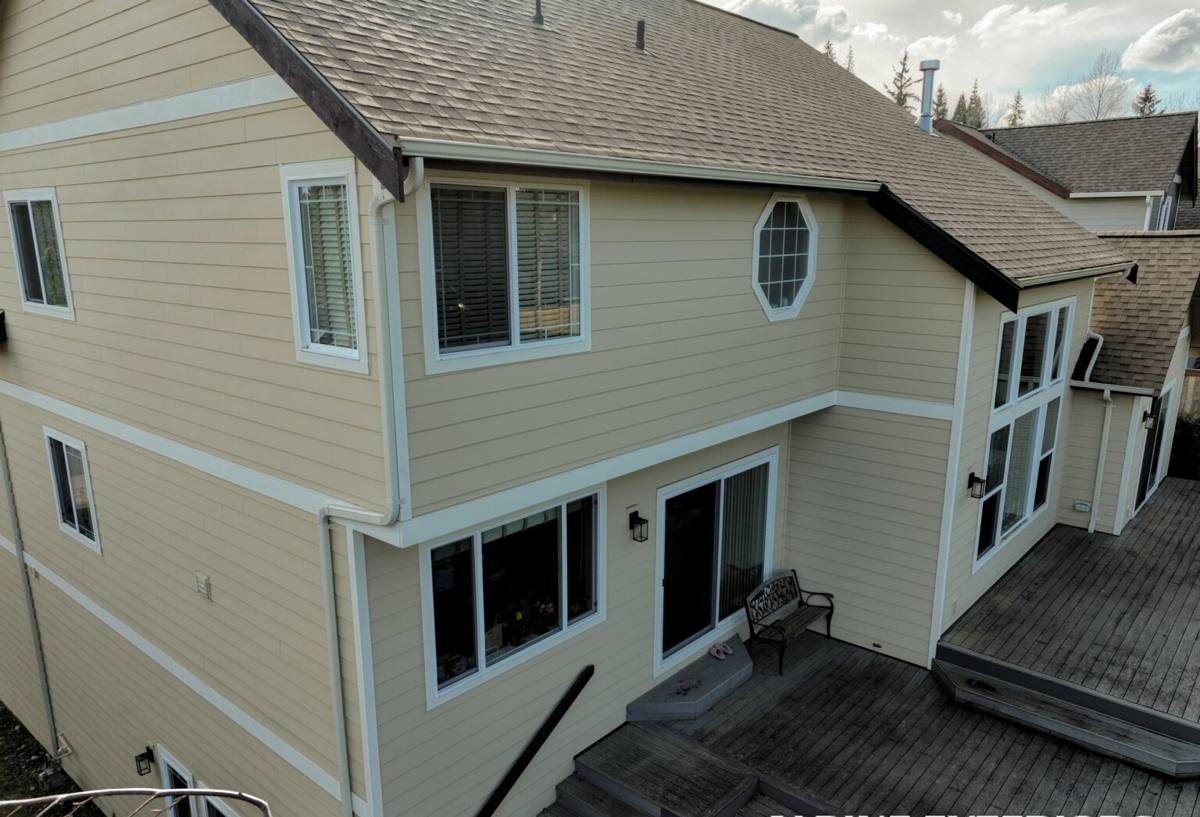
Signs Your Siding Needs Repair, Not Replacement
Most siding problems we get called out for in Lynden are localized. A full re-side is sometimes the right call, but it's often not necessary if the damage is caught early and confined to specific areas. Here's what to look for:
- Soft or spongy spots when you press on the siding, especially near the bottom courses or around windows and doors
- Visible gaps, cracks, or separation at butt joints and corners
- Paint that's bubbling, peeling, or flaking in patches rather than uniformly across the wall
- Dark streaking, moss, or algae buildup concentrated on shaded or north-facing walls
- Warping or bowing boards, particularly on walls exposed to prevailing wind-driven rain
- Rust stains bleeding from fasteners, which usually means the wrong fastener was used or it wasn't seated correctly
- Rot or damage at the transitions — where siding meets trim, roofline, deck ledger boards, or foundation
If what you're seeing is limited to one or two of these and the wall behind it is still sound, repair is almost always the right first step. Widespread soft spots across multiple walls, or rot that's clearly been traveling for a while, is a different conversation — and a good contractor will tell you honestly which situation you're in rather than defaulting to whichever answer costs more.
What a Correct Siding Repair Actually Involves
A siding repair that's done right is not just "cut out the bad piece and nail in a new one." That approach papers over the actual problem and the same failure often shows back up a season or two later. A repair worth paying for includes a few steps that are easy to skip if a crew is rushing:
1. Find out why the siding failed before replacing it
Rot and moisture damage almost always have a cause — a missing kickout flashing, a gap in the house wrap, a sealant joint that failed, a downspout dumping water where it shouldn't. Replacing the damaged board without fixing the cause just resets the clock on the same failure.
2. Check what's behind the siding, not just the siding itself
Once boards are pulled, we look at the water-resistive barrier, flashing, and sheathing underneath. If moisture has been getting behind the siding for a while, the damage is often more than skin deep, and that needs to be addressed before anything new goes back up.
3. Match the material correctly
We work almost exclusively in James Hardie fiber cement, and matching an existing Hardie installation means getting the right plank profile, exposure, and ColorPlus finish so the repair doesn't stand out as an obvious patch. This is one of the real advantages of hiring a crew that already knows the product line — a mismatched reveal or the wrong butt joint detail is visible from the street for years.
4. Detail the repair for the next storm, not just today
That means correct fastener placement, proper caulking only where Hardie's install guide calls for it (not everywhere, which traps moisture instead of shedding it), and flashing that actually directs water past the repair rather than into it.
Common Repair Scenarios We See Around Lynden
| Scenario | Typical Cause | What a Proper Fix Involves |
|---|---|---|
| Rot at the bottom courses near grade | Splash-back, poor grading, or siding installed too close to the ground | Cut back damaged material, correct clearance if possible, replace with properly flashed Hardie planks |
| Moss and algae buildup on shaded walls | Long moss season, limited sun exposure, tree cover | Clean with the correct method (not pressure-washing directly into seams), inspect for trapped moisture, treat and monitor |
| Damage around window and door trim | Failed caulking or flashing at penetrations | Remove and reset flashing, replace compromised trim and adjacent siding, reseal to spec |
| Cracked or separated butt joints | Wind-driven rain forcing water into unsealed or poorly lapped joints | Replace affected boards, correct joint detailing, confirm proper overlap and fastening |
| Impact damage (branches, debris, equipment) | Storms, tree limbs, yard work | Cut out and replace the damaged section, matched to existing profile and color |
Repair vs. Full Re-Side: How to Think About the Decision
Homeowners often assume any visible damage means a full re-side is coming. That's frequently not true, but there are a few honest factors that push the decision one way or the other:
- Extent: Damage isolated to one or two walls or specific spots usually favors repair. Damage spread across most of the exterior usually favors replacement.
- Age and condition of the rest of the siding: If the undamaged siding is nearing the end of its service life anyway, a repair is a short-term patch rather than a long-term fix.
- Underlying moisture history: If we open up a wall and find the water-resistive barrier or sheathing has been compromised in multiple areas, that points toward a broader problem than a spot repair can solve.
- What's actually installed now: If the current siding is a product we don't install — vinyl, LP SmartSide, primed wood — repair options are more limited, since we won't mix installation approaches across incompatible systems. In some of those cases, a targeted repair with matching material from the original installer makes more sense than us patching it with something different.
Our Process for a Lynden Repair Call
The process is straightforward and we keep it that way on purpose:
- We come out and inspect the damage in person, including pulling back siding where needed to see what's underneath.
- We tell you plainly whether it's a repair situation, a partial re-side, or a full replacement — and why.
- You get a written estimate with the scope spelled out, not a vague number.
- If you approve, we schedule the work and complete it to the same installation spec we use on full jobs, including correct flashing, fastening, and finish matching.
- We stand behind the repair the same way we stand behind new installations.
Why Hiring a Crew That Already Works Lynden Matters
Siding repair is one of those jobs where local familiarity actually changes the outcome, not just the convenience. A crew that regularly works in and around Lynden has already seen how the valley's humidity, the region's moss season, and driving rain off the marine weather systems affect siding on homes similar to yours. That means faster, more accurate diagnosis of why a repair failed in the first place, rather than guessing.
It also means accountability. A contractor based in Ferndale who works this part of Whatcom County regularly is going to be around next year if a question comes up about the repair — not a crew that passed through once and moved on. That matters more with siding repair than almost any other exterior trade, because a poorly diagnosed repair often doesn't show its failure until the next wet season.
Why We Only Work With James Hardie
We install and repair James Hardie fiber cement siding exclusively. It's non-combustible, holds a factory-baked ColorPlus finish that resists the fading and chalking that repainting cycles are meant to fix, and its HZ product lines are engineered specifically for climate zones like ours — cold, wet, humid. That consistency matters even more on repair work than on new installs, because we're not guessing how a replacement board will perform against the original material over the next ten winters. We know how Hardie behaves in this climate because we've watched it hold up in it.
That standardization is also why we're upfront when a home has a different siding product on it. We won't pretend a repair on vinyl or engineered wood is something it isn't, and we'll tell you honestly what your options are, even if that means recommending you go elsewhere for a like-for-like patch.
If you're seeing damage, soft spots, or moss buildup on your Lynden home's siding, we're happy to take a look and give you a straight answer on what it needs. Reach out for a free, no-pressure estimate — there's a form below.