 Ferndale
 Decking in an Exclave: Point Roberts' Unique Climate Load
Point Roberts sits on its own peninsula at the bottom of the Tsawwassen Peninsula, surrounded on three sides by water and cut off from the rest of Whatcom County by the international border. That geography matters more for a deck than most homeowners realize. A home here takes on marine air off the Strait of Georgia and Boundary Bay almost constantly, along with the same long, wet Pacific Northwest winters that soak the rest of Whatcom County. The combination — persistent salt-laden humidity plus months of low sun and standing moisture — is harder on exterior wood surfaces than what you'd see even a few miles inland.
A deck built for a dry-climate spec sheet doesn't hold up out here. What does well is a system chosen and installed specifically for salt exposure, driving rain, and a moss season that can run from October through April. That's the lens we use on every Point Roberts decking project.
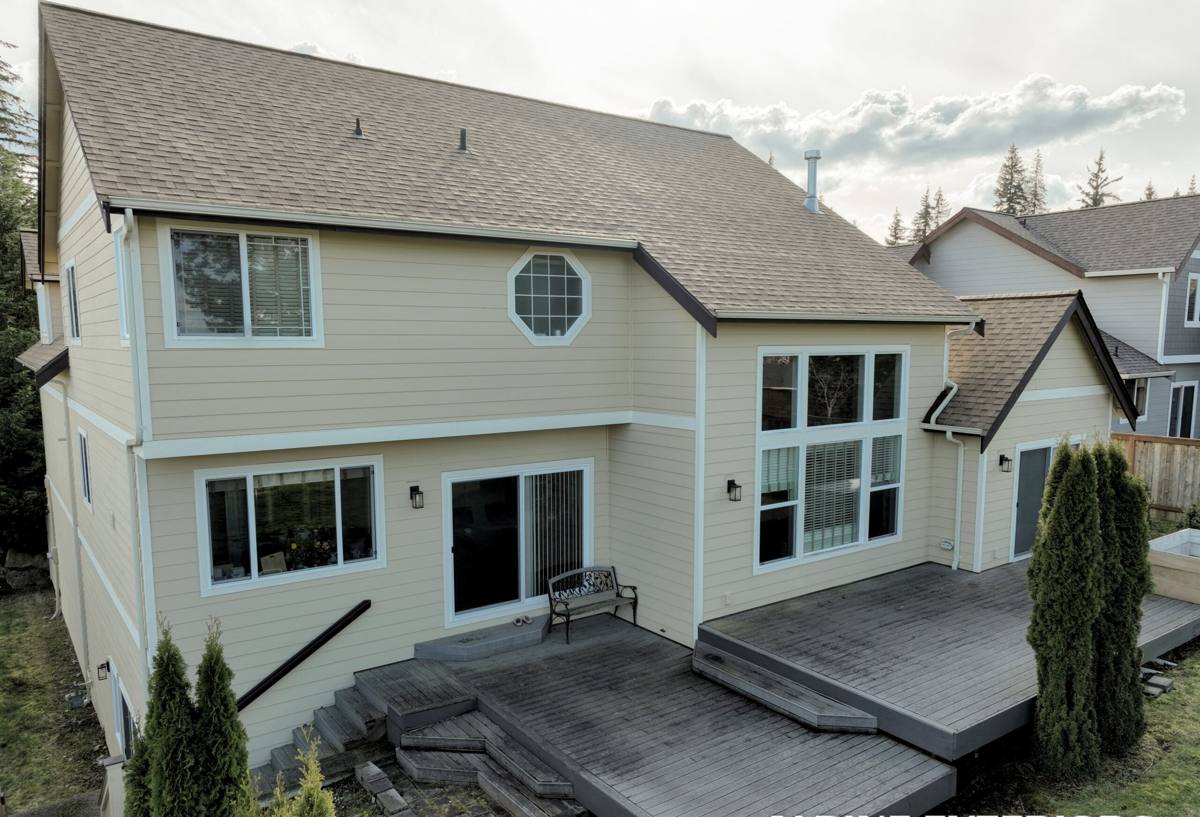
What Salt Air, Rain, and Moss Actually Do to a Deck
Salt Air
Airborne salt doesn't just sit on the surface — it works into fasteners, connectors, and any exposed end grain. On wood decking it accelerates graying and checking. On lower-grade composite boards it can dull surface color faster than the same product would fade a few miles inland. Metal hardware is the bigger concern: standard coated screws and joist hangers corrode noticeably faster in a marine environment than they do even 15-20 miles east.
Driving Rain
Wind-driven rain off the water doesn't fall straight down — it gets pushed sideways into ledger boards, stair stringers, and the gap between decking and house siding. Water that would run off a flat roof in a calmer climate gets forced into joints and end cuts here. Flashing details and gap spacing that are "good enough" elsewhere aren't good enough on an exposed Point Roberts lot.
Moss and Mildew
Low winter sun angles, tree cover on many lots, and near-constant dampness create ideal moss and algae conditions for six-plus months of the year. Moss doesn't just look bad — it holds moisture against the board surface and, on the wrong material, that trapped moisture drives rot at fastener holes and end cuts. Any decking material or board profile we recommend out here has to shed water and resist organic growth, not just look good in a showroom.
Why Composite Makes Sense for This Location
We install real wood decking elsewhere in our service area, but for Point Roberts specifically, composite is usually the more honest recommendation. It's not that wood "fails" here — it's that wood in this environment demands a maintenance schedule (annual sealing, more frequent board replacement, more vigilant hardware checks) that most homeowners, especially those managing a second home or vacation property across the border, aren't set up to keep on top of.
A quality composite board is manufactured to resist moisture absorption, doesn't require yearly sealing, and holds its color better under UV and salt exposure than an unsealed or infrequently maintained wood deck will. That trade-off — slightly higher material cost up front, meaningfully less upkeep over the life of the deck — is the right call for most of the properties we see out here, particularly ones that sit empty for stretches at a time.
Capped vs. Uncapped Composite
| Factor | Capped Composite | Uncapped Composite |
|---|---|---|
| Moisture resistance | Sealed polymer shell resists water and salt intrusion on all sides | More porous; can absorb moisture at cut ends and surface over time |
| Moss/algae resistance | Smooth cap sheds standing water, harder for spores to grip | More textured surface holds moisture longer, favors growth |
| Fade resistance in coastal UV/salt | Better long-term color hold | More noticeable fading and graying over several seasons |
| Upfront cost | Higher | Lower |
| Our recommendation for Point Roberts | Preferred for full sun/wind exposure or waterfront-facing decks | Acceptable on sheltered, shaded, low-exposure decks |
What a Correct Composite Deck Build Actually Involves
Composite decking is often sold as a "low maintenance" product, and it is — but only if the substructure and installation underneath it are done right. The board itself is only part of the system. On a marine-exposed site like Point Roberts, we pay particular attention to:
- Ledger board flashing: proper metal flashing and a drainage gap where the deck meets the house, so wind-driven rain can't wick behind the band board.
- Joist protection: joist tape or an equivalent moisture barrier on top of every joist, since composite decking traps more moisture against the substructure than open wood does.
- Fastener selection: stainless steel or marine-rated hidden fasteners and structural connectors, not the standard coated hardware that's fine 20 miles inland but corrodes faster here.
- Board spacing: gapping tuned for our wet season, wide enough for drainage and airflow without becoming a debris trap.
- Ventilation underneath: enough clearance and airflow below the deck surface to let the substructure dry out between rain events instead of sitting damp for weeks.
- Stair and rail connections: these see the most direct wind-driven rain and the most foot traffic, so they get the same hardware standard as the ledger — no shortcuts.
Skip any one of these and you can still end up with rot, corrosion, or a moss problem underneath a composite deck that looks fine from above. The board is engineered to last decades; the framing and fasteners underneath it have to be built to the same standard, or they become the weak point.
Our Process on a Point Roberts Project
1. Site Evaluation
We look at sun exposure, wind direction, existing drainage, and how close the deck sits to the water line, since that tells us how much salt and wind-driven rain it's actually going to take. We also check the condition of any existing substructure if this is a replacement.
2. Material Selection
Based on exposure, we walk you through capped vs. uncapped options, color choices (darker colors show less algae staining but run hotter underfoot; lighter colors hide less dirt but resist heat buildup), and railing systems that hold up to the same conditions.
3. Permitting
Deck work typically requires a permit through Whatcom County. Because Point Roberts is geographically separated from the rest of the county, we build the extra logistics — scheduling inspections, coordinating material delivery through the border crossing — into the project timeline up front rather than treating them as surprises.
4. Tear-Out and Framing
On replacement projects, we remove old decking and inspect the ledger, posts, and footings before anything new goes down. Framing issues are far cheaper to fix before the new deck surface goes on than after.
5. Installation
Hidden fastener systems, proper board gapping, and stainless hardware throughout. We finish with railing, stair treads, and any picture-frame border detailing as part of the same continuous install, not a separate follow-up trip.
6. Final Walkthrough
We walk the finished deck with you, cover basic care specific to your board choice, and point out anything worth watching (drainage points, areas more prone to shade and moss buildup) based on your specific lot.
Maintaining a Composite Deck Through Whatcom County's Moss Season
Composite is low maintenance, not no maintenance, especially with a moss season this long. A simple seasonal routine keeps a deck looking right and prevents the kind of buildup that eventually stains or degrades even a capped board:
- Sweep leaves and debris off the deck surface regularly through fall — trapped organic matter is what feeds moss and algae growth.
- Rinse with a garden hose and a soft-bristle brush a few times a year; avoid pressure washers on composite unless it's a wide-fan, low-pressure setting, since tight pressure streams can etch the surface cap.
- Use a composite-safe deck cleaner for any moss or mildew staining — avoid straight bleach, which can discolor some board finishes.
- Keep gutters and downspouts near the deck clear so runoff isn't dumping directly onto the deck surface or substructure.
- Check railing posts and stair connections once a year for any looseness — hardware is the first thing to show wear in a salt environment, well before the boards do.
- Trim back overhanging branches where possible; shade slows drying time and speeds up moss growth on the deck surface.
Cost Factors to Expect
Composite decking costs more up front than pressure-treated wood, and pricing varies by board tier, deck size, railing style, and site access. Rather than quote a number that won't reflect your actual property, here's what moves the price on a typical Point Roberts project:
| Factor | Why it affects cost |
|---|---|
| Board tier (uncapped vs. capped) | Capped boards carry a higher material cost but lower long-term maintenance |
| Substructure condition | Replacing rotted framing or footings adds labor beyond the visible decking work |
| Deck height and railing requirements | Taller decks need code-compliant railing systems, which adds material and labor |
| Site access and material delivery | Point Roberts' border-crossing logistics can add scheduling time versus a mainland Whatcom County job |
| Stairs and multiple levels | Each stair run and landing adds framing, fastening, and finish work |
We give a firm, itemized quote after the site visit — not a phone estimate — because so much of the real cost depends on what's underneath the existing deck and how exposed the site is.
Why It Matters That We Already Work in Point Roberts
Point Roberts isn't a typical job site. Crews and material deliveries cross an international border to get there, which means scheduling has to account for border wait times and customs logistics that don't factor into a normal Whatcom County job. A contractor who hasn't planned for that can turn a straightforward deck build into a string of delays.
Beyond logistics, familiarity with the local exposure conditions matters. We've seen how differently a deck ages on a wind-exposed lot near the water compared to a sheltered, tree-covered lot a few blocks in, and we adjust material and fastener recommendations accordingly rather than applying a one-size-fits-all spec. That's the difference between a deck that's still solid in fifteen years and one that starts showing corrosion and moss problems in five.
Get an Honest Estimate
If you're planning a new composite deck or replacing an aging one on a Point Roberts property, we're happy to take a look and walk you through what your specific site needs — no pressure, no upsell on materials you don't need. Use the form below to request a free estimate.