 Ferndale
 Point Roberts Asks More of Siding Than Most of Whatcom County
Point Roberts sits on its own peninsula, surrounded by water on three sides, which means homes there take a steadier beating from the weather than houses just a few miles inland in Ferndale. The exposure is more constant: salt-laden air moving in off the water, wind-driven rain that hits siding at an angle instead of falling straight down, and a damp season that runs long even by Pacific Northwest standards. None of that is exotic weather, but it adds up differently on a peninsula than it does further inland, and it shows up first in the siding.
Salt Air and Corrosion
Air moving off saltwater carries fine salt particles that settle on exterior surfaces and accelerate corrosion of anything metal — fasteners, flashing, trim edges. Siding materials that depend on paper facings, adhesives, or bare wood fibers are more vulnerable to that slow chemical breakdown than a material that's inert to begin with. Over years, homes closer to the water tend to show fastener staining, trim corrosion, and finish breakdown sooner than homes set back from it.
Driving Rain Off the Water
Rain that comes in sideways off open water finds every gap a straight-down rain would miss. It gets pushed under lap joints, behind trim, and into seams that would stay dry in a more sheltered location. That's a water-management problem as much as a material problem — it means flashing details and drainage planes matter more here than they do on a wall tucked behind trees or other buildings.
A Moss Season That Doesn't Really End
Cool, wet, low-sun conditions are exactly what moss and algae need, and Point Roberts gets a long stretch of them — often from fall through spring, with shaded or north-facing walls staying damp even between storms. Siding that holds moisture at the surface gives moss something to grow on. Siding that sheds water and dries quickly gives it less of a foothold.
Why We Only Install Fiber Cement Here
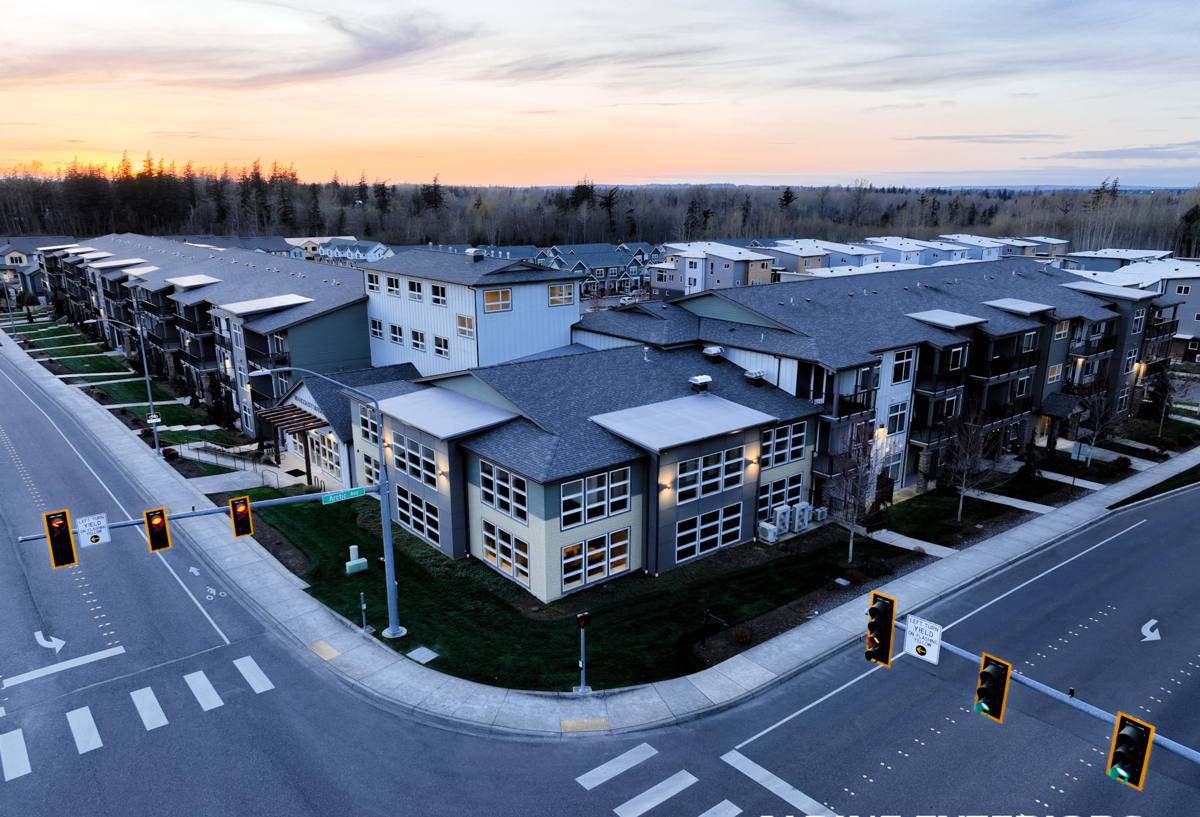
We install James Hardie fiber cement exclusively, and in a location like Point Roberts, that's not a marketing preference — it's a practical one. Fiber cement is dimensionally stable, so it doesn't swell, cup, or delaminate the way wood-based or wood-fiber products can when they take on repeated moisture. It's non-combustible. And because Hardie's factory-applied ColorPlus finish is baked on rather than field-painted, the color layer itself is more resistant to the fading and chalking that salt air and UV exposure cause over time on a repainted surface.
The table below lines up what this climate throws at a wall with what the siding actually needs to do about it.
| Climate Factor in Point Roberts | What the Siding Needs to Handle It |
|---|---|
| Salt-laden air off the water | Corrosion-resistant fasteners and trim; a material that doesn't rely on organic fibers or adhesives that break down chemically over time |
| Wind-driven, angled rain | Correctly lapped and flashed joints, a drainage plane behind the siding, and sealant only where it's actually needed |
| Long moss and algae season | A dense, factory-finished surface that sheds water quickly rather than holding it at the surface |
| Repeated wet/dry cycling | Dimensional stability — a material that doesn't swell, warp, or crack from repeated moisture uptake |
What Correct Installation Involves in This Climate
Fiber cement is only as good as the install behind it. In a high-exposure spot like Point Roberts, a few details matter more than they would on a sheltered inland lot.
Weather Barrier and Flashing
A continuous, properly lapped weather-resistant barrier goes on before the siding, with flashing integrated at every window, door, deck ledger, and roof-to-wall transition. In a location that takes rain from more angles than average, gaps in flashing are where water gets in — and where it gets in is usually not where it shows up first.
Fasteners That Won't Corrode
We use fasteners rated for the exposure, not just whatever's cheapest to run. In a salt-air environment, corrosion-resistant fastener choices aren't optional — a fastener that starts rusting will eventually stain the siding and lose its grip.
A Rainscreen Gap for Drainage and Drying
Leaving a drainage gap between the weather barrier and the back of the siding gives any moisture that does get past the outer layer a path to drain and air to circulate and dry it out. On a wall that stays damp longer than average, that airflow is what keeps moisture from sitting against the wall assembly.
Caulking, Trim, and Joint Details
Hardie's installation instructions call for specific clearances above grade, decks, and roof lines, and specific gapping and sealant practices at butt joints and trim. Skipping these is the single most common cause of early siding failure — not the material, the shortcuts around it.
ColorPlus Finish and the HZ5 Product Line
James Hardie engineers its siding by climate zone, and the HZ5 line is built for the wetter, cooler conditions found throughout Western Washington, including Whatcom County and the coastal exposure Point Roberts sees more of than most. The ColorPlus finish is applied and cured in a factory setting under controlled conditions, which gives it more consistent coverage and better adhesion than a field-applied coat of paint typically achieves — and it carries its own finish warranty separate from the substrate warranty, backing both the material and the color.
That combination — a substrate engineered for wet climates, plus a finish that isn't fighting the local weather to cure properly on installation day — is a meaningful part of why this material holds up on exposed sites over a long ownership timeline.
Our Process for a Point Roberts Siding Job
- Assessment — We look at the current siding, wall assembly, and specific exposure of your home: which sides face open water or prevailing wind, where moss is already established, and where past water intrusion may have occurred.
- Scope and estimate — We walk through what's needed — full tear-off versus sections, trim and flashing repairs, any sheathing repair if water damage is found underneath — before any work starts, so there are no surprises mid-job.
- Tear-off and inspection — Removing the old siding lets us actually inspect the sheathing and framing underneath, which is often the only way to know what shape the wall is really in.
- Weather barrier, flashing, and rainscreen — This is the layer that does the real water-management work; the siding is the visible layer on top of it.
- Siding installation — Installed to Hardie's specifications for fastening pattern, clearances, and joint treatment.
- Trim, caulking, and final walkthrough — We finish trim details and go through the completed job with you before calling it done.
Why It Matters That We Already Work in Point Roberts
Point Roberts is a US exclave — reaching it by land means crossing into Canada and back out again, which affects how material deliveries and crew scheduling have to be planned compared to a job in Ferndale itself. A crew that hasn't worked there before is learning that logistics puzzle on your job. We've already built the delivery timing and border-crossing logistics into how we schedule Point Roberts work, so it doesn't turn into delays or a job that drags out longer than it should.
There's also a familiarity factor that isn't about paperwork. Knowing which sides of a typical Point Roberts home take the worst of the water exposure, and where moss tends to establish first on that specific kind of lot, comes from having done the work there before — not from a general siding background.
Maintenance After Installation
Fiber cement is low-maintenance, not no-maintenance. A little attention keeps it looking right for the long haul, especially given how long the damp season runs in this part of Whatcom County.
- Rinse siding annually, and more often on shaded or north-facing walls where moss tends to establish first
- Keep gutters and downspouts clear so water isn't sheeting down the siding face
- Trim back vegetation and tree cover that keeps walls shaded and slow to dry
- Re-caulk joints and trim if you notice cracking or gaps opening up over time
- Have flashing and trim inspected periodically, since that's where small problems show up before they become bigger ones
What Affects the Cost of a Point Roberts Job
Every job is priced on its own scope, but a few factors consistently move the number for homes in this area: how much of the existing siding needs to come off versus how much can stay, whether sheathing repair is needed once the old siding is removed, the amount of trim and detail work around windows and rooflines, and delivery logistics tied to the exclave's location. We'll walk through all of it with you before any work starts, in plain terms, so you know what you're paying for and why.
If you're weighing new siding for a Point Roberts home, we're happy to take a look and give you a straightforward, no-pressure estimate — just fill out the form below and we'll go from there.