 Ferndale
 Why Birch Bay Siding Wears Differently Than the Rest of Whatcom County
Birch Bay sits right up against the water, and that changes the math on siding repair. Homes a few miles inland around Ferndale deal with Whatcom County's wet winters, but they're not getting a steady dose of salt-laden air off the bay on top of it. That salt exposure accelerates corrosion on anything metal behind or holding your siding on — fastener heads, flashing, trim caps — long before it becomes visible as a soft spot or a loose board.
Add in driving rain that comes off the water at an angle instead of straight down, and you get wind-driven moisture forced into seams, laps, and corner joints that would stay dry on a more sheltered inland wall. Then there's the shade. Plenty of Birch Bay lots are wooded or set close together, which keeps north- and east-facing walls damp and slows drying — exactly the conditions moss and algae need to get established and stay established most of the year.
None of that means Birch Bay siding fails faster across the board. It means the failure points are predictable if you know what to look for, and a repair that ignores salt, wind-driven rain, or moss exposure tends to come back sooner than it should.
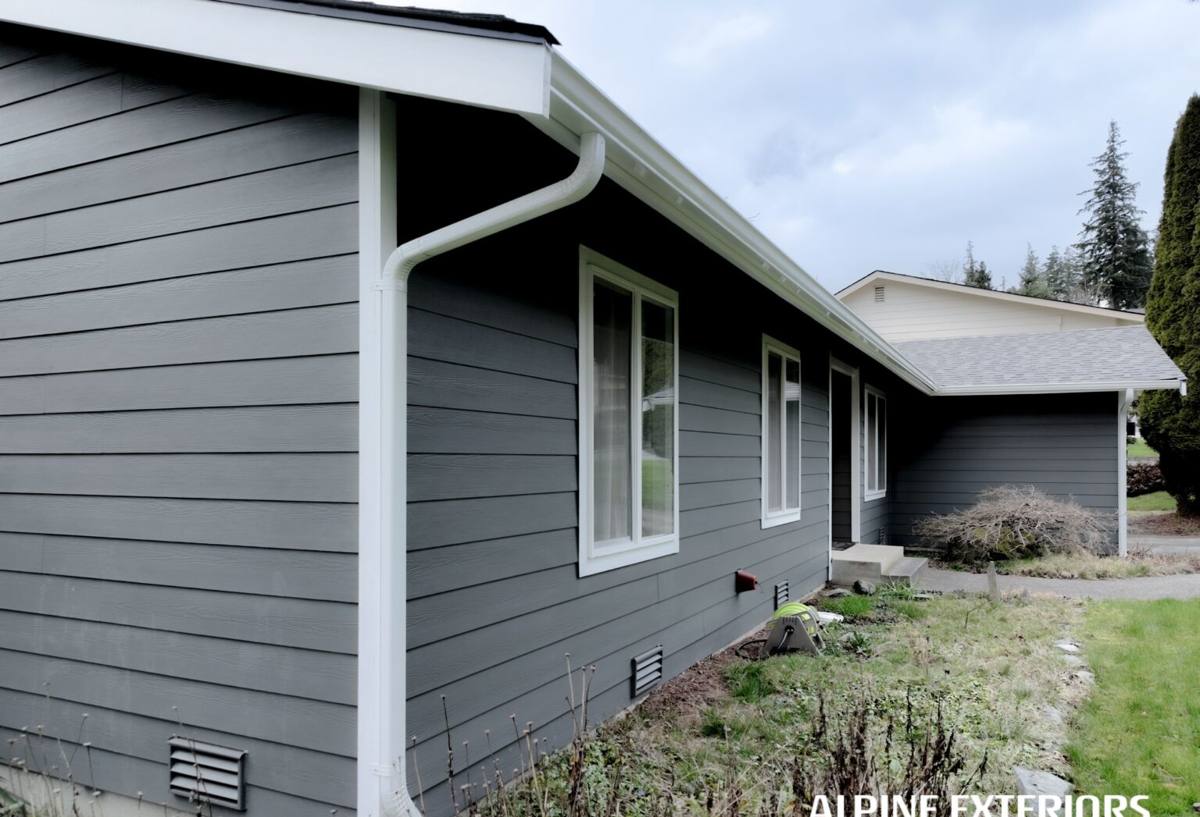
The Warning Signs Worth a Second Look
Salt-Air Corrosion Clues
Rust streaks bleeding down from a nail head or a piece of trim are one of the clearest signs that fasteners or flashing are corroding faster than the siding around them. Left alone, a corroded fastener eventually loses its grip, and a board that's supposed to be locked flat starts to lift at the edge — which then gives wind-driven rain a place to get behind the wall.
Moss, Algae, and Trapped Moisture
A little surface moss on a shaded wall isn't an emergency. What matters is whether it's holding moisture against the siding long enough to soften what's underneath. Watch for paint that's bubbling or peeling in patches rather than fading evenly, discoloration concentrated at butt joints or the bottom of a wall, and any spot that feels spongy or gives slightly when you press on it. Those are signs moisture has already worked past the surface.
What a Correct Repair Actually Involves
A repair that's just cosmetic — cutting out a damaged piece and slotting in something that looks similar — is the kind of fix that fails again in a season or two on a site like Birch Bay. Done correctly, a siding repair here means:
- Removing the damaged material back to solid, sound substrate, not just the visibly bad section
- Checking the house wrap or weather barrier behind the repair area for tears, gaps, or staining that points to moisture already having gotten through
- Inspecting and repairing flashing at the point of failure, since a bad repair patched over failed flashing just fails the same way again
- Letting framing or sheathing dry out fully before anything new goes back on, especially during Whatcom County's slower-drying winter months
- Matching the replacement material's profile, exposure, and finish so the repair doesn't stand out or shed water differently than the surrounding wall
- Fastening to the manufacturer's specified pattern rather than whatever gets it to hold for now
Skip any one of those steps and you've covered up a problem instead of fixing it — which shows up again as the same stain, the same soft spot, or the same lifted corner within a year or two.
Repair or Replace? How We Make That Call
Not every siding issue needs a full re-side, and we're not going to tell you it does. A repair makes sense when the damage is isolated — a handful of boards, one section of wall, corrosion caught while it's still cosmetic. A full re-side is the honest recommendation when the inspection turns up moisture damage spread across multiple sections, when the existing siding is old enough that it's reaching the end of what it can be expected to hold up, or when we'd be repairing the same wall for the second or third time.
There's also a material-matching reality worth being upfront about. If your home has vinyl, LP SmartSide, or cedar siding, we may not be able to source an exact match — colors get discontinued, profiles change, and cedar in particular weathers unevenly next to a fresh patch. In those cases we'll tell you plainly whether a targeted repair will actually blend and hold, or whether you're better served re-siding the affected wall — or the house — with a single, correctly matched product from the start.
Our Birch Bay Siding Repair Process
- On-site inspection — a physical look at the damage plus moisture readings where the wall assembly is accessible, not just a glance from the ground
- Diagnosis — what failed, why it failed, and whether the cause is isolated or likely to show up elsewhere on the house
- Repair plan — matching material sourced where possible, or a straightforward recommendation to widen the scope if we find hidden damage
- Careful removal — taking out only what needs to come out, without damaging sound siding around it
- Addressing the moisture path first — flashing and weather barrier repaired before anything new goes back on the wall
- Reinstallation to spec — correct fastening pattern, correct exposure, correct clearances
- Finish match — factory-finished color match where the repair is on Hardie siding, or a clean field-paint touch-up where that's what the wall requires
- Final walk-through — so you know exactly what was done and why
What Drives the Cost of a Repair
Every repair is different, but the same handful of factors move the price up or down on almost every Birch Bay job we quote:
| Factor | Why It Matters | What It Means for Your Estimate |
|---|---|---|
| Extent of visible damage | A few boards versus a whole wall changes labor and material scope directly | Small, isolated repairs cost less; wider damage narrows the gap with a partial re-side |
| Hidden moisture behind the siding | Damaged sheathing or wet insulation isn't visible until the wall is opened up | Can add cost once discovered — we flag this as a possibility before starting |
| Accessibility | Second-story walls, tight side yards, and waterfront setbacks common in Birch Bay affect equipment and labor time | Harder-to-reach areas typically add time and cost |
| Material matching | Discontinued colors or profiles on older vinyl, LP, or cedar siding may not be replicable | May shift the recommendation from a patch to a broader re-side of the section |
| Flashing and trim condition | Corroded or failed flashing has to be replaced, not just siding around it | Adds material and labor beyond the siding itself |
Why We Stand Behind James Hardie for Every Repair
When a repair on an existing wall opens things up and we find widespread caulking failure, corroded fasteners across several sections, or moisture that's traveled further than the original damage suggested, we're upfront that the material we install going forward is James Hardie fiber cement — nothing else. That's not a sales pitch layered onto a repair call; it's a standard we hold to because of what this specific exposure does to alternatives over time.
Vinyl siding can warp, fade, or become brittle faster under direct salt-laden sun and wind than it would a few miles inland. Wood-based and engineered wood products are more sensitive to moisture if the weather barrier behind them is ever compromised — which is exactly the failure mode we're often called out to repair. Cedar needs ongoing refinishing, and that maintenance cycle only gets shorter this close to the water. James Hardie's fiber cement is non-combustible, its ColorPlus factory finish is built to resist the fading and chalking that salt air and sun accelerate, and its HZ product lines are engineered for exactly this kind of climate exposure. Paired with a strong transferable warranty, it's the material we're comfortable standing behind when a Birch Bay repair grows into a bigger conversation.
Why Local Experience in Birch Bay Matters
A crew that already works this stretch of coastline knows which wall orientations take the brunt of wind-driven rain off the bay, which shaded, wooded lots need extra attention for moss before it gets ahead of the paint, and how much longer wet sheathing takes to dry out during a Whatcom County winter compared to a summer repair. That familiarity shows up in smaller ways too — knowing not to seal a Hardie repair the way you'd caulk a vinyl patch, or recognizing corrosion patterns that are specific to salt exposure rather than assuming every stain is the same generic moisture problem. It's the difference between a repair that's built for this location and one that's built for anywhere.
Keeping a Repair Ahead of the Next Storm Season
A correctly done repair still needs a little upkeep to get its full lifespan out of it, especially this close to the water:
- Rinse salt residue and moss growth off exterior walls at least once a year — more often on shaded or water-facing sides
- Keep gutters and downspouts clear so runoff isn't running across the siding face
- Trim back trees and shrubs that keep walls shaded and slow to dry after rain
- Check fastener heads and trim for early rust streaks, and address them before corrosion spreads
- Only reseal or touch up paint where the manufacturer calls for it — over-caulking field joints can trap moisture instead of keeping it out
- Have siding checked after a major windstorm, not just once a year on a schedule
If you're seeing rust streaks, soft spots, lifted boards, or moss that won't quit on a Birch Bay home, it's worth having it looked at before the next wet season pushes a small problem further into the wall. We're happy to come take a look and give you a straightforward, no-pressure estimate — just fill out the form below.