 Ferndale
 Building a Deck That Actually Holds Up in Sudden Valley
Sudden Valley sits in a part of Whatcom County where the weather doesn't do a homeowner any favors. Decks here take a beating from three directions at once: damp salt-tinged air rolling in off the water, driving rain that comes in sideways more often than straight down, and a moss season that can stretch from late fall clear into spring. A deck built to a generic national spec — the kind you'd see in a big-box how-to guide written for a dry climate — will show problems within a few years. Soft spots at the ledger, black streaking on the boards, corroded fasteners bleeding rust down the face boards, railing posts that wobble because the post base never had a chance to drain. None of that is inevitable. It's the result of a deck built without accounting for where it's actually going to live.
We're a Ferndale-based crew that works Sudden Valley regularly, and this page is about that one job — deck building — done right for this one area. Not a general contractor pitch, not a catalog of every service we offer. Just what a correct deck looks like here, and why it's worth hiring people who already know the conditions instead of relearning them on your project.
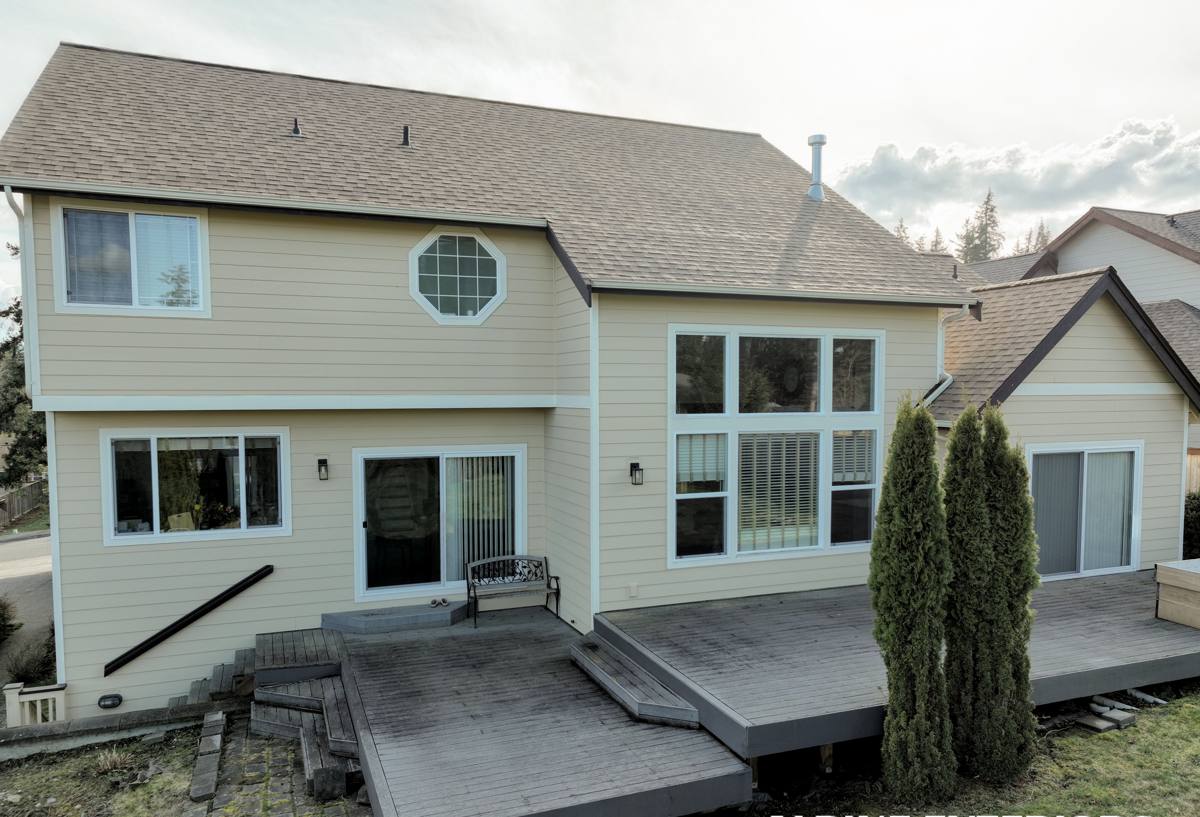
What This Climate Actually Does to a Deck
Moisture That Doesn't Let Up
The bigger issue in Sudden Valley isn't any single storm — it's the sheer number of wet days in a row. Wood and composite decking both need time to dry out between rain events. When that drying window keeps getting cut short, moisture works its way into end grain, fastener holes, and any spot where two pieces of material meet without a gap. That's where rot starts, and it's almost always invisible until the board is already compromised.
Salt Air and Metal Hardware
Salt-laden air accelerates corrosion on anything metal — screws, joist hangers, post bases, railing brackets. Standard electro-galvanized fasteners that might be fine forty miles inland can start showing rust streaks on a coastal-influenced deck in a couple of seasons. That rust doesn't stay put; it stains the decking around every fastener head and weakens the connection underneath.
Moss, Algae, and Surface Buildup
A long, cool, wet moss season means anything shaded or slow to dry — the north side of a deck, the area under a hot tub, boards tight against the house — grows a slick green film that's not just unsightly. It holds moisture against the wood, and on composite it can actually etch or stain the surface if it's left to sit for a full season.
Material Choices That Make Sense Here
There's no single "best" decking material — there's a best material for this climate and this budget. Here's how the common options actually perform under Whatcom County conditions, not in a showroom.
| Material | How it handles our climate | Maintenance reality | Rough lifespan here |
|---|---|---|---|
| Pressure-treated lumber | Handles moisture fine if properly sealed and detailed; least forgiving of skipped maintenance | Needs re-sealing every 1-2 years in this rain pattern | 15-20 years with upkeep |
| Cedar | Naturally rot- and insect-resistant, ages to gray if left unfinished, still needs end-grain protection | Stain/seal every 2-3 years to hold color and resist moss | 20-25 years with upkeep |
| Composite decking | Won't rot, but can trap surface moisture and grow moss/algae film if not cleaned | Periodic washing, no sealing, but moss removal is manual | 25-30 years, backed by product warranty |
| PVC decking | Fully moisture-proof board itself, best resistance to staining and mildew | Lowest maintenance, occasional wash | 25-30+ years, backed by product warranty |
We don't push one product across every job. A shaded, low-airflow deck under trees is a poor candidate for anything that needs regular sealing — that's a composite or PVC conversation. A sun-exposed deck with good airflow can do very well in cedar or treated lumber for a fraction of the material cost, as long as the finish schedule actually gets kept up. We'll tell you honestly which category fits your site and your appetite for maintenance, including where a lower-cost option means more work down the road — that's a trade-off, not a defect in the product.
The Structural Basics That Actually Determine Lifespan
The decking surface is what you see; the framing underneath is what determines whether the deck is still safe and sound in fifteen years. In a wet climate, these details matter more than they would somewhere dry:
- Ledger flashing: The point where the deck attaches to the house is the single most common failure point on a deck near water-heavy weather. Proper flashing keeps water from working behind the ledger board and into the house framing.
- Joist tape or capping: Covering the tops of joists with a waterproof membrane keeps rain from soaking into end grain and fastener holes, which is where rot starts on an otherwise sound frame.
- Post base drainage: Posts set directly on concrete without a standoff base sit in standing water after every rain. A proper elevated post base keeps the end grain off wet surfaces.
- Fastener grade: Stainless steel or high-grade coated fasteners cost more up front and hold up far better against salt-influenced air than standard galvanized hardware.
- Board spacing and airflow: Correct gapping between boards, and clearance underneath the deck, let air move through so surfaces actually get a chance to dry between storms — which is what keeps moss from taking hold in the first place.
How We Build a Deck in Sudden Valley
Site Visit and Design
We start by walking the site — sun exposure, drainage direction, tree cover, how close the deck sits to the ground, and how it ties into the house. That tells us which material and detailing approach fits, rather than defaulting to a one-size answer.
Permitting
Most deck projects of any real size need a permit through Whatcom County, and elevated decks or those attached to the home almost always do. We handle that process as part of the job so it's not left for the homeowner to sort out.
Framing
This is where the climate-specific work happens: correct ledger flashing, joist protection, footing depth appropriate to the soil, and post bases that keep wood off standing water. It's the part of the job nobody sees once it's done, and it's the part that determines whether the deck is still tight in ten years.
Decking and Railing
Boards go down with proper spacing for drainage and expansion, fastened with hardware rated for the exposure. Railing is set to current code height and spacing requirements, with posts anchored to actually resist lateral load — not just cosmetically attached.
Final Walkthrough
We walk the finished deck with you, cover what maintenance it'll actually need and on what schedule, and make sure everything is solid before we call it done.
What Maintenance Looks Like Here, Realistically
Every deck needs some upkeep — the honest question is how much and how often in this specific climate.
- Clear leaves, needles, and debris off the deck surface and between boards through fall, when buildup traps moisture against the wood.
- Sweep or wash off moss and algae film before it establishes, especially on shaded sections — once it's ground in, it takes more than a hose to remove.
- Check fastener heads and hardware once a year for early rust staining, particularly on decks with any salt-air exposure.
- Reseal wood decking on the schedule appropriate to the product — skipping a cycle in this rain pattern shortens the board's life noticeably.
- Confirm gutters and downspouts near the deck are directing water away, not dumping it onto the structure or ground beneath it.
Why a Local Ferndale Crew Matters for This Job
A crew that's built decks all over the country can still do competent framing. What they can't do without local experience is know, without guessing, which side of a Sudden Valley lot holds moisture longest, which fastener grade actually holds up against the salt air coming off the water, or how long a finish realistically lasts before the moss season starts winning. We work this area regularly, which means the material and detailing choices on your deck come from what we've seen hold up here — not from a spec sheet written for a different climate.
Questions Worth Asking Before You Hire
Whoever builds your deck, these are reasonable things to ask before signing a contract:
- Will the ledger board be flashed, and how?
- What grade of fastener and hardware is being used, and is it rated for coastal-influenced air?
- Will joists be capped or taped to protect end grain?
- What's the post base detail — is wood kept off standing water?
- Is a permit being pulled, and who's responsible for the inspection?
- What maintenance schedule does the chosen material actually require in this climate?
If a contractor can't answer those clearly, that's worth noticing before the framing goes up, not after.
If you're planning a new deck or replacing a tired one in the Sudden Valley area, we're happy to come take a look and give you a straightforward, no-pressure estimate — just fill out the form below.