 Ferndale
 Birch Bay's Climate Is Harder on a Roof Than Most Homeowners Realize
Birch Bay sits right on the water, and that changes what a roof has to deal with compared to a home a few miles inland in Ferndale. The combination of salt-laden air, driving rain off the Salish Sea, and a long, damp moss season puts real wear on asphalt shingles that a manufacturer's warranty label doesn't account for. None of this means asphalt shingles are the wrong choice for a Birch Bay home — they're still one of the most practical, cost-effective roofing systems available. It means the installation has to be done with this specific environment in mind, not treated like any other roof in Whatcom County.
Salt air accelerates corrosion on exposed metal — nail heads, flashing, vent stacks, and gutter hardware all take a beating faster here than they would twenty minutes inland. Wind-driven rain doesn't just fall straight down; it gets pushed sideways and upward under shingle edges and around penetrations, which means flashing details and underlayment choices matter more here than in calmer inland neighborhoods. And the moss season — which in this part of Whatcom County can run for the better part of the year on shaded, north-facing slopes — feeds on the organic material in older shingles and holds moisture against the roof deck long after a storm has passed.
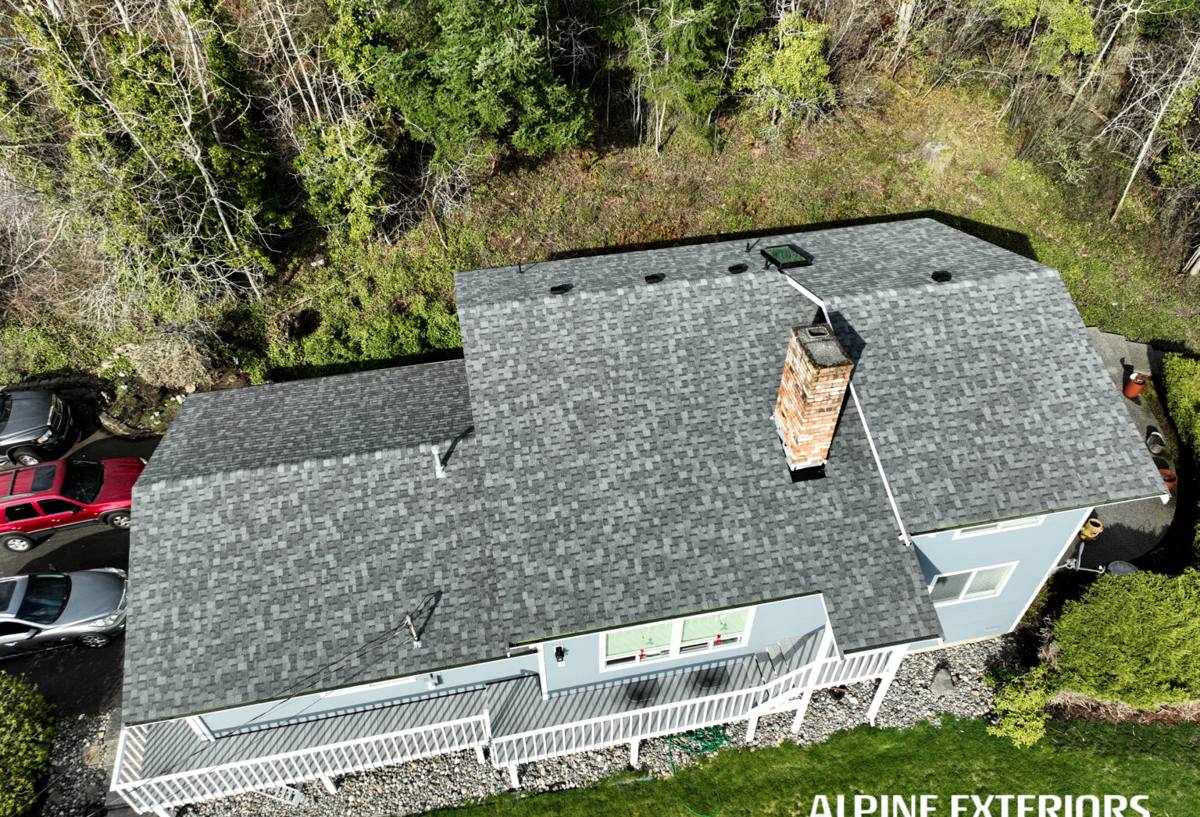
What a Correctly Built Roof Needs in a Coastal Whatcom County Setting
Fasteners and Flashing
Standard galvanized fasteners can start showing rust streaks and losing holding power years before they would on a roof further from the water. We use corrosion-resistant fasteners and flashing components rated for coastal exposure, particularly at valleys, chimneys, skylights, and any place two roof planes meet. These are the spots where a roof actually fails — almost never in the open field of shingles.
Underlayment
A synthetic underlayment with strong water-shedding performance, plus self-adhered ice-and-water membrane at eaves, valleys, and penetrations, gives the roof a second line of defense when wind-driven rain gets past the shingle surface. In a spot like Birch Bay, that second layer isn't a luxury upgrade — it's the difference between a roof that shrugs off a winter storm and one that develops a slow leak nobody notices until there's a stain on a ceiling.
Ventilation
Moss and moisture problems are often as much about what's happening under the shingles as on top of them. A roof deck that can't breathe traps humidity, which shortens shingle life from underneath and encourages the kind of damp, shaded conditions moss thrives in. Balanced intake and exhaust ventilation is part of doing this job right, not an add-on.
Signs a Birch Bay Roof Needs Attention
- Moss growing in mats on north-facing slopes or anywhere shaded by trees
- Granules collecting in gutters or at downspout outlets
- Shingle edges curling or lifting, especially on the sides that face prevailing wind and rain
- Rust streaking below nail heads, vents, or flashing
- Soft spots or sagging when walked on (a sign of deck moisture, not just shingle wear)
- Daylight visible through the attic roof deck, or damp insulation below it
- Missing or torn shingles after a windstorm, even if the rest of the roof looks fine
Any one of these on its own isn't necessarily an emergency, but in this climate they tend to compound quickly. A small amount of moss left untreated for a season or two can lift shingle edges enough to let water underneath, turning a cleaning job into a repair job.
Choosing the Right Shingle for This Environment
Not every asphalt shingle product is built the same way, and the differences matter more here than they would in a drier, calmer climate. The table below covers the practical trade-offs we walk homeowners through.
| Shingle Type | Wind Performance | Moss/Algae Resistance | Typical Use Case |
|---|---|---|---|
| 3-tab (standard) | Lower wind rating | Depends on granule treatment | Budget-focused re-roofs, secondary structures |
| Architectural (laminated) | Higher wind rating, better wind uplift resistance | Usually available with algae-resistant granules | Most Birch Bay homes; better fit for coastal exposure |
| Impact-resistant / heavier-class | Strong wind and impact performance | Algae-resistant options available | Homes with tree cover, high wind exposure, or longer-term hold plans |
We're not going to tell a homeowner that any major manufacturer's product is bad — the honest answer is that thinner, lighter-weight shingles simply have less material to resist the wind uplift and granule loss that coastal exposure causes over time. For most Birch Bay homes, we steer toward architectural shingles with algae-resistant granules as the baseline, not the upgrade. On homes with heavy shade or a lot of tree cover close to the roofline, we'll talk through the heavier-class options too.
Our Asphalt Shingle Roofing Process
1. Inspection and Deck Assessment
Before we quote anything, we get on the roof and check the actual condition of the decking, not just the shingles. Moisture-damaged or soft decking has to be addressed before new shingles go down — covering a bad deck with new shingles just hides the problem for a year or two.
2. Tear-Off and Prep
We remove the old roofing down to the deck rather than layering over it. This lets us properly inspect the sheathing, address any rot or soft spots, and start the new system on a clean, solid base — which matters more here given how much moisture this climate can drive into a roof over the years.
3. Ice-and-Water Membrane and Underlayment
Self-adhered membrane goes down first at eaves, valleys, and around all penetrations, followed by synthetic underlayment across the field of the roof.
4. Flashing
New corrosion-resistant flashing at all chimneys, skylights, sidewalls, and valleys — this is where most leaks actually originate, so it gets as much attention as the shingles themselves.
5. Ventilation Check
We confirm intake and exhaust ventilation is balanced for the attic space, adding or adjusting vents where the existing setup falls short.
6. Shingle Installation
Installed to manufacturer nailing patterns and exposure specs, with corrosion-resistant fasteners throughout.
7. Cleanup and Walkthrough
Full site cleanup including a magnetic sweep for stray nails, then a walkthrough so the homeowner knows exactly what was done and what to watch for going forward.
Maintenance That Actually Matters in Birch Bay
- Have moss physically removed rather than just chemically treated when it's built up in mats
- Keep gutters clear so water isn't backing up under the shingle edge, especially during fall storm season
- Trim back tree branches that shade the roof and keep it damp longer after rain
- Do a visual check after any major windstorm off the water for lifted or missing shingles
- Get a roof looked at every couple of years even with no visible problems — coastal wear often starts underneath before it shows on the surface
Cost Factors for a Birch Bay Roofing Project
Every roof is different, and we don't like giving numbers that don't reflect the actual home, but these are the factors that move the price up or down on most projects in this area.
| Factor | Why It Matters |
|---|---|
| Roof size and complexity (valleys, dormers, angles) | More cuts and flashing details mean more labor and material |
| Deck condition underneath the old roofing | Rotted or soft sheathing needs to be replaced before re-roofing |
| Shingle class chosen | Architectural and impact-rated products cost more than 3-tab but hold up better here |
| Amount of tear-off (single vs. multiple layers) | More layers of old roofing mean more removal and disposal work |
| Access and site conditions | Steep pitches, tree cover, or tight lot access can add time to the job |
Why Local Experience in Birch Bay Matters
A roofing crew that mostly works drier, inland jobs can still do competent work, but they're not necessarily thinking about salt air corrosion on fasteners or how far wind-driven rain travels under a shingle edge in a waterfront wind event. Working regularly in Ferndale and Birch Bay means we've seen which parts of a roof fail first in this specific climate, and we build every job — flashing, underlayment, ventilation, fastener choice — around that reality rather than a generic install. It's also worth having a contractor who knows the area well enough to give you a straight answer about whether a repair will actually hold up through another wet season, or whether you're better off putting that money toward a full re-roof.
If you're dealing with moss, a leak, storm damage, or simply an aging roof and want a straight assessment of where things stand, we're happy to take a look. Reach out for a free, no-pressure estimate using the form below.