 Ferndale
 Why Birch Bay Decks Wear Differently
Decks in Birch Bay take a beating that decks ten miles inland simply don't. Sitting right along the Salish Sea in Whatcom County, Birch Bay homes get salt-laden air blowing off the water almost year-round, plus the driving, sideways rain that comes with winter storms off the Strait of Georgia. Add a moss season that can stretch from October well into April, and you've got a combination that ages wood and fasteners faster than most manufacturers' warranties ever account for.
Salt air is corrosive to metal hardware long before it visibly damages wood. Nails, screws, joist hangers, and bolts that would last decades in a drier inland climate can start rusting and losing grip strength within a handful of years near the water. Meanwhile, constant damp plus shade from surrounding trees gives moss and algae everything they need to colonize deck boards, railings, and stair treads — and once established, that growth holds moisture against the wood around the clock, not just when it's raining.
We're not describing a generic coastal-climate problem here. This is what we see specifically on decks we repair in Birch Bay, and it shapes exactly how we approach every job in this area.
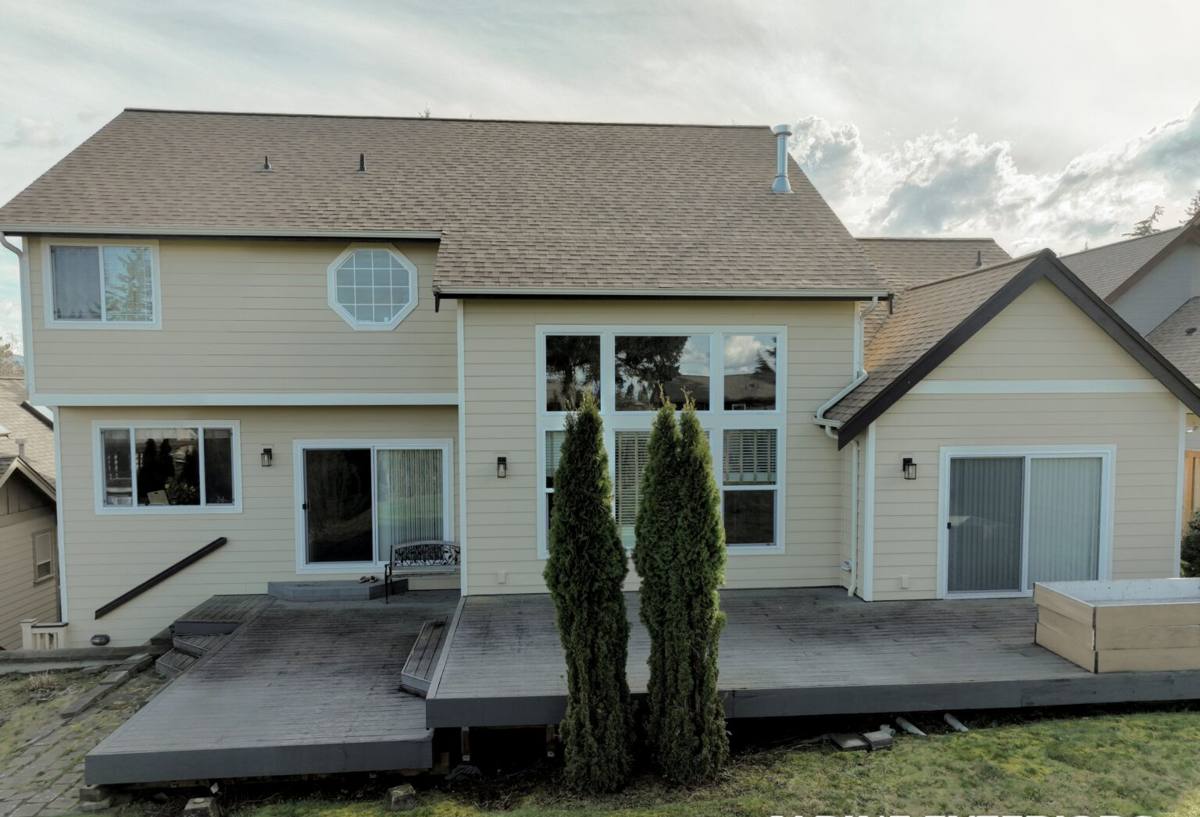
The Warning Signs We Look For
Most deck damage in this area doesn't announce itself with a dramatic failure — it shows up gradually, and homeowners often live with early warning signs for a season or two before calling anyone. Here's what tends to show up first on Birch Bay decks:
- Soft or spongy spots underfoot, especially near the house-to-deck ledger connection
- Green or black staining on boards that stays damp longer than the surrounding area after rain
- Rust streaking below screw heads or joist hanger connections
- Railings or stair stringers that feel slightly loose or wobbly, even if they look fine
- Gaps opening up between deck boards, or boards cupping (edges higher than the center)
- Visible moss or algae film that makes the surface slick when wet
Any one of these on its own might be minor. Several together usually mean moisture has been working on the structure for a while, not just the surface finish.
Why the Ledger Board Deserves Special Attention
The ledger board — where the deck attaches to the house — is the single most important structural connection on most decks, and it's also the spot most prone to hidden rot in a climate like this. Flashing that was installed correctly ten or fifteen years ago can still fail as caulk shrinks and metal fasteners corrode, letting water track behind the ledger where it's invisible from above. We check this connection closely on every Birch Bay repair, even when the visible symptoms are somewhere else on the deck.
What a Correct Repair Actually Involves
A lot of deck "repairs" amount to replacing whatever board looks worst and calling it done. That approach tends to miss the underlying cause, which means the same spot — or the one next to it — fails again within a year or two. A repair that actually holds up in this climate involves a few non-negotiable steps:
- Diagnose before you replace. We probe suspect boards, joists, and the ledger connection to find the true extent of rot or fastener failure, not just the visible damage.
- Address the moisture source. Replacing a rotted board without fixing the drainage, flashing, or ventilation issue that caused it just resets the clock on the same failure.
- Match structural lumber correctly. Framing members carry load differently than decking boards — undersized or mismatched replacement lumber is a common shortcut that shows up as bounce or sag later.
- Use fasteners rated for coastal exposure. Standard galvanized fasteners corrode faster here than inland; stainless or heavy-coated hardware costs more up front but avoids a repeat repair.
- Reseal and treat exposed cuts. Any new cut end on treated lumber needs sealant on the exposed grain, or it becomes the next entry point for rot.
Repair vs. Replacement: Making the Right Call
Not every deck with problems needs to be torn out. The right call depends on how much of the structure is affected versus the surface, and how old the deck is relative to its expected service life in this climate.
| Factor | Leans Toward Repair | Leans Toward Replacement |
|---|---|---|
| Extent of rot | Isolated to a few boards or one section | Widespread across framing and decking |
| Ledger board condition | Solid, flashing intact | Rotted, water tracked behind siding |
| Structural framing (joists, beams) | Sound, load-bearing capacity intact | Soft, cracked, or undersized for current code |
| Deck age | Under 15 years, built to a solid original spec | Original construction quality was already marginal |
| Fastener condition | Localized corrosion | Rust throughout most connections |
We'll always tell you honestly which side of that line your deck falls on. A repair that's really a stopgap on a structurally compromised deck isn't a good use of your money, and we'd rather say that up front than sell you a patch job.
Moss, Algae, and Ongoing Maintenance
Because Birch Bay's moss season runs so long, a repaired deck needs a maintenance rhythm that fits the local climate, not a generic care schedule copied from a manufacturer's brochure. A few habits make a real difference in how long a repair lasts:
- Clear leaves and debris from between boards before they trap moisture through the fall and winter
- Keep gutters and downspouts near the deck clear so runoff isn't dumping directly onto it
- Address moss growth early with appropriate cleaning rather than letting it establish and spread
- Check railings and stair connections for looseness at least once a year, ideally before winter storms
- Reapply sealant or finish on schedule — coastal UV and salt exposure shortens the effective life of most finishes compared to inland use
Decking Material Considerations for This Climate
When we're replacing sections during a repair, we'll talk through material options honestly rather than pushing whatever's easiest to install. Pressure-treated lumber remains a solid, cost-effective choice when properly maintained, but it does require ongoing sealing to perform well in salt air. Composite decking cuts down on the sealing and staining maintenance, though it comes with a higher upfront cost and its own installation sensitivities — proper spacing and fastening matter more with composite than with wood, since mistakes there are harder to correct later. Cedar has natural rot resistance and a look a lot of homeowners want, but it's a softer wood that needs more diligent finish maintenance in a climate this wet.
There's no universally "best" material — the right choice depends on your budget, how much maintenance you're willing to do, and what's already built into the rest of the structure. We'll give you our honest read on trade-offs for your specific deck rather than a one-size-fits-all recommendation.
Our Repair Process
When we come out for a Birch Bay deck repair, the process is straightforward:
- On-site inspection. We walk the full deck, probe suspect areas, and check the ledger connection, railings, and stair structure — not just the spot you called about.
- Honest assessment. We explain what we found, what's causing it, and whether repair or partial replacement makes sense, in plain language.
- Written scope and estimate. You get a clear breakdown of what work is included before anything starts.
- Repair work. We replace what needs replacing, correct the moisture or drainage issue behind the damage, and use coastal-rated fasteners and hardware throughout.
- Final walkthrough. We check the repair together and flag any maintenance items worth keeping an eye on going forward.
Why Local Experience in Birch Bay Matters
A crew that mostly works drier, inland neighborhoods can still do competent carpentry — but they may not immediately recognize how much faster corrosion and rot progress this close to the water, or which failure patterns are common on decks built to older, pre-coastal-spec standards. Working regularly in Ferndale and Whatcom County's coastal communities means we've seen how salt air and moss actually behave on decks here over time, not just in theory. That translates into fewer surprises during the inspection and repair recommendations that actually fit the conditions your deck faces every day.
If you've noticed soft spots, rust staining, moss buildup, or a railing that doesn't feel as solid as it used to, it's worth having it looked at before the next wet season adds to the damage. We offer free, no-pressure estimates for Birch Bay deck repairs — fill out the form below and we'll take a straightforward look at what your deck actually needs.