 Ferndale
 Why Bellingham Homes Need Siding Built for This Specific Climate
Bellingham sits on Bellingham Bay in Whatcom County, and that location shapes everything about how siding ages here. Homes close to the water deal with salt-laden air that accelerates corrosion on fasteners and trim. Homes further inland, tucked under tree cover on the hillsides and around the lakes, deal with near-constant shade, moss growth, and siding that rarely gets a full day of sun to dry out after a storm. Add in the region's long, low-intensity rain seasons — weeks of drizzle rather than short downpours — and you get a wall assembly that stays damp longer than almost anywhere else in the country.
Wood-based and wood-adjacent siding products struggle in this environment because they're organic material that wants to absorb moisture, swell, and eventually rot or delaminate. Vinyl holds up to moisture fine but flexes, fades, and can crack in cold snaps, and it doesn't stop moss and mildew from taking hold in the seams. Fiber cement changes the equation because the core material is inert — sand, cement, and cellulose fiber cured into a dense board that doesn't feed rot and doesn't absorb water the way wood does. That's the baseline reason we standardized on James Hardie products for homes throughout Ferndale and Bellingham.
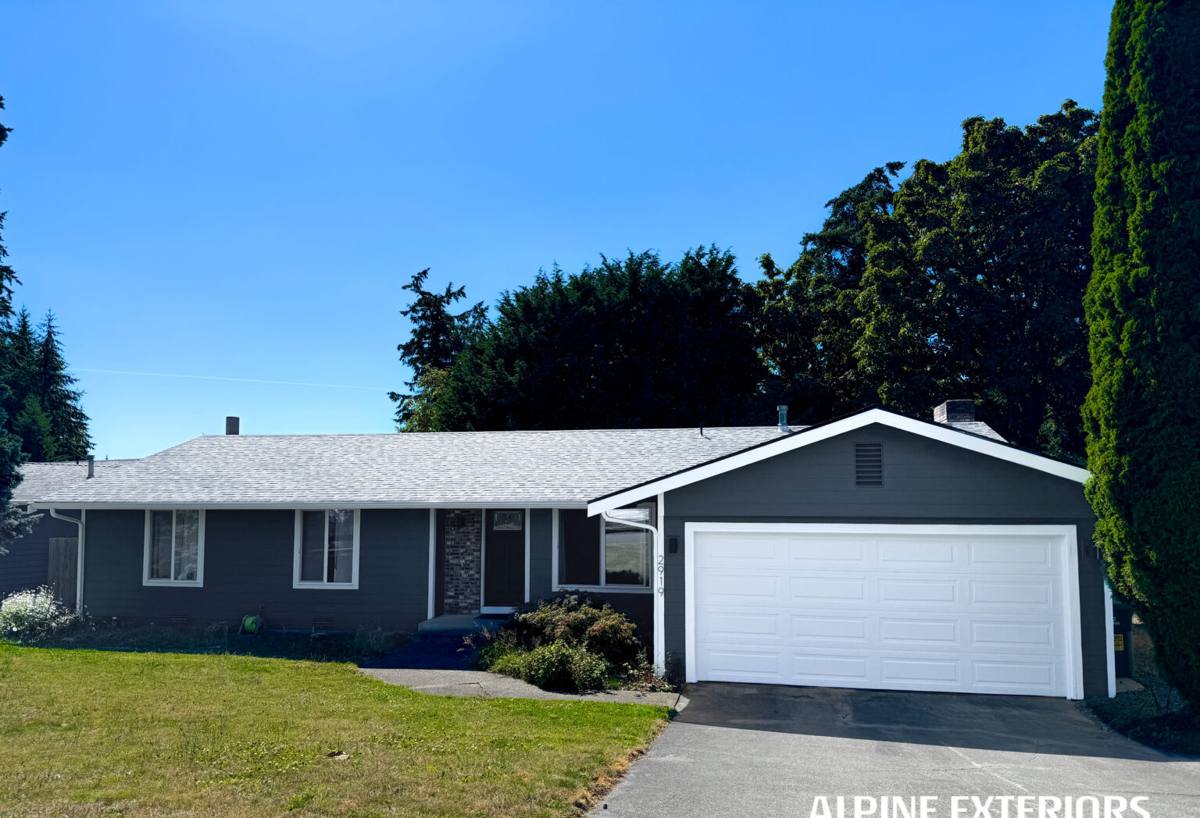
What "Correct" Looks Like for James Hardie in a Marine Climate
Buying Hardie siding doesn't automatically get you Hardie performance. The product is engineered to a spec, and that spec assumes the installer follows manufacturer requirements for clearances, fastening, and flashing. In a climate like Bellingham's, skipping these details doesn't show up as a problem in year one — it shows up in year five or six, as moisture intrusion behind the siding that you can't see until there's a soft spot or a stain on an interior wall.
The details that matter most here
- Minimum clearance between the bottom of the siding and grade, decks, roof lines, and paved surfaces — this is one of the most commonly skipped steps and one of the most consequential near the coast
- Correct fastener type and placement, since salt air accelerates corrosion on the wrong hardware
- A weather-resistive barrier and rainscreen or drainage plane behind the siding, which matters more here than in dry climates because the wall assembly needs a way to shed the moisture that inevitably gets past the cladding
- Proper caulking and sealant only where Hardie's install instructions call for it — over-caulking traps moisture just as often as under-caulking lets it in
- Factory-cut and factory-primed edges kept intact, with field cuts sealed per manufacturer instructions
None of this is exotic. It's just detail work that has to happen every time, on every elevation, and it's the difference between siding that performs for decades and siding that needs attention in year seven.
Picking the Right Hardie Product Line for a Bellingham Property
James Hardie makes regionally engineered product lines, and the HZ10 formulation is built for the Pacific Northwest's wetter, milder climate rather than the freeze-thaw extremes of other regions. For most Bellingham homes, that's the correct starting point. From there, the decision is mostly about look and budget rather than performance, since all the HZ10 profiles share the same core material.
| Product | Look | Best fit |
|---|---|---|
| HardiePlank lap siding | Traditional horizontal lap, several width and texture options | Most common choice for Bellingham single-family homes; works with almost any architectural style |
| HardiePanel vertical siding | Vertical panel with battens | Craftsman and modern builds, accent gables, or mixing with lap siding for visual interest |
| HardieShingle | Staggered or straight-edge shingle profile | Homes going for a coastal or cottage look without using real cedar shingles |
| HardieTrim | Fascia, corner boards, window and door trim | Pairs with any of the above; keeps trim from being the weak point in an otherwise solid siding job |
Color matters more here than people expect. ColorPlus factory-applied finish is baked on and cured before the boards ever reach the job site, which gives it better fade and moisture resistance than field-applied paint — a real advantage in a climate where a fresh paint job on wood siding might only look good for a few years before mildew and moss start showing through. For homes under heavy tree cover, we'll often talk through darker versus lighter ColorPlus tones, since darker colors tend to hide moss shadowing better between cleanings, while lighter colors show it faster but also make it easier to spot early.
Moss, Mildew, and the Maintenance Bellingham Siding Actually Needs
No siding product is moss-proof. Moss and mildew grow on the surface film of dirt and organic debris that collects on any exterior material, and Bellingham's shaded, damp lots make that buildup happen faster than in drier parts of the state. What matters is how the underlying material responds to that buildup and to the cleaning it takes to remove it.
Fiber cement holds up well to routine washing — a garden hose and soft brush, or an occasional gentle pressure wash at low pressure, without the board absorbing water and swelling the way wood trim or OSB-backed products can. The ColorPlus finish is also formulated to resist the kind of staining that makes older, field-painted siding look dingy within a couple of years. For homes near the bay, we also recommend a quick annual look at fasteners and trim for any early corrosion signs, since the combination of salt air and moisture is the one condition where hardware failure shows up before the siding itself does.
A simple annual check for Bellingham homeowners
- Rinse siding and trim in spring after pollen and winter debris build up, and again in fall before the wet season
- Look at the bottom edge of the siding near grade, decks, and downspouts for any staining or soft spots
- Check caulked joints around windows and trim for cracking or gaps
- Keep gutters clear so water isn't sheeting down the wall face during heavy rain
- Trim back vegetation and tree limbs that keep a wall section shaded and damp longer than the rest of the house
Why We Don't Install Alternatives on These Jobs
We get asked fairly often about vinyl, LP SmartSide, or cedar, and it's a fair question — all three have a place in the market. We simply don't install them, and it comes down to how each one performs specifically in a climate like this one over the long haul, not a claim that they're broadly bad products.
Vinyl is inexpensive and low-maintenance in the sense that it doesn't need painting, but it's also a thinner, more flexible material that can crack in a cold snap and shows heat distortion in ways fiber cement doesn't. Engineered wood products like LP SmartSide use a wood-strand core, which means they're still an organic material at the core — treated to resist moisture, but still vulnerable if a seam, cut edge, or fastener point lets water in over years of Whatcom County's wet season. Cedar is a beautiful, genuinely traditional choice for this region, but it's also the highest-maintenance option: refinishing on a real schedule, vulnerability to rot at end grain and ground contact, and a shrinking pool of contractors willing to install and warranty it correctly. We'd rather stand behind one product system we can install to spec and warranty with confidence than offer several we can't fully vouch for in this specific climate.
Our Process for a Bellingham James Hardie Job
Because we work Ferndale and Bellingham regularly, the process is dialed in rather than improvised project to project.
1. On-site assessment
We look at your current siding, sheathing condition where accessible, drainage around the foundation, roofline transitions, and any moisture staining that points to an existing problem the new siding needs to solve rather than cover up.
2. Product and color selection
We walk through HZ10 profile options and ColorPlus colors against your home's exposure — sun, shade, proximity to the water — so the choice is based on how it'll actually perform here, not just how it looks in a sample chip.
3. Tear-off and prep
Old siding comes off, sheathing gets inspected and repaired as needed, and a weather-resistive barrier and drainage plane go in before a single piece of Hardie touches the wall.
4. Installation to manufacturer spec
Clearances, fastening, and flashing details are followed exactly as James Hardie specifies for this climate zone — not as a generic install, but with the local conditions in mind.
5. Trim, caulking, and final walkthrough
HardieTrim finishes out corners, fascia, and openings, sealant goes only where it belongs, and we walk the job with you before calling it done.
What Warranty Coverage Actually Means Here
James Hardie backs its siding products with a non-prorated limited warranty, and ColorPlus finishes carry their own separate finish warranty. Both are transferable, which matters to homeowners in this area since it can be a selling point if the home changes hands. The manufacturer's warranty depends on installation meeting Hardie's specifications, which is another reason correct installation isn't optional — it's the thing that keeps the warranty valid in the first place. We stand behind our own workmanship on top of that, so you're covered on both the product and the install.
Get an Estimate for Your Bellingham Home
If your current siding is showing moss staining, soft spots near grade, or paint that won't hold up anymore, we're glad to take a look. We'll walk your property, talk through what your specific exposure to sun, shade, and salt air means for product and color choice, and give you a straightforward estimate — no pressure, no upsell to a product we wouldn't put on our own homes. Use the form below to request a free estimate.